
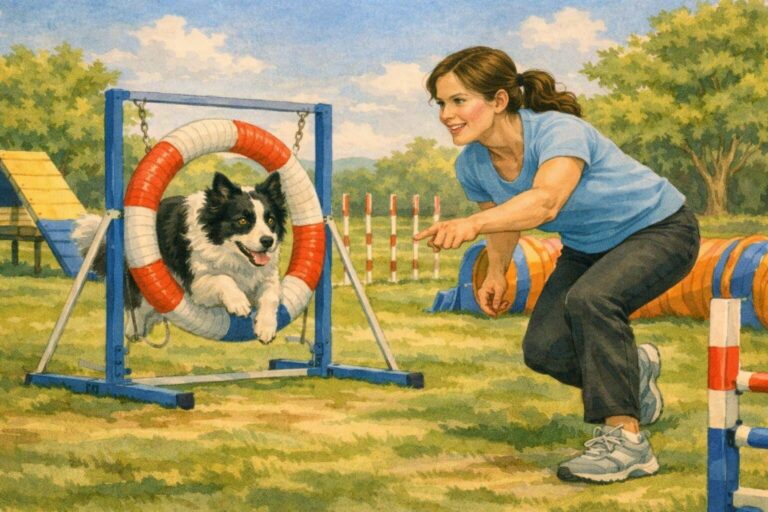
AI-generated image
When the course suddenly turns into a maze: How to help your dog rediscover the joy of play
Do you remember how it all began? That first time you stood on the agility course with your dog. Maybe it was a trial class, maybe a gift from friends. You didn’t have high expectations, but then something happened. Your dog, who usually just lay on the sofa at home or walked obediently on a leash, transformed right before your eyes. His ears perked up, his eyes began to shine, and when he flew over a small jump for the first time, there was that spark. That indescribable moment of pure joy when you knew: This is it. This is our thing.
The next few months were magical. You train twice a week, attend your first small competitions, and collect ribbons and experiences. The dog sports community becomes your second home. You get to know your dog all over again – his ambition, his speed, his way of thinking. He knows your commands, your body language, your excitement before the run. You’ve become a team that could hardly be better. People who aren’t involved in dog sports don’t understand that. To them, it’s “just dog training” or “running around a bit.” But you know better. It’s a partnership of equals. A language without words.
The Break in the Run: When Everything Falls Apart and Nothing Goes Right
But then came that one day. Maybe it was a major competition you’d been looking forward to for weeks. Everything was perfectly prepared: the race number is in place, your dog is focused, you’ve walked the course. You give the start signal, and your dog takes off. And then it happens. At the third hurdle, he stops, turns around, and looks at you with an expression you can’t interpret. You call, coax, and give a command, but he won’t run. Or he runs the wrong way, jumps over a hurdle, or refuses the tunnel. Precious seconds slip away, your voice grows shriller, and your body tenses up. Your dog senses this, becomes uncertain himself, and suddenly the well-coordinated team has turned into a mess of frustration and misunderstandings.
After the run, there is silence. You stop the timer, stow the leash, and walk back to the car. Your dog is still wagging his tail, but you don’t even notice. You’re disappointed. In him? In yourself? In both of you?

The gradual erosion of self-confidence in both of you
The worst part is that you can’t forget that one mistake. It creeps into your mind like a catchy, annoying earworm. At the next training session, you’re tense. You want to do better, to prove that the mistake was just a one-off. So you give more commands, raise your voice, and get more impatient. Your dog, who was usually so motivated, becomes more hesitant. He looks at you more often than he pays attention to the course. You lose your flow.
The next competitions don’t get any better. You rack up disqualifications or slow times. The other teams in your class win or place, and you stand on the sidelines feeling like you’re letting your dog down. You hear the well-meaning advice from others: “More basic training,” “Different treats,” “Why don’t you let him take a break?” You try everything. You buy new training aids, book a private lesson with a well-known trainer, and make sure his diet is perfect. But nothing brings back the old performance.
Eventually, you ask yourself: “Am I just not good enough for this sport?” Or even worse: “Is my dog not good enough?” You’re ashamed of this thought, because you love your dog more than anything. But the frustration gnaws at you. The anticipation of the next race has long since given way to a dull fear. You wonder if you should cancel the competition. You wonder if you should switch clubs. You wonder if you should quit.
When Humans Become a Distraction: The Truth About the Blackout in Dog Sports
Here’s the truth that hardly anyone tells you: In nine out of ten cases, the problem isn’t with the dog. Your dog knows the course. He knows the obstacles, the signals, the sequence. He loves to run. But he also loves you. And he senses every twitch of your body, every tone of your voice, every tiny hint of uncertainty.
Horses aren’t the only animals that mirror their owners. Dogs do it even more directly. If you’re tense, your dog gets tense. If you doubt yourself, your dog gets unsure. If you’re afraid of making a mistake, your dog becomes afraid of disappointing you. And it is precisely this fear that blocks him. Your dog isn’t thinking, “I don’t want to jump right now.” He’s thinking, “Something isn’t right. I don’t understand my human. I’m confused.” And then he stops or runs around aimlessly.
You may have already tried to work on yourself. You’ve practiced positive self-talk, closed your eyes before the start, and paused to collect yourself. But that’s like sticking a Band-Aid on a deep wound. It helps for a moment, but as soon as the pressure comes – the starting bell, the spectators, the competition – everything breaks open again. Because the block isn’t in your conscious mind. It often lies in your subconscious. In old images of failure, in the voice of your inner critic, in the entrenched belief that you aren’t good enough.
The key lies in your mind, and that’s good news
Now you might be reaching the point where you’re thinking, “Should I see a coach?” You could. But most coaches don’t understand dog sports. They don’t know that specific feeling when you’re standing on the course and your dog is charging toward you at full speed. They don’t know the pain of a disqualification when you know you’re actually capable of better. And they don’t know the silent communication between human and dog, where every muscle tension becomes a message.
That’s why I developed my approach. It combines two things that are inseparable in dog sports: sports hypnosis for you as a dog handler and a deep understanding of the human-dog relationship.
Hypnosis isn’t magic – it’s mental fine-tuning
You might have reservations about hypnosis. That’s normal. But let me explain what it is and what it isn’t. Hypnosis isn’t sleep, it isn’t unconsciousness, and it isn’t a loss of control. You experience a state of deep, pleasant relaxation. Similar to those rare moments when, just before waking up in the morning, you slip back into a cozy void. In this state, your critical thinking – that constant inner judge – is set aside for a moment. Positive, helpful suggestions can reach your subconscious directly, without your inner critic immediately brushing them aside.
We install new, powerful images. Imagine walking the course in your mind. But not the way it scares you, but the way you dream it will be. You see your dog flying, hear your own clear commands, feel the lightness in your legs as you change direction. You smell the grass, hear the applause at the end. But not as pressure, but as affirmation. This isn’t a daydream. It’s a mental rehearsal that your brain processes just like a real experience. The more often you play this inner movie, the more familiar the pattern of success becomes to your brain.
Why I Understand This
I’m not a dog sports enthusiast myself, but I am a martial artist. I know what it feels like to have that inner pressure to do everything right or perfectly. I’ve learned that the biggest enemy isn’t the difficulty of the task, but the voice in your own head that whispers, “You can’t do this.”
My training in sports hypnosis and my many years of experience with dogs (I’m also trained in animal communication) have taught me how to silence that very voice. Not through force or suppression, but through elegant redirection. Much like a good agility dog takes a sharp turn without losing speed.
The next competition is sure to come, but you don’t have to go into it with fear
Your next competition might be just a few weeks away. You could sit back and wait, hoping things will get better. You could keep training, keep analyzing, keep feeling frustrated. Or you could do something that actually makes a difference. You could work on the one thing where all your training has failed so far: your own mindset.
Imagine you’re at the starting line. Your dog is beside you, the leash is short, the tension is palpable. But your heart is beating calmly. You’re breathing deeply. You look at the course and don’t think, “There’s the difficult spot.” You think, “We can handle this with ease.” You give the start signal, and your dog takes off. You run alongside, give clear commands, and everything flows. No tension, no hesitation. At the end, the clock stops. A good time. But that’s not the most important thing. The most important thing is that your dog comes to you, tail wagging and eyes shining, and you feel: We’re back. We’re one again.
Every day you hesitate is a run lost
Dog sports are full of wonderful moments. But they’re also full of pressure, full of expectations, full of moments when you get in your own way. You don’t have to accept that these mental blocks have become your constant companion. You don’t have to accept that the joy of the run has disappeared. You have the power to turn things around – right where the blockage often lies: in your mind.
Schedule a no-obligation preliminary talk with me. Tell me about yourself and your dog. Tell me about the obstacle course that has driven you apart. And let’s work together to create a plan for how you can find your way back to each other. With more ease, more trust, and more joy than ever before.
You don’t have to fight this battle alone.
I look forward to reuniting you and your dog on the course – but above all, in your minds.
Note:
Hypnosis and / or surrogate work are not a substitute for medical and / or psychiatric diagnosis and / or intervention.
The success of hypnosis and / or surrogate work cannot be guaranteed.
Furthermore, my services are intended for healthy people and animals.
The text displayed above was generated using AI.
The photos shown above were also generated by AI.
Sports Mind
6 months support (sporting animals addable to the booking)- 8 sessions
- One session every 3 weeks
- Several topics can be addressed
- Work with „traditional“ hypnosis
- Work with simpson protocol
- Quantum work
- Surrogate sessions for the animal (up to 3)
- Animal communication (5 questions + 1 message included)
- Additional extra question(s) (maximum 5)
- 1 Message from you to your animal
- 1 Message from your animal to you
- Check-in with your animal between deputy sessions
- Final animal communication
- Written protocol(s) of the animal communication(s)
- Personal information transfer(s) (Zoom)
- Anchoring and NLP techinques
- Learn your own applications
- Learn self-hypnosis
- EFT / Tapping
- Audio files for further support
- 1:1 support
- Individual approach
- Holistic approach
- Preliminary talk with goal agreement
- Access to the exclusive client area
- Information material (in the client area)
- Preparatory hypnosis as MP3
- Preparation checklist
- Follow-up talk after the sessions
- E-Mail Support
- Queries possible
- Payment in instalments possible (maximum 6 months)
Book Preliminary talk / Hypnosis
- Click on “Done” after booking.
Book your next appointments within 3 weeks.
Individual hypnosis sessions & quantum work sessions