
Childrens golf hypnosis
Sometimes what is missing is not talent.
Sometimes it is simply access to what is already within your child.
595€ (for 4 sessions)
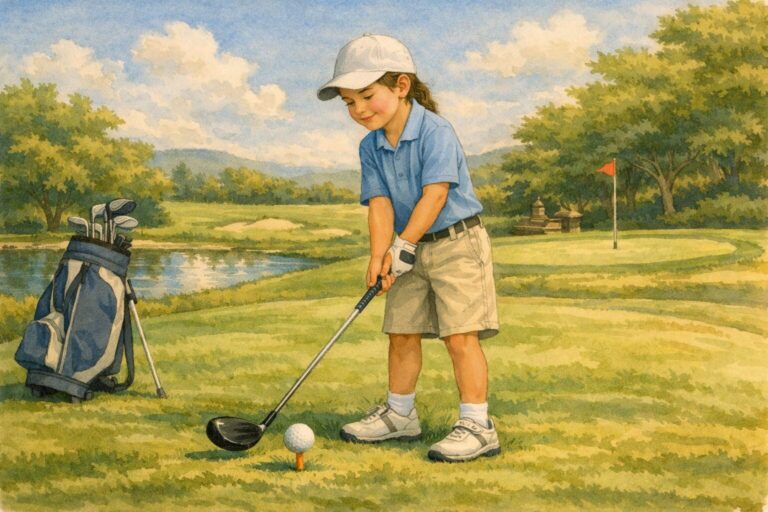
AI-generated image
Mindset Training in Junior Golf: Why Hypnosis Often Makes the Decisive Difference on the Green
Imagine your child is the youngest golf enthusiast at the club. At just seven years old, they’re already hitting balls enthusiastically on the driving range, spending every spare minute on the putting green, and can rattle off the names of professional golfers in their sleep. The youth coaches praise their talent, their handicap is steadily dropping, and at the club age-group championships, they’ve consistently finished in the top three lately. Trophies and medals adorn their room, and their joy for the game seems boundless.
But then comes the day when everything feels as if someone has scooped all the sand out of the bunkers. Your child comes back from the golf course in tears, club still in hand, and can barely speak. What happened? At an important youth tournament – perhaps their first national-level event – they suffered a total mental blank at the first tee. The driver felt unfamiliar, the ball landed in the tall rough, the next shot went out of bounds, and finally came the disqualification. Not because your child doesn’t know how to play the game, but because their mind suddenly couldn’t execute what their body had been training for years.
This is exactly where the downward spiral that every young golfer fears begins. In the days and weeks that follow, you notice how your child is changing. They hesitate when it’s time to go to practice. They make excuses to avoid going to the range. The coaches report that they suddenly become unsure on the last few holes, that their fluid movements seem stiff. And you yourself hear phrases that break your heart: “Mom, I don’t want to play anymore. Everyone is staring at me.” Or: “I can’t do anything anyway. I’ll never be able to compete with the others.” The fear of failure, which has manifested itself in this one competitive situation, is now gradually eroding your child’s self-confidence – and this in a sport that requires mental strength more than any other.
The mounting pressure… from outside and within
Golf is a sport made up of a thousand small moments. The putt on the 18th green that decides victory or defeat. The tee shot in front of a group of waiting parents and players. The silence as everyone watches your child take a swing. Once self-confidence has been shaken, every one of these moments becomes torture. Your child starts imagining worst-case scenarios even before stepping onto the course: “What if I hit it into the water again?”, “What if the coach laughs at me?”, “What if everyone thinks I’m a disgrace?”
Added to this is the pressure from those around them. The coaches expect performance because they know your child’s talent. The other parents might whisper if your child suddenly falters. And of course, you as a parent. You’ve invested so much, from the first golf lessons to the new clubs and tournament entry fees. But all of that is nothing compared to the pressure your child puts on themselves. They know they can do better. They have the technique; they have the experience. But their mind isn’t cooperating.
You’ve already tried to help: extra training sessions with the club’s pro coach, a nutritionist, maybe even sessions with a sports psychologist. But none of it seems to be really working. The problem probably runs deeper. It lies in the subconscious. That’s exactly where old beliefs and mental blocks are stored – like that one dark day when I was disqualified. As long as this mental block isn’t resolved, your child will keep coming back to the same place: They can shoot arrow after arrow effortlessly in practice, but as soon as the competition starts, their inner team seems paralyzed.

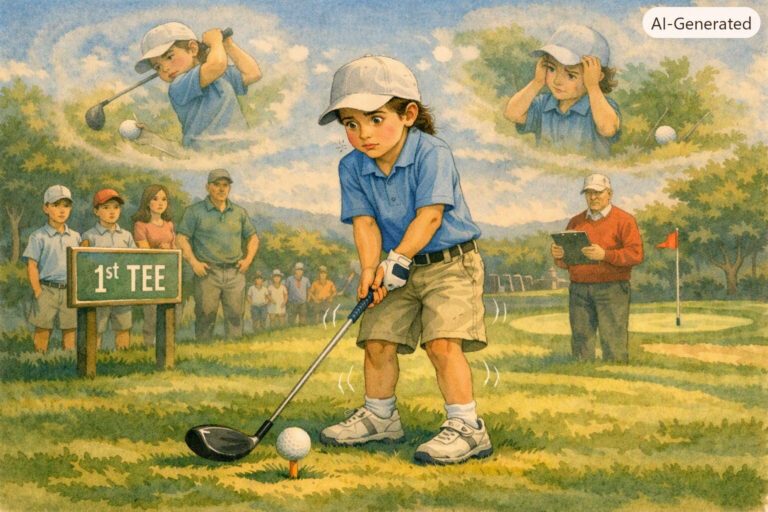
The golf-specific vicious cycle: mental blocks, the yips, and fear of the first tee
In golf, there’s a well-known phenomenon called “the yips.” It’s a mental freeze that occurs mainly during putting or the short game. Your child can practice a hundred times, but as soon as the putt really counts, their hand shakes or the club gets stuck in the backswing. Even more common, however, is the classic mental block: the mind goes blank, automatic reflexes fail, and every shot feels like the first one after a long winter break. And the worst part: once experienced, this fear becomes increasingly ingrained. Your child begins to have nightmares before every tournament. They wake up drenched in sweat because they dreamed of hitting the ball seven times off the tee without it wanting to fly. The night before the competition becomes torture, and their performance suffers accordingly.
A particularly familiar scenario for many young golfers is teeing off in front of an audience. There is often a special tension at the first tee of a tournament. Other children, parents, coaches, and the starter are watching. Your child feels the eyes on them, the seconds stretch out, and then it happens: the swing becomes abrupt, the ball flies sideways into the rough, maybe even out of bounds. This single experience can be enough to cement a mental block on the course. From then on, your child may avoid anything that could create this kind of pressure. They no longer compete in tournaments, they only play on the quietest practice ranges, or they withdraw completely from club life.
The possible Solution: Children’s Golf Hypnosis as the Key to Mental Freedom
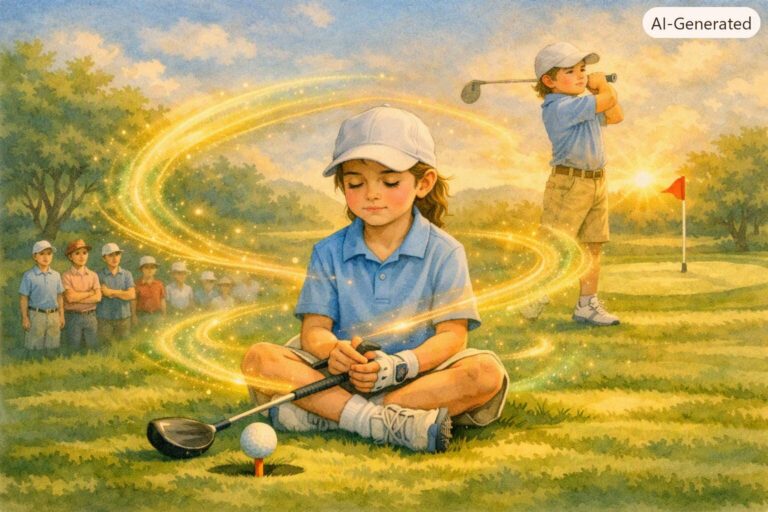
But it doesn’t have to come to that. Hypnosis tailored for children works directly with the subconscious mind. The blockage can be resolved right where it originated. In a relaxed state (which feels completely normal and pleasant to children, like daydreaming), the brain can reprogram old, negative associations. The bad day on the golf course isn’t erased, but it loses its terror. New, positive anchors are set: a firm grip on the putter, confidence in one’s own swing, calmness at the tee.
The applications of children’s golf hypnosis are diverse. It can help with mental blocks before the first tee, recurring mental blank-outs during play, or the dreaded yips when putting or chipping. It can relieve the internal pressure caused by handicap requirements or coaches’ expectations. And it can give your child exactly what they need most: the self-confidence to say to themselves, “I can do this. I’ve done it a thousand times, and I’ll be able to do it now, too.” Hypnosis is not esoteric; it is a scientifically recognized method that is increasingly used in sports – from professional golfers to ambitious young people.
Dear Larissa, we are very happy to have found you. We noticed positive changes after the very first session and were able to consolidate them with the help of the exercises. Now, 2 weeks after the second session, I finally have “my child” back. He is once again carefree, happy and open in his general communication and his feelings. We certainly still need some time to consolidate it “as a whole” and are making another appointment for this. Everyone knows that when it comes to your own children, you quickly become insecure, scared or have other negative feelings. The step to work with you Larissa was exactly the right one and I am glad that I listened to my gut feeling before we got into completely different waters. 1000 thanks for your help and see you soon. Lg Alexandra
Alexandra
Real review and not AI-generated 😉
My Expertise: Experience from the World of Sports
I am not only a certified hypnosis coach, but I have also been actively involved in competitive sports for many years as a judoka and remain active today as an aikidoka. I know the pressure firsthand. I know how it feels when your hands get sweaty, your heart races, and your thoughts suddenly take on a life of their own. Above all, however, as a volunteer coach, I have worked with countless young athletes who have gone through exactly the same crises as your child. This combination of practical sports knowledge and hypnotherapy training is crucial: I understand the language of kids, I know how to guide them into a trance in a playful way, and I have a sense of when the right moment for intervention is.
It’s time to take action! Because every additional competition reinforces that fear
Every time your child steps onto the golf course today with a fear of failure, the negative imprint in their subconscious runs deeper. The solution isn’t more technical training. Your child already knows how to do that. The solution is to clear their mind.
So take action today. Book a no-obligation introductory session where we can get to know each other, you describe the situation, and we’ll create an initial roadmap together.
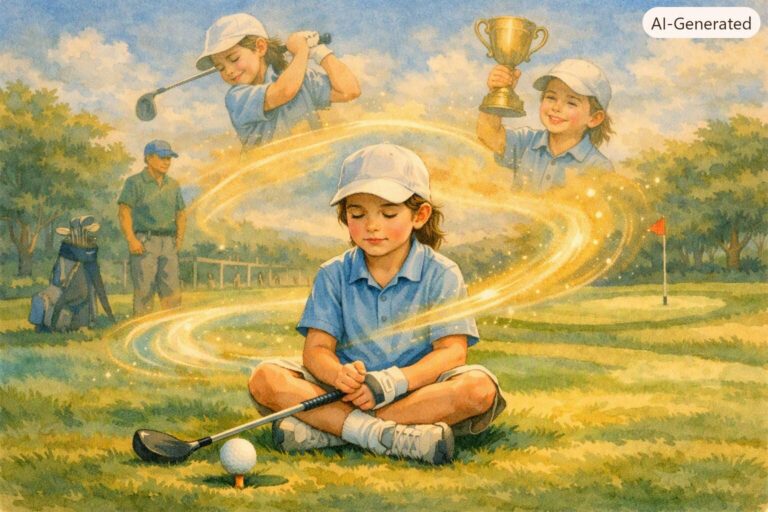
Simply book the hypnosis session, and I’ll show you how your child can likely be back on the green with a smile in no time. Free, lighthearted, and full of confidence in their own abilities.
I look forward to helping your young golfer regain their game – and, above all, themselves.
Note:
Hypnosis and / or surrogate work are not a substitute for medical and / or psychiatric diagnosis and / or intervention.
The success of hypnosis and / or surrogate work cannot be guaranteed.
Furthermore, my services are intended for healthy people and animals.
The text displayed above was generated using AI.
The photos shown above were also generated by AI (except for the review, which is real)..
Children support
5 - 17 years- 4 sessions
- One session every 3 weeks
- 1:1 support
- Individual support
- Holistic approach
- Preliminary talk with goal agreement
- Preliminary talk with the parents
- Preliminary talk with the child
- Access to the exclusive client area
- Information material (in the client area)
- Preparatory hypnosis as MP3
- Preparation checklist
- Follow-up talk after the sessions
- E-Mail Support
- Queries possible
- Payment in installments possible (maximum 3 months)
Book Preliminary talk / Child hypnosis
- Click on “Done” after booking.
Book the next appointment within 3 weeks.
3 hypnosis sessions & 1 quantum work session