Childrens competitive horseback riding / Childrens dressage hypnosis
Sometimes what is missing is not talent.
Sometimes it is simply access to what is already within you.
595€ (for 4 sessions)
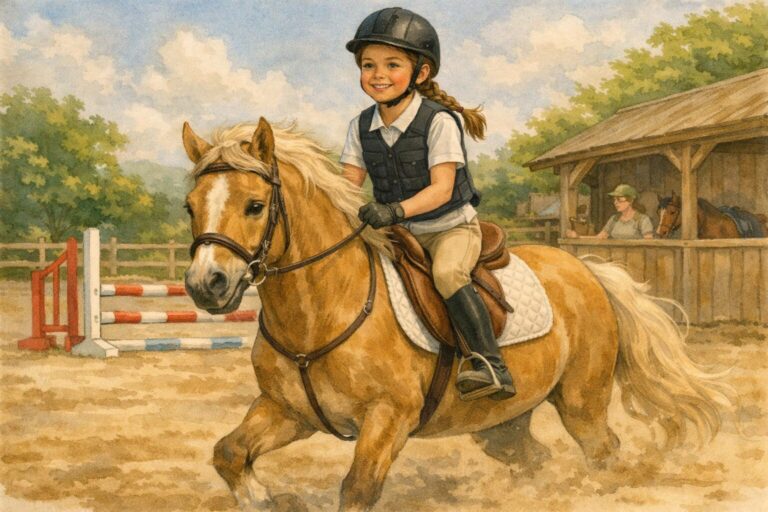
AI-generated image
When the bond between human and horse suddenly breaks down, and how hypnosis can help young dressage riders find their way back into the arena
Your child loves horses more than anything. There’s nothing better for them than walking into the stable, breathing in the smell of hay and leather, and grooming their own horse or the riding school pony. The hours spent on horseback are the happiest of their life. They train several times a week; the riding instructor praises their fine seat and their feel for the horse. In their first school horse tests, they’ve already earned good grades, maybe even won a ribbon. Their bedroom is filled with horse magazines, winner’s rosettes, and a big dream: to one day stand in the big dressage arena.
Then comes the day that changes everything. Your child competes in a tournament, perhaps their first real dressage test in Class E or A. They sit on their horse, ride in, everything feels good. Then the signal to start the test. Your child bows, the judge waves, they ride to the first point of the test, and suddenly nothing happens. The horse senses the tension, your child’s legs go limp, their hands tremble. The first lesson, one they’ve actually internalized for years, fails. The horse refuses, becomes uncertain, perhaps jumps to the side. Your child loses control, the dressage test falls apart. Tears, a walk-off, disqualification, or at the very least a completely disappointing result.
After the tournament, you find your child in the stable aisle, burying their head in the horse’s mane. “I can’t do this anymore,” they sob. “I did everything wrong. The horse hates me now.” You try to comfort them, to explain that things like this happen. But deep down, you know: That wasn’t a normal mistake. That was a mental breakdown.
The Silence After the Hoofbeat
What follows is a creeping sense of alienation. Your child still goes to the stable with you, but without the old sparkle in their eyes. They groom the horse lovingly, but when it comes time to mount, they hesitate. They make excuses: “Not today, my back hurts” or “The horse is acting strange today.” The riding instructor is puzzled, because everything went perfectly in training. But your child no longer dares to perform the simple exercises in class, let alone sign up for the next competition.
Eventually, the words come that break your heart: “I don’t want to ride anymore,” “I’m a bad rider,” “Everyone else is so much better.” You remember the time when your child talked for hours about nothing but the next dressage test, the reins, the perfect lateral movement. Now there is silence – or worse: a dull resignation.
Fear has taken hold. Not of the horse, but of failing in the arena. Of the judges’ gazes, the other riders, the spectators. Of the feeling that the horse senses the uncertainty and then stops obeying. Your child has experienced every dressage rider’s worst nightmare: losing control, when dressage is precisely about sensitive control in harmony.

The Unique Challenges Facing Young Dressage Riders
Dressage is perhaps the most mentally demanding equestrian discipline. It comes down to millimeters, the subtlest aids, and absolute concentration for several minutes at a time. Every judge watches critically; every movement is evaluated. The horse plays its own role. It has a mind of its own, its own fears, and its own form on any given day. No matter how well your child sits: if the horse senses fear, it becomes restless.
Added to this is the immense pressure at the competition. The long walk to the arena, the warm-up, the wait for the start. The other riders in their perfect suits, the shiny boots, the groomed horses. Then the entrance into the arena, the silence, the bell. Your child alone with their horse and the task at hand. This is exactly where the mental block often sets in. The memory of the sequence of movements blurs, the aids become uncertain, breathing becomes shallow. The horse reacts with defiance or lethargy. The scores are poor, tears flow.
What makes it especially treacherous: the next competition is often just two weeks away. The riding instructor says: “Just keep going, it was a one-off.” The other kids at the stable might whisper. But your child carries the defeat around like a heavy weight. At night, they wake up and dream that they can no longer control the horse in the arena. Or they dream that the horse just stops and refuses to move. These nightmares dampen the anticipation.
What You’ve Already Tried and Why It’s Not Enough
You’ve done everything a good riding mom or dad can do. You’ve talked to the riding instructor. He went extra slow, practiced easier exercises, and encouraged your child. Maybe you even brought in another trainer for a few private lessons. Maybe you switched horses or upgraded the equipment. Maybe you tried relaxation exercises or gave them a lucky horseshoe. But as soon as they step back into the arena, the old paralysis is back.
The problem isn’t with their riding technique. Your child can give the aids, they can correct their seat, they know the exercises by heart. They’ve proven that to you a thousand times. The problem often lies in the subconscious, right where that one day of failure at the competition is etched in their mind. As long as this inner block isn’t resolved, your child will keep experiencing the same block over and over. Often, not even the best horse or the most expensive riding instructor can fix that.
How Hypnosis Can Help Young Dressage Riders Regain Their Inner Balance
This is where children’s hypnosis comes in. It might sound a bit strange at first. But remember: dressage is ninety percent mental. If you’re mentally blocked, you can’t perform even the best technique. Hypnosis often works directly with the subconscious – without coercion or loss of control. Your child is guided into a pleasant, deep state of relaxation, similar to the feeling of dozing off on the couch after a tiring day at the stable. In this state, the brain’s internal guards are lowered, and positive suggestions can take effect.
Together, we replace the image of failure with the image of success: the calm entrance, the harmonious line, the judge’s approving nod. We anchor new inner affirmations: “I can do this. My horse trusts me. I am calm and clear.” And we’ll give your child small rituals to take with them. An inner anchor, like touching the saddle knob, that often makes calmness immediately accessible.
There are many areas where hypnosis can be applied for young dressage riders. There is the classic fear of entering the arena when all eyes are on you. There are mental blocks during a competition when you suddenly can’t recall the sequence. There is the fear of certain movements, such as the half-pass or flying change, when they must be performed under pressure. There is the general stage fright, which manifests as shaky legs or inner nervousness. And last but not least, hypnosis can also help when the horse itself has developed mental blocks and transfers them to the rider.
Why I Understand This Connection Between Mind and Horse
I’m not just a hypnosis coach – I’m an athlete myself. I know that feeling when your heart is pounding but you still have to perform. I know that little voice in my head that says, “The tough part is coming up – I hope I can pull it off.” And I know that moment of relief when everything goes well, and the feeling when nothing goes right. When your child sits across from me, they often sense: She knows what a high-pressure situation feels like. She’s been where I am right now. Although I don’t come directly from the equestrian world, I’m familiar with those inner thought processes from my years of experience as a volunteer judo coach and active aikidoka. Additionally, because of my professional specialization, I work extensively with both people and animals together.
On top of that, I have training in child hypnosis and many years of experience working with young athletes across a wide range of sports. I know how to work with metaphors that apply to the context of horseback riding. The gentle connection between hand and mouth, the calm flow of movement, the trust you can place in your horse. And I know that children often respond particularly well to imaginative techniques because they haven’t yet built up as many internal blocks as adults have.
Dear Larissa, we are very happy to have found you. We noticed positive changes after the very first session and were able to consolidate them with the help of the exercises. Now, 2 weeks after the second session, I finally have “my child” back. He is once again carefree, happy and open in his general communication and his feelings. We certainly still need some time to consolidate it “as a whole” and are making another appointment for this. Everyone knows that when it comes to your own children, you quickly become insecure, scared or have other negative feelings. The step to work with you Larissa was exactly the right one and I am glad that I listened to my gut feeling before we got into completely different waters. 1000 thanks for your help and see you soon. Lg Alexandra
Alexandra
Real review and not AI-generated 😉
Every day the grooming kit sits unused is a lost opportunity
Your child’s life revolves around horses. The stable is their second home; the horses are their best friends. When fear takes over their riding, your child isn’t just losing a hobby. They’re losing a part of themselves. Every week they don’t return to the arena, the hurdle gets higher. The other children keep riding, collecting ribbons, improving. Your child watches, and it gnaws at their self-esteem.
But it doesn’t have to stay that way. It’s up to you to give your child the key that unlocks their inner block. You no longer have to watch them suffer. You no longer have to stand helplessly by the fence while your child struggles in the arena, even though they’re capable of so much.
Schedule a no-obligation preliminary talk with me. Tell me about your child, their horse, the beautiful moments, and the challenges. I’ll listen, and then I’ll show you a possible path forward so your child can soon ride into the arena again with their head held high and a light seat – free from inner tension, but with full confidence in themselves and their horse.
The next competition is waiting. And your child is waiting to finally feel again why they love riding. Give them the chance to rediscover that love.
I look forward to helping your young dressage rider find harmony with themselves and their horse once more.
Note:
Hypnosis and / or surrogate work are not a substitute for medical and / or psychiatric diagnosis and / or intervention.
The success of hypnosis and / or surrogate work cannot be guaranteed.
Furthermore, my services are intended for healthy people and animals.
The text displayed above was generated using AI.
The photos shown above were also generated by AI (except for the review, which is real)..
Children support
5 - 17 years- 4 sessions
- One session every 3 weeks
- 1:1 support
- Individual support
- Holistic approach
- Preliminary talk with goal agreement
- Preliminary talk with the parents
- Preliminary talk with the child
- Access to the exclusive client area
- Information material (in the client area)
- Preparatory hypnosis as MP3
- Preparation checklist
- Follow-up talk after the sessions
- E-Mail Support
- Queries possible
- Payment in installments possible (maximum 3 months)
Book Preliminary talk / Child hypnosis
- Click on “Done” after booking.
Book the next appointment within 3 weeks.
3 hypnosis sessions & 1 quantum work session