About hypnosis
“Larissa, how awesome is hypnosis! I’ve never had such a quick and lasting change with other methods! It was / is so easy! I don’t understand why everyone doesn’t use hypnosis to work on themselves… If I have something again, I’ll only do it with hypnosis!” – Very satisfied client and family man
This is an original statement (slightly adapted) from a very satisfied client who was very surprised (in a positive sense) after hypnosis at how easily you can achieve your goals and how sustainable the whole thing can be.
From 696€ (for 4 sessions)

AI-generated image
About hypnosis
Definition:
- Relaxation
- Increased attention
- More control than without hypnosis
Terms:
- Suggestion => offer (suggestion)
- Word „sleep“ => Command for the brain, to act like asleep
Other:
- Even science hastn’t managed to find a definition
- Hypnosis is nevertheless an approved method
Long: What is hypnosis?
Hypnosis: a „state” between relaxation and heightened alertness
The word “hypnosis” comes from the Greek (“hypnos” = sleep), but it is not actually sleep. The Scottish surgeon James Braid (1795-1860) coined the term in the 19th century, but later realized that hypnosis is a state of focused concentration. He even wanted to change the term to “monoideism” (fixation on an idea) – but the name “hypnosis” remained.
Today we know: Hypnosis is a natural state of consciousness in which you are deeply relaxed and highly focused at the same time. Does that sound contradictory? Perhaps at first glance, but anyone who has experienced hypnosis knows how powerful and pleasant this state can be.
What do the experts say?
Interestingly, there is no universally accepted definition of hypnosis, although it has been scientifically recognized since 2006. Even science has not yet found a clear explanation. However, many well-known hypnotists and experts have tried to describe hypnosis:
- Dave Elman:
“Bypassing the critical factor of consciousness and establishing acceptable and selective thinking in the subconscious mind.”
- Milton Erickson:
“A state of heightened awareness and receptivity and increased receptivity to an idea or set of ideas.”
- Dirk Revenstorf:
“Hypnotherapy uses hypnotic trance to facilitate behavioral change, new thought associations and emotional restructuring.”
- Jason Linett:
“Hypnosis is a natural process in which your mind becomes more receptive to positive suggestions and new skills.”
- American Psychological Association (APA):
“An altered state of consciousness with focused attention and increased responsiveness to suggestions for action.”
And what does Wikipedia say?
Wikipedia defines hypnosis as:
“A natural psychological process in which the mind’s critical thinking ability is bypassed and selective thinking is established.”
The German Wikipedia, on the other hand, describes hypnosis as:
“State of artificially induced partial sleep combined with an altered state of consciousness.”
However, this definition is misleading because hypnosis is not sleep. Hypnosis is rather a focused wakefulness in which you have even more control over your subconscious than in a normal waking state.
Hypnosis is like a driving lesson
Imagine hypnosis is like learning to drive a car:
- The driving instructor (me as the hypnotist) gives instructions.
The learner driver (you as the client) is at the wheel. - If I tell you: “Turn left”, but you turn right, there’s nothing I can do about it. You are in control.
It’s the same in hypnosis: I make suggestions, but you decide whether to follow them. If you cooperate, we can achieve great results. If you don’t, hypnosis is ineffective. You are always in control.
Why hypnosis is so powerful
When we are awake, we often have limited access to our subconscious. In hypnosis, this access is opened up – you gain more control over yourself, not less. Your subconscious (and sometimes even the superconscious) is activated to find solutions to your issues.
Are you ready to leave your limitations and blockages behind?
You have the power to change your life and hypnosis is the key. Why wait any longer when you can take the first step now?
Most of the time very good! 😉
Just kidding!
So, we use the neuroplasticity of our brain and create a change by using a cognitive restructuring through hypnosis, e.g. through guided imagery 😉
You can find out exactly what that means, when you scroll down to the long version.
Long: How does hypnosis work?
There is a positive intention behind everything our subconscious mind does (even if it is not logical for us).
Hypnosis is like a magnifying glass on which the sun shines and focuses the light.
How does hypnosis work?
Hypnosis works! And most of the time it works very well! 😉
But joking aside: there are several explanations as to how hypnosis works. Basically, we use the neuroplasticity of our brain and use hypnosis to bring about a cognitive restructuring, for example through guided imagery.
Okay, that might sound a bit cryptic. So, again in simple terms:
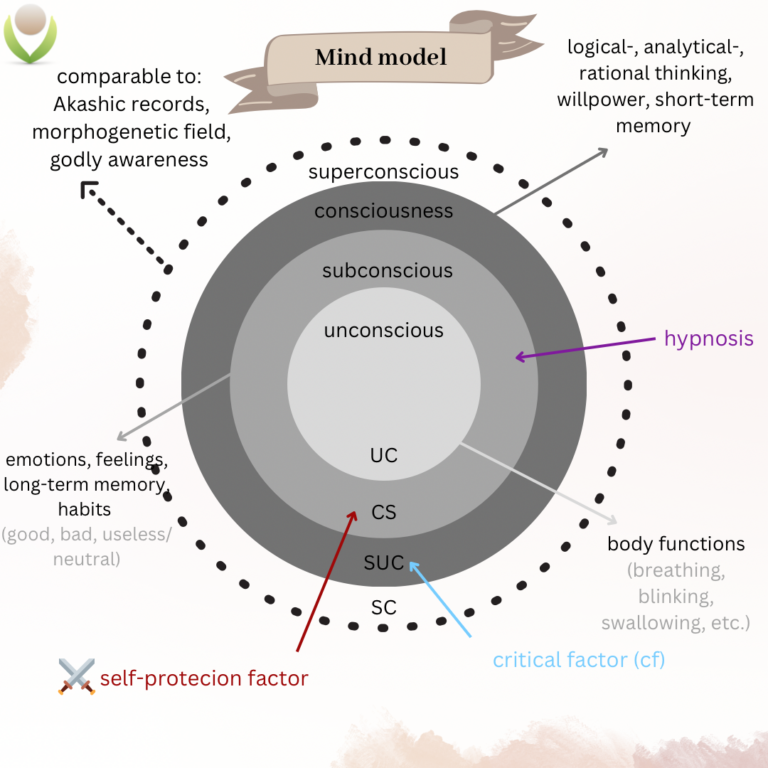
The different levels of consciousness
To understand how hypnosis works, we first need to look at the different levels of consciousness:
- the unconscious mind:
the unconscious mind controls our bodily functions, such as breathing, blinking or swallowing. It works automatically and without our conscious intervention. - the subconscious:
This is where our emotions, feelings, long-term memory and habits are located, whether good, bad or neutral. The subconscious is like a huge memory that influences our daily actions. - the conscious mind:
The conscious mind is responsible for our logical, analytical and rational thinking. It is also where our willpower and short-term memory are located. It is the part of us that actively makes decisions. - the superconscious:
The superconscious mind is comparable to the Akashic Records, the morphogenetic field or the divine consciousness. It is a universal source of knowledge and wisdom that goes far beyond our normal understanding.
How does hypnosis use these levels?
Hypnosis enables us to communicate directly with the subconscious. Through guided imagery, suggestions and relaxation techniques, we can replace old patterns with new, positive ones.
Want to find out more about how hypnosis can help you? Contact me and we can discuss how we can achieve your goals together.
Hypnosis: simple and effective
- For your subconscious: release blockages and establish new, positive habits.
- With respect and safety: your needs always take center stage.
- Individually tailored: Each hypnosis session is tailored to your personal goals.
Are you ready to leave your limitations and blockages behind?
You have the power to change your life and hypnosis is the key. Why wait any longer when you can take the first step now?
- Contact / booking an appointment
- Documents
- Preliminary talk
- Induction
- Work
- Exduction
- Follow-up discussion / explanation
- (follow-up session)
To better understand the individual myths, read the respective texts in detail.
Hypnotic gaze (like Mowgli’s snake Ka from the Jungle Book):
Movies and TV… It doesn’t exist in real life. (But you can do an induction in a similar way -> mirror neurons are used)
Hypnosis necessarily requires a pendulum or a pocket watch:
Hypnosis also works without a pendulum or pocket watch (it is mostly used for show purposes to live up to the cliché, i.e. for fun)
Telling secrets:
If you would tell me without hypnosis, yes, otherwise not. You can also lie or deliberately conceal something in hypnosis.
Being without will:
No, you are always in control and with hypnosis even more so (by accessing your subconscious etc.)
Manipulation:
Nope, manipulation can be found in magic, physiotherapy, etc. Nothing is manipulated in hypnosis…
Being away:
You are not asleep or fainting, you just have your eyes closed and may feel (hypnosis feels different for everyone) a little different than usual (I can tell if you are really in hypnosis or just playing it… 😉)
No memory of what happened:
You can remember everything if you want (yes, there is the forgetting suggestion in show hypnosis, but it is always limited in time and the person allows it)
Getting stuck:
Self-selected state into which you have brought yourself (with the help and guidance of the hypnotist), therefore you could also end it yourself (interrupt focused attention) + In the entire history of hypnosis, no one has ever gotten stuck (if you want to know where this prejudice comes from, you can do that in the long part -> just scroll down)
Hypnosis is magic or supernatural:
No, it is not. It is neither magic nor something supernatural. It has been scientifically examined and proven several times that it can help.
Occultism:
Hypnosis also has nothing to do with the occultism. This assumption comes from the portrayal of hypnosis in films and television. However, this often does not correspond to reality.
Under hypnosis:
You are not UNDER hypnosis, but IN hypnosis. Under = NO control (you have even more control with hypnosis than without) and in = in a relaxation (you don’t say I’m under a relaxation)
Hypnosis is dangerous:
How dangerous is communication? Hypnosis is just as “dangerous” as communication… However, if you have no idea what you are doing, then hypnosis can be “dangerous”.
Evoking false memories:
Yes, it is possible, but this is only the case if you are poorly trained and don’t know what to look for when asking questions. Incidentally, I learned in my trainings which questions to ask and how etc.
Only weak / easily influenced people can be hypnotised:
No, that is not the case. In principle, anyone who wants to can be hypnotised. However, there are also contraindications that speak against hypnosis.
PS: If you do not want to do something, please tell me (also during hypnosis), this is the only way I can react.
Long: Prejudices, myths, beliefs
Hypnotic gaze: Myth vs. reality
Have you ever seen the snake Kaa from The Jungle Book? Her hypnotic gaze is legendary, but of course purely fictional! In reality, there are no eyes that turn like Kaa’s. Hypnosis doesn’t work with magical gazes either, but only with your consent. You are always in control.
If you’ve ever experienced something like this in real life (and not just on TV), be sure to let me know! 😊
Does hypnosis need a pendulum or a pocket watch?
No, definitely not! The idea that hypnosis always requires a pendulum or a pocket watch comes from old movies. Nowadays, most hypnotists use more modern and effective methods.
I do not use a pendulum in my coaching. Unless you specifically request it.
Telling secrets under hypnosis?
“Would you tell me your secret without hypnosis?” If the answer is no, then you won’t do it under hypnosis either. Hypnosis even gives you more control over yourself – you can lie or consciously withhold information.
Our “gatekeeper”, technically known as the “critical factor”, checks everything that happens during hypnosis. If a suggestion does not suit you, it is simply rejected. Hypnosis therefore strengthens your self-determination instead of restricting it.
Unwilling under hypnosis? A myth!
Hypnosis is like a driving lesson: the driving instructor gives instructions, but you are in control of the wheel. If you decide not to listen to the instructions, the driving instructor can only intervene to a limited extent. It’s the same during hypnosis. You are always in control.
If you follow the instructions, you can achieve great results. If you decide not to, the hypnosis will have no effect. So you have the power, not me (as the hypnotist).
Manipulation? No, thank you!
Hypnosis is not manipulation. If you want to experience manipulation, go to a magic show or physiotherapy instead 😉. In hypnosis, you retain full control. You alone decide what you allow.
We are manipulated every day. Through the media, advertising and our environment. But in hypnosis, you decide what you accept and what you don’t.
Am I “gone” under hypnosis?
No, you are neither unconscious nor asleep. Hypnosis feels different for everyone. Some describe it as deep relaxation, others as clear focus. The word “sleep” is often used as a signal word, but has nothing to do with sleep at night.
Memory gaps after hypnosis?
In show hypnosis, it is sometimes suggested that you don’t remember the hypnosis. However, this is temporary and only works if you allow it to. As a rule, you remember everything.
Can you get “stuck” in hypnosis?
No, that’s a myth! In the entire history of hypnosis, no one has ever got “stuck”.
This myth comes from the time when a show hypnotist had a participant go into the Esdaile State (named after the British doctor James Esdaile) on stage. This is very deep hypnosis.
Normally you work in so-called somnambulism, which is also the depth of work on stage and usually also in a coaching session.
At the end of the show, the show hypnotist let the participants emerge from hypnosis, only one of the participants did not seem to come back. The show hypnotist had no idea about the Esdaile State at the time, which is why the police and an ambulance arrived. The police questioned the show hypnotist in detail as to why this man did not emerge from hypnosis. The participant emerged from the hypnosis after some time. He was very surprised at all the commotion, as he thought that he had come back immediately after the show hypnotist had ended the hypnosis for everyone. The show hypnotist was detained by the police until the participant emerged from the hypnosis.
At this point, everyone understandably thought that the participant was stuck in hypnosis, which of course is not the case. The delayed emergence from hypnosis is due to the fact that the perception of time is (generally) different in hypnosis. You also feel so comfortable in Esdaile because you can forget everything around you. That’s why some clients (once they are in Esdaile) don’t want to go back to the here and now so quickly and easily.
Don’t worry, nowadays we as hypnotists (if we have learned this in training) know how to deal with the situation. It is definitely not common for someone to go into the Esdaile state just like that and without the guidance of the hypnotist.
PS: I learned in my training courses what the signs of the Esdaile state are and how to get someone out of it.
Is hypnosis magic, supernatural or occult?
No, hypnosis is neither magic nor something supernatural, nor is it occultism. It is a scientifically recognized method that has been proven to help.
Under hypnosis:
You are not UNDER hypnosis, but IN hypnosis. Under = NO control (you have even more control with hypnosis than without, as hypnosis gives you access to your subconscious etc.) and in = in a state of relaxation (you don’t say I’m under a state of relaxation).
Is hypnosis dangerous?
Hypnosis is as dangerous as communication. You can do a lot of good with words, but you can also do harm. Hypnosis is a tool, and as with any tool, it depends on who is using it. In professional hands, hypnosis is safe. However, there are contraindications that speak against hypnosis.
False memories through hypnosis?
This can only happen if the hypnotist is poorly trained. I have learned how to ask the right questions and make sure that no false memories are created.
Only weak people can be hypnotized?
Wrong! Anyone who wants to can be hypnotized.
Are you ready to leave your limitations and blockages behind?
You have the power to change your life and hypnosis is the key. Why wait any longer when you can take the first step now?
“Help me to help myself.”; “Help me to do it myself.”
This is the motto of Montessori education. This could just as well be the motto for working with hypnosis. Why?
- You always help yourself
- The solution is already within you (in the client)
- As a hypnotist, I am the “tour guide”, so to speak
- Hypnosis is only the supporting tool for the change
- I’ll give you the help you need to be able to solve your problems yourself
Long: Montessori and hypnosis
Hypnosis and the Montessori principle: “Help me to do it myself”
Just like Montessori education, hypnosis is about helping you to find your own solutions. The answers to your questions and the solutions to your problems already lie within you. Sometimes they are difficult to access.
My job as a hypnotist is to show you the way and activate your subconscious (or even your superconscious) so that you can find your own answers. Hypnosis is like a key that opens the door to your inner knowledge. You have everything you need. I just help you discover it.
Why hypnosis is so effective
Our subconscious is an incredibly powerful part of us. It stores memories, emotions and resources that we often cannot access when we are awake. Through hypnosis, you can uncover these hidden treasures and use them to resolve your issues yourself.
Whether it’s about blockages or personal goals, the solution is already within you. Hypnosis helps you to bring them to light.
How does this work in practice?
Imagine that your mind is like a large, unknown forest.You know that somewhere in this forest there is a hidden treasure, the solution to your problem.But without a map or a guide who knows the way, the search can take a long time.
In hypnosis, I am your guide.I show you the way, but you walk it yourself.You decide how fast or slow you go, and you find the treasure with your own power.
Why I love this approach
Because it empowers you. It’s not about me telling you what to do.It’s about you learning to listen to your inner voice and finding your own solutions.
Are you ready to leave your limitations and blockages behind?
You have the power to change your life and hypnosis is the key. Why wait any longer when you can take the first step now?
Hypnosis is basically hypnosis. Difference: What happens and what is done
Show hypnosis:
- Pure entertainment
- The people on stage are willing to do things that they would not otherwise do
Change hypnosis:
- Working on problems
- Always being treated with respect
- Without spectators (only client and hypnotist)
- Only do things that you want to do (and are good for you and NOT for entertainment)
- Do not do embarrassing things or ”tell secrets” (unless you would also tell the secrets without hypnosis, in which case hypnosis acts as a catalyst)
Long: Show hypnosis vs. change hypnosis
Show hypnosis vs. change hypnosis: what’s the difference?
Hypnosis is always used to achieve a goal. However, the type of goal and the setting differ significantly between show hypnosis and change hypnosis.
Show hypnosis: focus on entertainment
Show hypnosis has a clear goal: entertainment. The participants on stage are there voluntarily and various tests are carried out at the beginning of the show to find out how suggestible they are. Only those who are highly suggestible and willing to engage with the situation remain on stage.
Show hypnosis is about entertaining the audience. The participants often do things that they would not otherwise do. But always within a safe and controlled framework.
Change hypnosis: focus on personal development
Change hypnosis, on the other hand, serves a completely different purpose: it helps you to achieve personal goals and bring about positive changes in your life. Whether it’s about stress reduction, self-confidence or overcoming blockages. The goals are as individual as the people themselves.
Respect and safety are paramount in change hypnosis. There are no spectators. It’s just you and the hypnotist (or sometimes the parents in the case of children). You only do what you want and what is good for you. Because this is not about entertainment, but about your personal development.
If you still want to have a bit of fun, for example through hypnotic phenomena such as arm catalepsy, you are welcome to discuss this beforehand. We will then see together whether and if so, how we can incorporate this.
Safety and trust in change hypnosis
You can be sure of a professionally conducted change hypnosis:
- No embarrassing situations: You won’t do anything you don’t want to.
- No secrets will be revealed: Hypnosis is not a truth serum. You will only reveal things that you would say when you are awake.
- Respectful treatment: Your needs and boundaries are always the focus.
Are you ready to leave your limitations and blockages behind?
You have the power to change your life and hypnosis is the key. Why wait any longer when you can take the first step now?
Q&As
Can you make me…
Nope!… In fact, I can’t just make you… I can’t “heal” you either. If anyone can do that, it’s you. I can only guide you to do it yourself.
Important: I do not have a healing license and may not make any promises of healing.
If you think I can use hypnosis to make you do something against your will, I’m afraid I’ll have to disappoint you. You also won’t be revealing your debit card PIN or anything like that to me.
Is hypnosis the right approach for me?
Yes, if:
- You are ready to change yourself and your life
- You *don’t* want to carry on as before
- You finally want to lead a free, self-determined and carefree life
- You take initiative for change
- You want support from me
- You see hypnosis as a tool to help you on your journey
- You are looking for support for your whole family (incl. animals) You want to follow my suggestions for action animals)
- You want to follow my suggestions for action
- You can concentrate for more than just a few minutes
- You are able to focus on what I say
- You believe (or allow yourself to believe) that hypnosis can help you
- You want to work with me on your goals
- You are not affected by a pathological intellectual disability, blindness or deafness
No, if:
- You do not fulfill the points just mentioned
Does hypnosis work?
Hypnosis can work if you want it to. If you think I’m going to do all the work for you, it won’t work. But if you want to achieve your goal and you’re willing to do your part, it will most likely work. (I can’t promise you that, though.)
I have to believe that hypnosis works, in order for it to work, right?
No, you don’t have to believe that hypnosis works. You just have to allow it to work. As long as you are able and willing to follow my instructions, hypnosis will work. (Gravity is also there or works, even if you don’t believe in it). Hypnosis is a technical process, so you don’t have to believe in it, but it would help the process a lot.
What is the difference between the unconscious, subconscious, conscious and superconscious?
Unconscious:
- Controls bodily functions (e.g. heartbeat, digestion, blinking, etc.)
Subconscious:
- Emotions
- Feelings
- Long-term memory
- Refers to our “innermost”
- Personality
- Values
- Moral concepts
- Seat of the self-protection factor
Consciousness:
- Thinking
- Filtering of thoughts
- Conscious perception
- Mediator and filter between self and subconscious
- Works at the level of the mind
- Logical thinking
- Analytical thinking
- Rational thinking
- Willpower
- Short-term memory
- Seat of the critical factor (CF)
Superconscious:
- “Higher authority” which can “influence” everything
- Overview of everything that happens and has happened in life
- Comparable to Akashic Records, Morphogenetic Field, Divine Consciousness etc.
I am not hypnotisable!
Okay. Then I have a few questions for you, which you should answer spontaneously with yes or no (note or write down how many yeses and no’s you have), because you’ll find the answer below.
Questions:
- Can you sleep at night? Yes or no?
- Did you briefly not know where you were when you fell asleep and/or woke up? Yes or no?
- Do you sometimes daydream? Yes or no?
- Are you sometimes lost in thought? Yes or no?
- Do you sometimes watch movies and feel like you are in the middle of the action? Yes or no?
- Do you sometimes read novels, for example, and feel like you are in the middle of the action? Yes or no?
- Do you sometimes drive a car and after a few minutes no longer know whether you have really followed all the traffic rules and/or missed an exit? Yes or no?
- Can you listen to the other person during a conversation and maintain a dialog with them? Yes or no?
- At a party in a beer tent or at a party, can you concentrate only on the person who is talking to you and block out everything else around you? Yes or no?
How many questions did you answer yes to? If you answered yes to at least one of them (or more), you are most likely hypnotizable. In fact, 80-90% of all people are hypnotizable.
But there are also the 10-20% who are not hypnotizable. This is usually because they have a pathological reduction in intelligence.
The more intelligent a person is, the better they should (normally) be able to be hypnotized. People who do not go into hypnosis are usually either afraid of it or have misconceptions about hypnosis.
Hypnosis is a natural state that “occurs” several times a day (e.g. when reading an exciting book, driving a car, in the workflow, etc.)
Everyone reacts differently to hypnosis. Some need a little longer, others respond very quickly.
I am not a visual person so hypnosis doesn’t work on me, right?
You don’t have to see anything during hypnosis. Some people see images and some don’t. This is completely normal and fine.
If you are one of those people who can’t see anything during hypnosis, you can usually still describe what is going on, e.g. by hearing, tasting, feeling or intuitively knowing things. You may also get flashes. Everything is just right the way it is.
Hypnosis is only used by spiritual people, right?
No, because hypnosis is not spiritual, but a scientifically recognized method (since 2006).
There are even celebrities who use or have used hypnosis. Here are a few of them:
- Adele
- Ben Affleck
- Courteney Cox
- Drew Barrymore
- Matt Damon
- Charlize Theron
- etc.
What does hypnosis feel like?
- Everything coming from outside is no longer so important
- Concentration on the hypnotist and the here and now (what is happening right now)
- Possibly changed feeling -> feeling of lightness (like floating), feeling of heaviness (pleasant pressure on the body, e.g. under water) or feeling of “I have my eyes closed”
- May feel different from session to session and even within a session
How do I know I am hypnotised?
- Eyelid fluttering (from top to bottom)
- Eye movements (from left to right)
- More frequent swallowing, due to increased salivation
- Gurgling / rumbling in the stomach
- Altered breathing (deeper breathing, rapid breathing, regular definite exhalation)
- Wet hands
- Increased tearing (without crying)
- Hypnotic phenomena such as catalepsy etc.
- Etc.
PS: By the way, I can determine whether you are really in hypnosis or just playing the whole thing 😉.
Can I hypnotise myself?
Yes, indeed. You can also hypnotize yourself. In fact, all hypnosis (even if it is performed by an experienced and trained hypnotist) is self-hypnosis.
But you can also hypnotize yourself (without someone else). You already do this several times a day without even knowing it. If, for example, after driving a few kilometers you have already asked yourself whether you have really obeyed the traffic rules, you have already been in a trance. You are also in a trance when watching a movie or reading a book.
Apart from the fact that you are already unconsciously hypnotizing yourself several times a day, you can also do it consciously. With the help of code words, for example, which I can give you during hypnosis. I will be happy to explain to you exactly how the code words work after our hypnosis session. Simply bring up the subject before (or after) the session. It’s best to talk about it beforehand so that I can give you the code words that are right for you.
What should I look out for when searching for the right hypnotist for me?
First and foremost, you should make sure that the chemistry is right. So if something goes against your values, it will probably also affect the hypnosis, which is why it is / would probably be better to keep looking for someone who fits better.
One thing that can be a good indicator – though not necessarily so – is the price. As the saying goes, “You get what you pay for,” and “If you buy cheap, you’ll end up buying twice.” Training is also an indicator. I know it’s usually hard to judge from the outside whether the training was really good, but a quick look at the certificates is usually enough. So pay attention to where, how, for how long, and using which methods or techniques the person was trained.
If you are not sure whether the person is right for you, then you usually have the option of arranging a preliminary talk / informational meeting etc. After that, you will probably be better able to decide whether it feels right for you or not.
I've tried hypnosis before (and it didn't work). Why should I trust you now, or give the whole thing another chance?
If you’ve actually been to a hypnosis session before and it didn’t produce the results you were hoping for, I’m sorry to hear that.
I understand your concerns. Without knowing the specifics, I can’t say for sure what went wrong, since there are many factors that can influence the success of a session. Even with the background information, it’s often difficult to pinpoint an exact reason. It’s always very individual, and sometimes you can’t even recall the details because it’s been too long, etc.
I’ll just list a few of the most common reasons here.
- Many hypnotists work purely with suggestion. That’s a good method, I won’t deny it, but sometimes a different approach is simply needed.
Through all my training, I’ve learned many different tools, experienced them firsthand, and of course applied them countless times. - It’s also possible that your original goal wasn’t addressed because there was another goal that needed to be tackled first or was more important at that moment.
- Maybe it just wasn’t the right time yet.
- Maybe it just takes a little time and close support.
- Every now and then, however, it also happens that there simply wasn’t a good rapport of trust, or that the person wasn’t the right fit for you.
I don’t mean to speak ill of anything or anyone here. I’m simply trying to provide a few points of reference so you can make a decision.
I’d be happy to answer any questions you still have during a free, no-obligation preliminary talk and to continue supporting you afterward, if it feels right and works for both of us.
Sometimes it’s just good to give things a second chance 😉
How long does a hypnosis session take?
This is always different. This depends on several factors, e.g.
- Which goal is to be achieved
- Whether there are other goals that influence the actual goal
- The complexity of the goal
- How big the goal is
- etc.
Sessions usually last between 30 and 210 minutes.
Children’s sessions usually last 20 – 90 minutes.
How many sessions will I need, and how long will it take to reach my goal?
This depends on many different factors, e.g:
- Which goal is being tackled
- How long this goal has been in place (but has not yet been achieved)
- Whether there are other goals that reinforce the actual goal (you don’t have to consciously know or be able to identify this)
- Whether you are really willing to change (or whether you think you don’t have to do anything for it => this is not the case, by the way, you “have” to be actively involved!)
- etc. pp.
I promise you that I will only do as many sessions with you as necessary.
Exactly how long it takes for your goal to be completely achieved depends on the factors I have just mentioned. In most cases, changes can be clearly seen after the third session. However, this varies from person to person.
If the Simpson Protocol is used, it may be that the necessary goals are tackled first and you may not notice the change at first.
It is best to ask or ask those around you to give you feedback if they notice changes that you have not yet noticed (as this can sometimes be a gradual process).
Can I do something wrong?
You can’t really do anything wrong during hypnosis. As long as you are ready for change and follow my suggestions for achieving your goals, we can achieve great things together.
The only thing you can do “wrong” is that you don’t prepare yourself properly (i.e. you don’t go through the information from the client area) and thus resist the change due to possibly false beliefs about hypnosis or other counterproductive influencing factors.
Please also read the point What should I pay attention to before and after my session? You will find further important information for you there.
Are there any contraindications associated with hypnosis?
Yes, there are contraindications. These are:
- Thrombosis
- Myocardial infarction
- Stroke
- Psychoses
=> The above are absolute contraindications
In my case, there are also non-absolute contraindications, which are all illnesses as defined by ICD-10 / 11 (in America better known as the DSM-5), since I do not have a healing license.
What should I look out for before and after my session?
It is best not to work on this day (if possible) or only do light work. Take time for yourself before and after the session. For example, go for a walk or do something else that is good for you. It is best to wear comfortable dark clothing (and if you like to wear make-up, it is best not to wear make-up). Don’t drink alcohol or take drugs. Caffeine can also be a hindrance. Don’t do anything that upsets you (e.g. your tax return or a horror movie etc.)
You will also be given everything you need to know in the client area. Please go through this completely before the session so that you are optimally prepared.
Yes, you can drive and attend appointments etc. after hypnosis. However, it is advisable not to do anything after hypnosis, as hypnosis can be exhausting. Rest afterwards and possibly even sleep.
It’s best not to mention the session just yet. Otherwise, other people might undermine your success (for example, because they’re jealous that you sought support and they don’t have the courage to do the same, etc.)
Observe what changes you (and your environment) can perceive and book a follow-up session (if necessary).
Am I allowed to move during hypnosis (e.g. scratching)?
Yes, you may move during hypnosis. You may scratch yourself or sit differently as long as I can see you (your head and hands) (and can still hear you).
If you need to go to the toilet during hypnosis, you can simply tell me and you can go to the toilet during hypnosis without any problems.
Am I a different person after the hypnosis?
Yes and no. I cannot and will not fundamentally “reprogram” you. But you can become a better version of yourself if you want to.
Is hypnosis possible for pregnant women?
Yes. Hypnosis is also possible in principle for pregnant women, but if you as a pregnant woman want to work on a goal in yourself that existed before the pregnancy (or that arose during the pregnancy but is not directly related to the pregnancy or birth, for example), I would advise you to wait until after the birth. There are several reasons for this. But it would be too much to list them here briefly.
Is hypnosis possible if I have a disability?
There is no general answer to this question. It depends on several factors.
For example:
- What disability is it?
- How does it affect him or her?
- Is the disability cognitive or physical? Or both?
- How long has it existed and how severe is it?
- Etc.
Hypnosis is more likely to be possible with a physical disability than with a cognitive impairment. If the person “only” sits in a wheelchair because he or she cannot walk, for example, but has no other limitations, there is usually nothing to prevent hypnosis (except perhaps the accessibility of the practice).
In the case of a cognitive disability, however, the situation is usually different. Here it also depends on the limitation etc. As long as the person is able to follow the hypnotist’s instructions and suggestions for action, there is usually nothing to prevent hypnosis.
However, it is always a case-by-case decision (even for people without disabilities) whether and if so, to what extent hypnosis can take place and whether it makes sense.
Furthermore, not every hypnotist has the confidence to work with someone who has a disability. This is not necessarily due to the competence of the hypnotist, but perhaps due to a lack of background knowledge about the disability in question or a lack of a healing license.
Is it possible to hypnotise animals?
Yes and no. If you shout very loudly at an animal, for example, it sometimes goes into a state of shock. This is only “comparable” to a hypnotic trance.
But just because you can’t hypnotize animals “directly” doesn’t mean that you can’t support them with the help of hypnosis. This is done through surrogate hypnosis for animals, through the Simpson protocol and with special questions.
What is the purpose of the preliminary talk?
- Clarify your open questions (it’s best to write them down so that everything is thought of)
- See together if, and if so, how I can best help you
- Get to know each other (is the chemistry between us right, also in relation to your child, if I am going to work with him / her)
- Recommendations on how to proceed if I am not the right person for you / your child / your animal
I work during your office hours… Can I schedule an appointment outside of your office hours?
No!
I understand that you work. However, I ask you to understand that I work too. And specifically during the hours I’ve listed or that are available for booking. You can’t very well tell a restaurant, “They’re not open in the morning, and I work in the afternoon and evening, so I’d like to come eat there at 3 a.m.”
How is it still possible for you to make an appointment with me? I also work on Saturdays. Many people have the day off then and can make the appointment. I also often work on holidays (when many people are off) and during school breaks. If that doesn’t work for you either, then you’d have to, for example, swap shifts, take time off, or use overtime to make it work.
By the way, I advise against scheduling an appointment during your (lunch) break. For one thing, the (lunch) break is meant for you to relax and have something to eat. For another, it puts pressure on both of us to ensure you’re back at work on time. That way, you can’t fully focus on yourself because you’re always keeping one eye on the clock. Plus, change processes can be exhausting, which is why it’s not advisable to work afterward.
Why don't you offer individual sessions?
I offer individual sessions, but only upon request.
Experience has shown that many people are looking for a quick “miracle” and think they can achieve all their goals with just one session. To counter this and to keep things clear, individual sessions can only be booked upon request and (with possible exceptions) only after a package has been booked.
Does the health insurance / insurance company cover the costs?
No, health insurance companies usually do not cover the costs. Neither do private insurance companies and / or supplementary insurance, as I do not have a healing license and am not affiliated with the health insurance system.
If you would like to pay in installments, just get in touch with me. We will then clarify everything else.
How can I pay? Can I pay in installments? Will I receive an invoice?
Payment:
Through my payment provider Mollie:
- Via PayPal
- Bank transfer
- Card
- Cash (only on site)
Payment by installments:
Interest-free installment payment possible by arrangement
Invoice:
You will automatically receive an invoice via my payment provider. (If you have not received one but need one, please send me a quick email.)
How long before the session can I cancel?
Up to 7 days before appointment (with possible exceptions)
Is there anything I need to bear in mind when booking?
Yes.
Please make sure that you enter your details correctly.
After successfully booking, click on Done. This is the only way to receive the password for the client area.
For the surrogate work (Animal support), please select dates that are directly consecutive.
In other words, animal communication on Tuesday / Friday and the first surrogate session on Wednesday / Saturday, so that the animal communication takes place one day before the surrogate work.
You can then book the second representative work as usual in 3 weeks.
Personal journeying
18 months support- 26 Sessions
- One session every 3 weeks
- Several topics can be addressed
- Work with „traditional“ hypnosis
- Work with Simpson Protocol®
- Spiritual hypnosis
- Quantum work
- Learn your own applications
- Audio files for further support
- 1:1 support
- Individual approach
- Holistic approach
- Preliminary talk with goal agreement
- Access to the exclusive client area
- Information material (in the client area)
- Preparatory hypnosis as MP3
- Preparation checklist
- Follow-up talk after the sessions
- E-Mail Support
- Queries possible
- Payment in installments possible (maximum 18 months)
Adult support
From 18 years- 4 sessions
- One session every 3 weeks
- 1:1 support
- Individual support
- Holistic approach
- Preliminary talk with goal agreement
- Access to the exclusive client area
- Information material (in the client area)
- Preparatory hypnosis as MP3
- Preparation checklist
- Follow-up talk after the sessions
- E-Mail Support
- Queries possible
- Payment in installments possible (maximum 3 months)
Book Preliminary talk / Hypnosis
- Click on “Done” after booking.
- Book your next appointment within 3 weeks.
For adult support: 3 hypnosis sessions & 1 quantum work session
For personal journeying: Individual hypnosis sessions & quantum work sessions
Any questions?
Then I’d be happy to schedule your free preliminary talk (via Zoom).
During the talk, I’ll answer any remaining questions you may have before we start working together on your goals.
AI-generated image