Sports Mind
1.111€
Anonym

Fields of application examples
Animal sport hypnosis

When harmony breaks down: The path back to unity with your horse
You know that feeling. That indescribable feeling when you ride into the arena together. The atmosphere in the hall, the smell of sawdust and leather, the muffled clatter of hooves on the floor. Your heart beats faster, but not with fear, rather with anticipation. Because when you’re in the saddle, you are no longer two. You are one.
You feel every muscle beneath you, every slight change in tension, even before your horse translates it into movement. You know its breath, its rhythm, its soul. You’ve been through so much together: countless hours of training in pouring rain, early mornings in the fog, those magical moments when everything was just perfect. The trophies in the cabinet are nice, but they’re not what matters. What matters is what you have between you. That invisible bond. That trust.
People outside the horse world don’t understand this. For them, riding is a hobby, perhaps a little exclusive, a little crazy. But you know better. You know that it’s a relationship. One of the deepest a person can experience. One that needs no words and yet says so much.
The crack in the bond: When trust suddenly becomes fragile
But then that one day came. Maybe it was a competition where something went wrong. A misunderstood signal, a fright, a refusal before a jump that you had already mastered a hundred times. Maybe it was a fall. One that hurt, but unsettled you even more. Or maybe it wasn’t anything dramatic. Maybe one day you just felt that something was different.
Your horse, which usually stands so relaxed in the grooming area, becomes restless when you fetch the saddle. Its ears, usually pricked up happily, suddenly lie flat. When you saddle it, it turns its head toward you, and there is something in its eyes that you cannot interpret. Is it mistrust? Is it fear? Or are you just imagining it all?
It gets worse during the test. Where you used to work together seamlessly, communication now falters. You give a signal and the response comes too late, too strongly, or not at all. You feel your horse becoming more and more tense beneath you. It stops breathing, just like you. You are both struggling. Against each other, instead of with each other.
The results are getting worse. The placings you were so proud of are no longer there. But that’s not the worst of it. The worst thing is this feeling of alienation. This silent question every evening in the stable: What did I do wrong? Why doesn’t it trust me anymore? Why can’t I feel you anymore?
The silent language of fear: when horses mirror us
Horses are highly sensitive creatures. They sense our heartbeat before we even consciously perceive it ourselves. They read our body language in nuances that completely escape us. And they carry our emotions, whether we want them to or not.
What you may not know: often, the fear you observe in your horse is not its own. Or rather, it is not only its own. Horses are masters of mirroring. If you are nervous before a competition, if you become uncertain before a difficult passage, if you are trembling inside, your horse senses it. And because it loves you, because it wants to trust you, it takes on this tension. It thinks: If my human is uncertain, there must be danger here. So I am uncertain too.
And then the cycle begins. You feel your horse’s tension and become even more nervous. It senses your nervousness and becomes even more tense. Until eventually, no one knows who started it. The harmony is gone. The trust is gone. And there you stand, two uncertain souls who love each other so much and yet can no longer reach each other.
You’ve tried to fight it. More training, more dressage, more jumping. Maybe you hired a new trainer, called in a saddler, the vet, the osteopath. You’ve done everything you can, but nothing has really helped. Because the problem isn’t in your horse’s body. And it’s not even just in yours.
The problem lies in the connection between you.
The key to lost language: animal communication as a bridge
This is where I come in. And I would like to introduce you to an approach that may sound unusual, but which starts exactly where conventional methods fail.
In my work, I combine two things that for me are inseparable: sports hypnosis for you as a rider and animal communication for your horse. Because the secret to true harmony lies not in working on just one of you. It lies in restoring the language between you.
Sports hypnosis helps you to release your own blockages. The fears that you may have been carrying with you since you first started riding. The pressure to perform that weighs on you. The old images of falls or failures that have burned themselves into your subconscious. We work with you so that you can get back in the saddle calm, centered, and full of confidence. So that your heartbeat becomes steady again. So that you can give signals that your horse understands, clearly and lovingly.
But that’s only half of it.
Your horse’s voice: What it has always wanted to tell you
The other half is animal communication. Many people smile at this until they experience it for themselves. But I have learned that horses have a lot to say. They have thoughts, feelings, memories, and above all, they have their own perspective on what has happened.
I connect with your horse on a subtle level. I ask it: How do you feel? What happened back then, on that one day? What do you need from your human? What are you afraid of? What do you wish for?
The answers I get are often astonishing. Sometimes the horse tells me about a moment of fear that you have long forgotten, but it has stored it away. Sometimes it talks about pain that no vet has found because it is emotional. Sometimes it simply says: I am so afraid of disappointing my human.
And sometimes, yes sometimes, it says things that will touch you deeply. Things like: I love her so much, but I don’t understand why she is always so tense when we are together. Everything used to be easy. I want to go back to that ease.
The magical combination: surrogate hypnosis for your animal
Your horse senses much more than you might initially assume.
In animal communication, your animal can often describe to me very precisely what is bothering it. It also often knows how to help itself. Be it through more verbal communication on your part, or through proxy work using hypnosis.
This is where it gets magical. We combine sports hypnosis for you with animal communication and proxy work for your horse.
Through proxy work, it is very often possible to precisely dissolve or transform the animal’s blockages. A real game changer.
Not only for you, but also for your faithful companion.
The reunion: When two souls find each other again
Imagine sitting on your horse again after such a session. But this time everything is different. You have let go of your fears. Not suppressed them, not fought them, but truly let them go. You feel a calmness within you that you haven’t felt in a long time. And you sense that your horse feels it too.
Its gait is softer, its breathing calmer. You apply pressure with your thighs and the response is immediate, but not hasty, rather fluid. You move together around the arena, and it feels like dancing. Like back when everything was still easy. But no, it feels like back when you were one. And you are again.
The test you may be riding today is almost irrelevant. Whether you win or lose is no longer what matters. What matters is this moment. This connection. This feeling that everything is right between you again. That you are talking again, without words.
The invitation: For a partnership that goes deeper than any competition
I’m not offering you a quick fix for the next competition. I’m offering you long-term support for you and your horse. Someone who understands that you are a team. That your relationship is the most important thing. That trophies come and go, but the bond between you remains.
If you are ready to go down this path, then let’s talk. Tell me about yourself. Tell me about your horse. Tell me about the moment when you lost each other, or perhaps even earlier, when you found each other.
And then let’s rediscover together the language that you both miss so much. The language of souls. The language of trust. The language that needs no words.
I look forward to accompanying you and your horse on this journey. Back to each other, back to harmony, back to unity.
Because the most beautiful thing about riding is not victory. It is the moment when you feel: We are one again.
Martial arts sport hypnosis
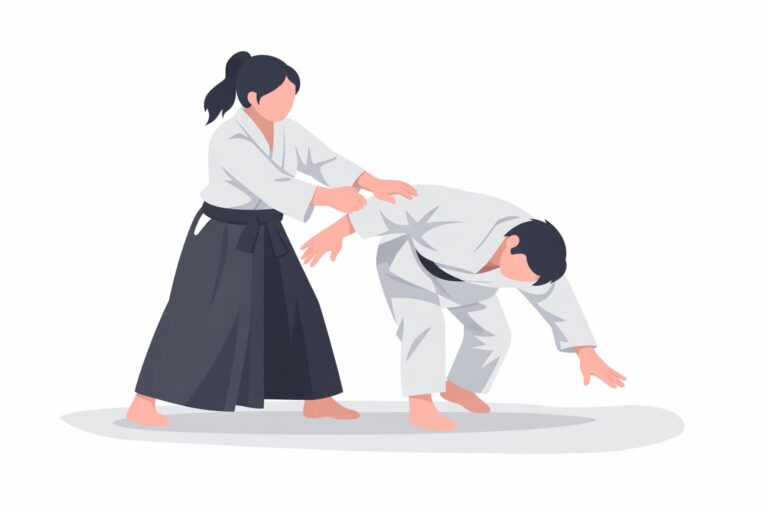
When your inner critic strikes harder than any opponent: The path back to your true martial art
Do you remember the moment you first stepped onto the mat? That specific feeling when your feet touch the firm yet yielding surface of the tatami. The smell that eats into your clothes. A mixture of sweat, cleaning spray, and that indefinable, venerable “dojo smell” that only insiders know. Maybe you were still a child, maybe you were already an adult. But you knew immediately: something is different here. There is more to this.
In judo, the “gentle way,” you learned that yielding means winning. That your opponent’s strength can become your own if you are skilled enough to evade and lead. In aikido, the “way of harmony,” you understood that it is not about victory or defeat, but about fusion. You learned to see an attack not as a threat, but as energy that you can redirect, in combat as in life. This is difficult to understand for your colleagues at the office who wonder about the bruises or sore muscles. Even more so for your partner, who sometimes mistakes your strict discipline for stubbornness. But you? You always knew better. The dojo was your space. Your refuge.
The calm before the storm: When your mind sabotages itself
But then came the day when something shifted. It rarely happens from one second to the next. It creeps up like a shadow that grows longer as the sun sets. You stand at the edge of the mat, your feet just short of the line, and suddenly that familiar tingling sensation is gone. Instead: a tugging in your stomach. A slight dizziness. A thought that sticks like a catchy tune: “What if I fail today?”
You go in anyway. You bow. You sit in seiza. You close your eyes to collect yourself, just as you have done hundreds of times before. But instead of calm, there is only noise. Images flash through your mind: the last competition you lost, even though you were better. The last belt exam, where you forgot the simplest technique in the middle of the kata. The looks from the others. The silence after your mistake.
You try to push the thoughts away. You tell yourself, “I’m experienced. I’ve done this countless times before. I can do this in my sleep.” But that’s exactly the problem. You could do it in your sleep. You could wake your partner up at three in the morning and he would get a perfect osoto-gari or a smooth irimi-nage. Your body knows it. Your muscle memory is a library of thousands of repetitions. But your mind? It just closed the library and threw away the key.
The randori begins. Your breathing becomes shallow. You see the attacker, or competition opponent, coming towards you and your brain switches into survival mode. You tense up. You try to do everything right, and that’s exactly why you do everything wrong. The fluid movements you’ve trained for years seem jerky and choppy. You’re no longer fighting the other person. You’re fighting the chaos in your head.
And the worst part? Your opponent senses it. Your partner senses it. Fear has a smell, and everyone in the dojo can smell it.
The blackout: when emptiness swallows you up
Perhaps you know that moment when things go terribly wrong. The moment of silence. You stand there, the attack comes, you reach for your sleeve, want to initiate, want to move, and there is nothing. Simply nothing. White noise. A vacuum. The technique you’ve done a thousand times is gone. As if erased. You stand there, a foreign body on the mat, and time seems to stand still while your insides are on fire.
Then comes the shame. It hits you harder than any throw. You leave the mat with your head down, making excuses (“The warm-up was too short,” “I had a hard day”), but deep down you know the truth: you failed. And not just technically. You failed yourself.
The next training sessions become torture. You go, but you’re not really there. You hold back, afraid that it will happen again. You avoid certain partners, certain exercises. Your ego, that fragile tyrant, constantly whispers new horror stories to you: “What if you try the throw now and land awkwardly? What if everyone sees that you ‘can’t do it anymore’? What if you’re just not good enough anymore?”
You, who once sought harmony between body and mind, now feel only division. The mind wants to, but the body blocks it. Or the body could, but the mind sabotages it. The downward spiral spins faster and faster. You wonder whether you should take a break. Whether you should change sports. Whether you are simply not cut out for it.
Futile attempts: The search for the switch
In your desperation, you look for solutions, just as you always have: with discipline and dedication. You do extra training to give your body back its feeling of strength. You analyze your technique down to the smallest detail, film yourself, break down every movement into individual parts. Maybe you even look for an experienced trainer for private lessons, hoping that one crucial tip will flip the switch again.
But the switch isn’t in your muscles. It’s not in your movement pattern. It’s in a region that you can’t reach with all the sweat and discipline in the world: your subconscious. That’s where fear has built its throne. That’s where that one defeat from the past has combined with today’s doubts to form a bulwark of self-doubt.
Returning to the source: Deep mental training for martial artists
This is exactly where my work comes in. And I’m not talking about some standardized mental coaching method taught to you by a psychologist with little experience on the mat. I’m talking about something else. I’m talking about something I’ve experienced myself.
I was a proud judoka for many years. I know the pressure just before a competition. I know the trembling in your legs when you face someone who seems stronger. I also know the humiliation when things don’t go your way. And I am now an active aikidoka. I have learned that the greatest battles are not those you fight on the mat, but those you fight within yourself before you step onto it.
My approach is not external coaching. It is internal guidance. I don’t offer hypnosis, where you lose control, because that would be the opposite of what a martial artist wants. I offer you deep mental training, a kind of Za-Zen for the modern warrior’s soul.
Together, we go to where the blockages are. We use hypnotic states, those deeply relaxed, focused moments that you may be familiar with from meditation after training, to talk to the part of you that is stuck down there. To the frightened child who doesn’t want to lose. To the perfectionist who doesn’t forgive mistakes. To the inner critic who shouts louder than any coach.
We install new, powerful images in your inner cinema. Imagine going through a technique in your mind. But not superficially, rather so deeply that every muscle, every fiber, every breath already knows the movement before you do it. That is the secret of the masters. Not just a thousand repetitions, but a thousand high-quality, mentally charged repetitions.
The principles of martial arts as an art of living
In judo, you learn that the best way to defeat a strong opponent is not to resist their strength, but to use it. That’s exactly what we do with your fear. We don’t fight it. We don’t say, “Go away!” Because that would only make it stronger. We do what you do on the mat: we use its energy. We redirect it. We ask: What are you trying to tell me? What are you trying to protect?
In aikido, they say: The attack is already the resolution. The opponent’s movement already contains the seed of their defeat. It’s the same with your blackout. The moment of greatest emptiness also holds the greatest opportunity. The opportunity to let go. The opportunity to trust. Not your mind, but your body. Not your ego, but what is really there. The skills you have trained for years, buried deep within you, beneath all the noise.
The way back to the mat and to yourself
Imagine you are returning to the dojo. But this time it is different. You are not entering the mat as a fighter who has something to prove, but as a student who is allowed to learn something, including about yourself. The bow is no longer an empty gesture, but a genuine arrival. You feel the ground beneath your feet. You hear your breath. You see your partner and you see not an opponent, but a mirror.
You begin the randori. The attack comes. And within you there is silence. No whirlwind of thoughts. No panic. Just presence. Your hands find the grip, your hips turn, the throw happens, not because you made it, but because it just happened. You feel the fall, the rise, the “ippon.” But the feeling afterwards is not triumph. It is gratitude. Gratitude that you are back. That you have not lost yourself.
That is what I offer you. Long-term and in-depth support. Support that sees you not only as an athlete, but as a person who has walked the path and wants to continue walking it. Support that understands that the black belt is not the end, but the beginning of the real learning.
The invitation
You didn’t choose this path because it’s easy. You chose it because it’s true. Because it teaches you who you are. Now you may be at a point where you think you’ve lost your way. But in judo, you know that there are no wrong moves, only those that teach you to fall better and get back up again.
Let’s get back up together. I offer you my hand. Not as a savior, but as a companion. As someone who knows the smell of the tatami, who knows the silence before the technique, who knows the pain of failure and the ecstasy of success.
Book your personal companion. Tell me about your journey. Tell me about the moment when everything came to a standstill. And then let’s find the flow again together. Because the journey is not over yet. It is just beginning.
I look forward to accompanying you on the mat, and in your life, in all your strength and gentleness.
Osensei, the founder of Aikido, said, “The way of the warrior is to find love in everything.” Perhaps it is time to rediscover this love for yourself.
Winter sport hypnosis
When the mountain becomes your inner enemy: Your way back into the flow
Do you remember how it felt when you first really skied? Not that clumsy plowing down the beginner’s slope, that struggle with skis that felt like two unruly boards. No. I mean the moment when it clicked. When you felt for the first time that the skis were no longer foreign objects, but an extension of yourself. When you set your edges and the snow beneath you began to sing.
That feeling of freedom. The clear, cold air filling your lungs. The steady rattling of the edges in the ice, followed by that magical moment when you plunge into the deep snow and the world becomes completely silent for a moment. The mountain in front of you, the sky above you, and you. Completely in the flow. Nothing exists except the next turn, the next wave, the next moment of pure presence.
It’s hard to explain to anyone who doesn’t ski. Your colleagues at the office don’t understand why you spend every winter vacation in the Alps. Why you start checking the weather reports for the ski resorts in September. Why you’re willing to get on the lift at six in the morning in minus ten degrees just to make the first untouched tracks in the powder snow. But you? You don’t have to explain it. You know. The mountain is calling. And you’ve always skied.
The crack in the snow: When fear suddenly joins the ride
But then that one day came. Maybe it was a harmless moment. A small patch of ice that you saw too late. An unexpected bump in the steep passage. Another skier who got too close to you. Or maybe it wasn’t anything dramatic at all. Just a thought that crept into your consciousness like cold air under your jacket: “What if I fall today?”
You pushed the thought away, of course. You swung into the turn and let yourself fall down the slope. But the thought came back. More persistent this time. “The slope is icy today. It’s going to be tight down there. If I lose control now…”
And then it happened. Not the fall. Much worse. You started thinking. Suddenly there was no flow, only analysis. You questioned every movement, controlled every turn. Your legs became heavy, your knees locked, your upper body stiffened. You weren’t skiing anymore, you were being skied. By fear.
Maybe you know the feeling when your legs start to burn, not from exertion, but from tension. When you stand on the slope, looking at a steep incline that you used to take with a grin, and today there’s just this queasy feeling in your stomach. The voice inside you that says: “Don’t go. It’s too risky. You can’t do it anymore.”
The invisible accident: when your head slows down your body
The tricky thing about this fear is that it has nothing to do with your ability. Technically, you’re better than ever. You’ve taken courses, refined your skiing technique, can carve, can handle deep snow, can handle steep slopes. Your body is strong, your muscles know what to do. You have thousands of kilometers in your legs, countless turns, muscle memory that could carry you through any situation.
But your head? It has decided to stop participating.
Imagine you’re standing at the top of the glacier, the descent is steep, the snow looks tempting, but you hesitate. You look for a line, a way, an excuse. You decide to go for it, but every turn is a struggle. You don’t trust your edges, you shift your weight too early, too late, too tentatively. You fight against the mountain instead of flowing with it.
And in the afternoon, when the others are making one last descent, you sit down in the hut. Your legs aren’t tired, but your head is exhausted. This constant state of alertness, this inner tension, this battle against your own fear. It wears you out more than any kilometer of deep snow.
When the flow becomes torture: the downward spiral
At some point, you start to question yourself. Am I too old for this? Are my best skiing years behind me? Is it worth the risk? You’re still skiing, but the ease is gone. That feeling of freedom, of merging with the mountain. It just doesn’t come anymore. You’re just a tourist on your own skis, a guest who no longer feels at home.
Maybe you’ve even had a serious fall. One that showed you how vulnerable you are. Something has been different ever since. Ever since, the voice has been louder. Ever since, the confidence has gone. Not just in yourself, but in the mountain, in the circumstances, in life.
You’ve tried to fight it. More time on the slopes to regain your confidence. You booked a ski instructor to explain the technique to you again. Maybe you even consulted a sports doctor to check if your knees are really still up to it. But no matter what you do, that feeling of anxiety, of blockage, won’t go away.
The invisible trail: Why the mind is sometimes stronger than the mountain
The truth is, your problem isn’t in your legs. It’s not in your technique. It’s not even in the mountain. It’s in the part of you that decided, in that one moment, “Warning, danger! I’m taking over from now on.”
Your subconscious, that ancient, highly sensitive watchdog inside you, made a decision back then. It stored the shock, the fall, the fear, and since then it has been working flat out to “protect” you. It slows you down wherever it can. It whispers horror stories to you before you even step into the lift. It makes you tense up so that you don’t lose control.
The only problem is that this protective mechanism, which may have made sense back then, is now your biggest enemy. Not only does it rob you of the joy of skiing, it robs you of a piece of yourself. It turns free flying into a tough battle.
Returning to the flow: Deep mental training for skiers
I know this feeling. Not only because I have been a passionate skier since I was 5 years old, but also because I know what it means when your head is no longer in the game. When your body can do it, but your mind blocks you. I’ve learned that the greatest descents aren’t the ones you take on the slopes, but the ones you conquer within yourself before you plunge down the hill.
That’s why I don’t work with superficial mental techniques that tell you to “just think positively” or “take a deep breath.” You’ve tried that a thousand times, and it hasn’t worked. I work with what really works: deep mental training.
This is not hypnosis, where you lose control. The opposite is true. It is a return to yourself. A journey inward, to where the old blockages lie. Together, we enter that deeply relaxed state that you may be familiar with from your last turn in powder snow. That moment when time stands still and everything just flows. And in this state, we untie the knots.
We talk to the frightened part of you that wants to protect you and teach it that you are safe today. That you are strong. That you can ski. We replace the old horror images, the fall, the shock, the fear, with new, powerful inner movies. Films in which you swing down the slope with ease and effortlessness. In which every movement is perfect. In which the mountain is not your opponent, but your partner.
From thinking to feeling: rediscovering ease
Do you know what sets the world’s best skiers apart? It’s not their muscle power. It’s not their technique. It’s their ability to switch off their minds and trust their bodies. They are in the flow. They don’t think, they feel. They feel the snow under their skis, the shift in weight, the energy of the slope. And they let themselves fall—trusting that they will be caught.
That is exactly what we are restoring together. That basic trust in yourself, in your abilities, in the mountain. So that you feel again: I can do this. I’m in the right place. The mountain is my friend.
Imagine you’re standing at the top of the glacier again. The wind is blowing, the sun is glistening on the snow, and below you lies the wide, empty slope. But today, there’s no queasy feeling in your stomach. Instead, there’s anticipation. That old, familiar tingling sensation. You plant your poles, push off, and the first turn comes naturally. The edge bites, the snow sprays, you feel the centrifugal force pushing you into the slope, and you laugh inside because it feels like flying. You don’t think about the next turn, you are the next turn.
You ski down the slope, and the world below, with all its worries, no longer exists. There is only you, the snow, and the moment. Pure presence. Pure freedom.
The invitation: Conquer the mountain together and yourself
I’m not offering you a quick fix for your next ski vacation. I’m offering you long-term support. One that focuses not only on your skiing technique, but on you as a whole person. One that understands that skiing was never just about skiing. It was always about the feeling of freedom. About being at one with nature. About conquering your own limits.
If you are ready to open yourself up to this feeling again, then let’s talk. Tell me about your mountain. Tell me about the moment when the fear came. Tell me about the feeling you miss.
And then let’s find the path that will bring you back together. Back into the flow. Back to the mountain. Back to yourself.
I look forward to accompanying you on this journey and seeing you skiing down the slopes with a smile on your face again soon.
The mountain is calling. It’s time to answer again.
Children’s sports hypnosis - From Blackout to the winner’s podium
Mindset work in childhood: hypnosis as the key to sporting success
Do you have a sports-loving child who only thinks about the next training session / the next sports session all day long and talks about nothing else? Is something missing in their life without sport? Your child also loves sports at school, gets top marks, but is looked at stupidly by their classmates because they not only achieve top performances in school sports, but also outside of school, in sports clubs? Cups, medals and trophies adorn the children’s room. Everything is going as it should, your child is always at the front of the pack in competitions, until one day. The day when your child’s sporting career will slowly but surely go down the drain if you don’t take action.
The turning point: when sport becomes a burden
You pick your child up from a competition, or perhaps you were there when you realized that something was wrong. Your suspicions are confirmed because your child comes running towards you crying and can’t make a sound. You calm them down first and then ask gently and sensitively what has happened. Still upset, they tell you that they lost the competition or were disqualified because they had a total blackout. Nothing of what he had trained, practiced and rehearsed for years could be recalled. And so it began. The downward spiral. Before every training session, you can now hear that your child is afraid to go to training because they are scared of how the other children and the coach will react. Word has already gotten around that nothing was going to work that day. Your child is now starting to feel less and less confident step by step. This doesn’t just affect the new things they learn in training, but also things that are already so deeply anchored in their subconscious that you could wake them up at 3 a.m. and everything would go smoothly. So your child loses more and more self-confidence and self-assurance with every training session.
The pressure is growing
Due to the constant pressure of expectations and performance from outside (e.g. from teachers, coaches and perhaps also from you parents), your protégé has now increasingly expressed that they want to stop doing the sport they actually love. Horror scenarios are running through his head when he thinks about going to the next competition. Statements like “Mum, please withdraw me from the sports club, I can’t do it anymore!”, “I’m not good enough for it anyway…!” Or “I don’t trust myself to do this, even though I can actually do it…. What’s wrong with me!” tug at your heartstrings as you realize how important sport is in your child’s life. Without sport, something is missing that can’t be replaced so easily. The constant thoughts of your protégé about possible “horror scenarios” such as losing in a competition or, even worse, being disqualified, even though none of this has happened, don’t leave you cold either.
A familiar scenario: fear of failure
Perhaps you know the following situation all too well. Your child wakes up in a cold sweat the night before an important exam because they have just woken up from a nightmare in which they have suffered a complete blackout, even though they have prepared so long and hard for this one day. It’s even worse when the nightmare then becomes reality and one of the most important days becomes one of the worst days because you feel like a complete failure.
You get help for yourself and your child in the form of extra training sessions with an external trainer. Maybe a nutrition coach too, as you know that our food can also affect our physical and mental state. You have experts such as sports doctors look at it, but none of this will really bring your child back to the level you would like. The downward spiral of low self-esteem will not and will not end.
The way out: children’s sports hypnosis
But it doesn’t have to come to this…! If you recognize the signals in time, you can prevent or counteract the whole thing.
Child-oriented hypnosis techniques help to restore your child’s self-confidence in no time at all and give them back the joy of sport.
Areas of application for children’s sports hypnosis
Hypnosis can help with just about any sport.
For example with:
- Martial arts e.g.: Judo, Aikido, Taekwondo, Jujitsu, Karate
- Climbing and bouldering
- Archery
- Ball sports e.g: Golf, tennis, basketball, soccer, handball, volleyball
- Horse riding
- Dancing
- Gymnastics
- Swimming and synchronized swimming
- Figure skating
- Etc.
My expertise: support from experience
With my many years of experience as a volunteer judo coach, I know exactly what challenges young athletes face and how best to help them. I myself was a proud judoka for many years and am now an active aikidoka. Other sporting activities such as bouldering / climbing, skiing etc. were also part of my hobbies. That’s why I know the challenges that can arise in the course of sporting activities. I went through some challenging moments myself, but afterwards I came out stronger and more confident because I was able to prove to myself that I could do it.
Time to act
It is important to take action in and actively work on your child’s goals.
With children’s sports hypnosis, your child can regain their self-confidence and continue their sporting career with joy and confidence.
So, take action today and support your young athlete with their goals and enable them to get the best out of themselves!
I look forward to helping your little athlete!
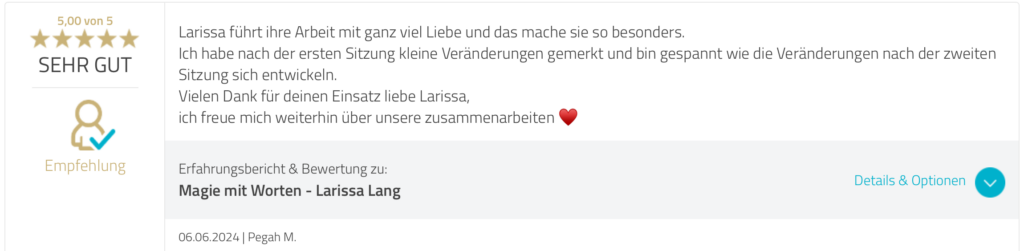
Review from a satisfied client (on Proven Expert)
Larissa conducts her work with a lot of love and that is what makes her so special.
I noticed small changes after the first session and I am curious to see how the changes will develop after the second session.
Thank you very much for your commitment, dear Larissa,
I look forward to working with you further ♥️
Pegah M.
Satisfied client
Appointment booking
- Click on “Done” after booking.
Book your next appointment within approx. 2 weeks.
You get:

Am I the right one for you (or your furry friend)?
You are in the right place with me when:
- You are ready to change yourself and your life
- You *don't* want to carry on as before
- You finally want to lead a free, self-determined and carefree life
- You take the initiative for change
- You want support from me
- You view hypnosis, quantum work & animal communication as tools that support you and your animal on your journey
- You are looking for support for your whole family (including animals)
- You participate in winter sports, are a martial artist, or practice a sport with your animal.
- You participate in a sport with your animal and would like support in doing so.
- You have a child who loves sports and needs support in this area.
You are in the wrong place with me when:
- You *don't* want to follow my suggestions for action
- You think that I will do the work for you
- You love to stay in your comfort zone
- You are looking for an excuse / proof that you are a hopeless case
- You want to prove to me that hypnosis doesn't work
- You have no trust in my methods and in me / to me
- You expect a result within a few seconds
- You want to stop smoking and / or lose weight
- You are an athlete in a field other than winter sports, martial arts, or sports involving animals (e.g., competitive riding)
- You identify yourself as a dog, etc., and now want to communicate with animals, for example.
Hey, I am Larissa
Coach for humans and animals
Hypnotist, quantum worker, animal communicator and coach for humans and animals.
I love non-fiction and specialist books, as well as psychology and spirituality.
I think that every child should have a carefree childhood. I want to support families (especially children and animals) to rediscover their own resources (which are in each of us) and thus enable a free and carefree life. It’s not that difficult.
I have been interested in hypnosis etc. since the age of 12 and have therefore read a lot about it in books, listened to podcasts and watched videos. Even in languages that I don’t even come close to understanding. So I decided back in 2015 that I wanted to help (especially families and animals).
What makes me unique
Continuous further training in various areas
Both subject-specific and non-subject-specific
Individual, goal-oriented work and no schema F or simply reading off scripts
In terms of age, I can understand children even better than someone who has been out of school for over 40 years
I work across disciplines and combine different approaches for maximum results
(hypnosis and animal communication, hypnosis and quantum work, quantum work and animal communication etc.)
I have enjoyed many comprehensive and high-quality training courses
I always want to find the best solution for you individually
I have specialized in families (with fur noses), surrogate work for animals and spiritual hypnosis and therefore don’t do everything.
For example, I don’t do quit smoking and / or weight loss…!
I have experienced hypnosis and quantum work for myself and am in a constant process of development and am continuously working on myself (also with the help of hypnosis, quantum work etc.) in order to be able to support you in the best possible way
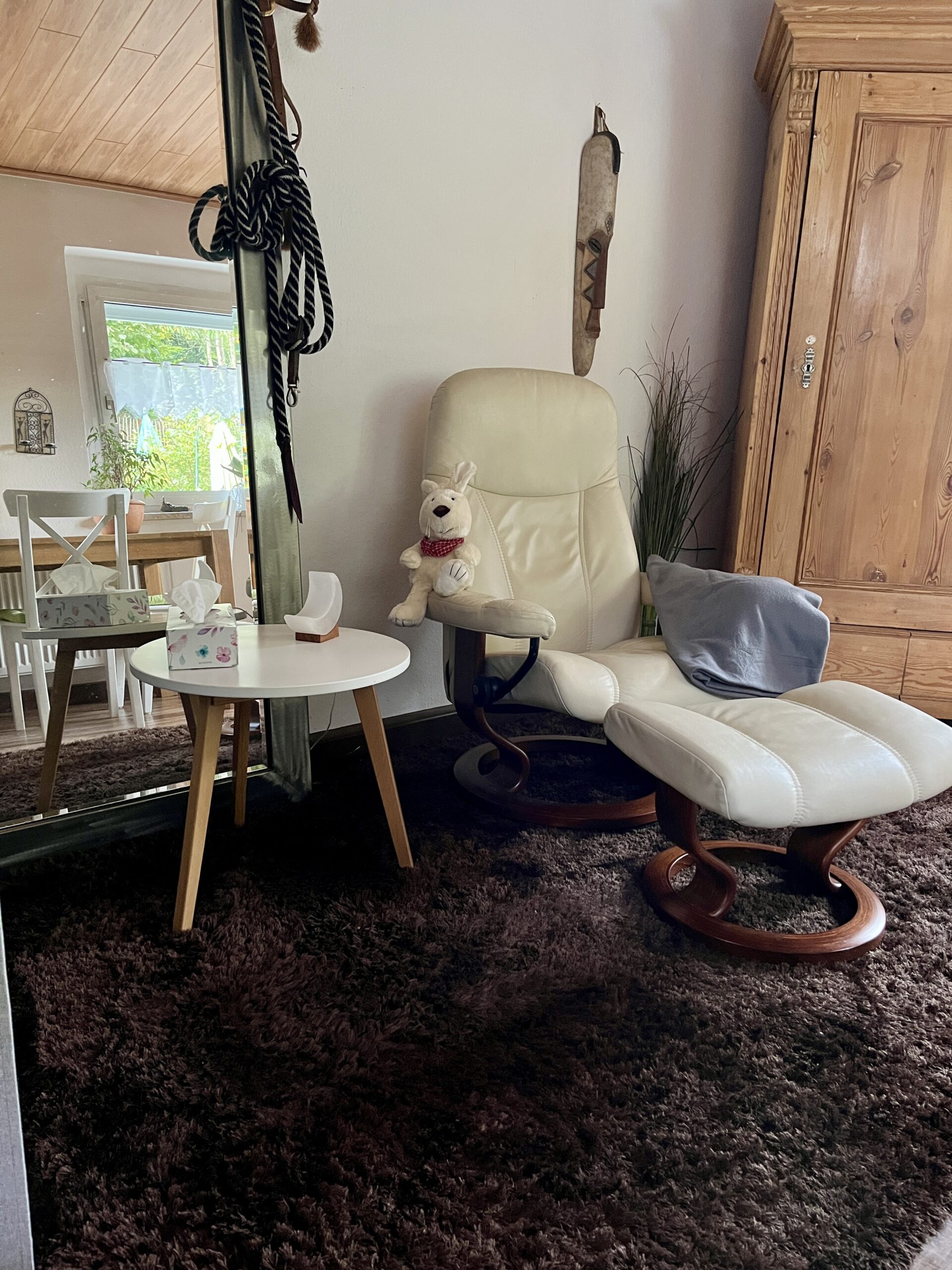
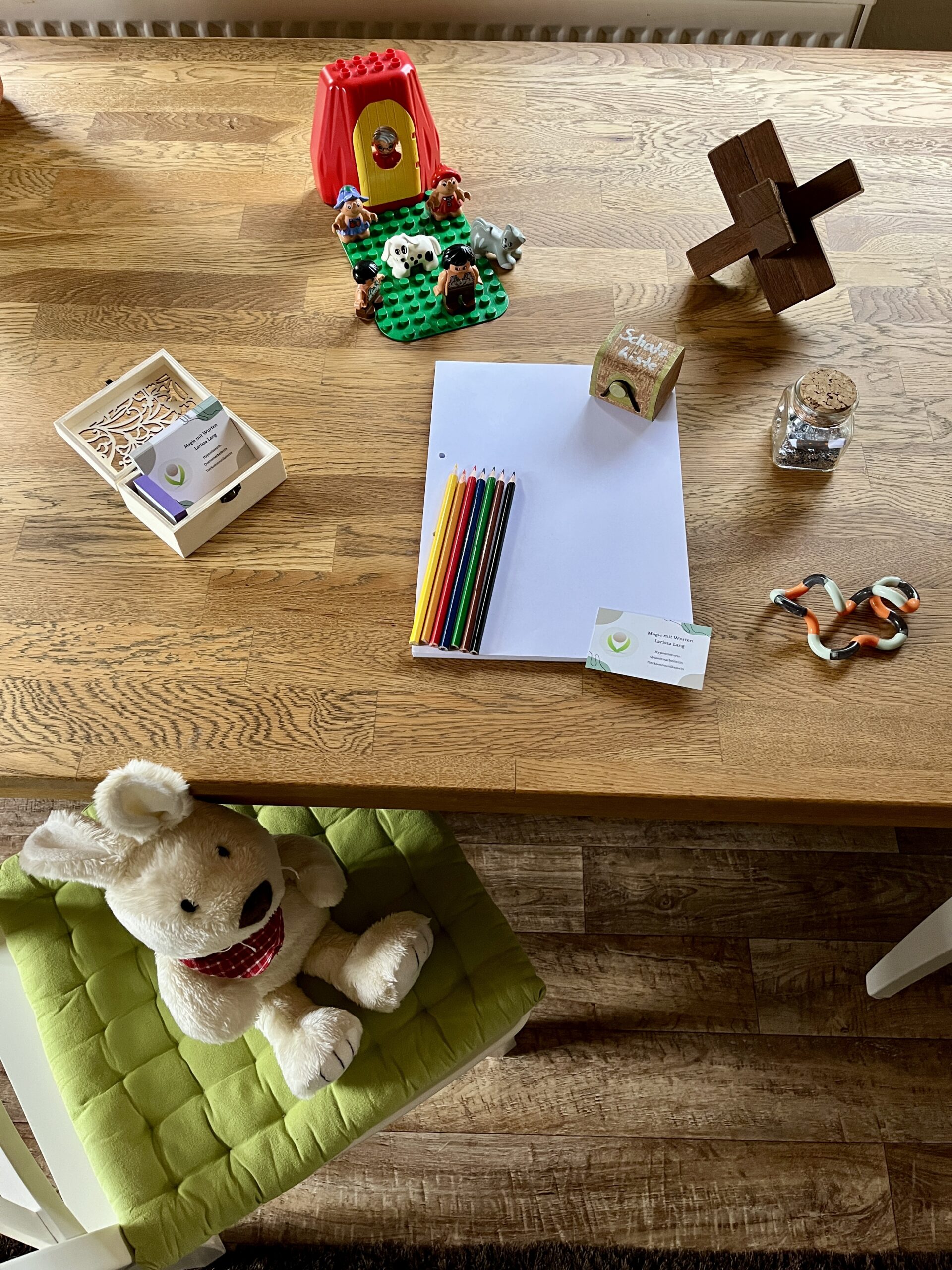
Photos from the practice
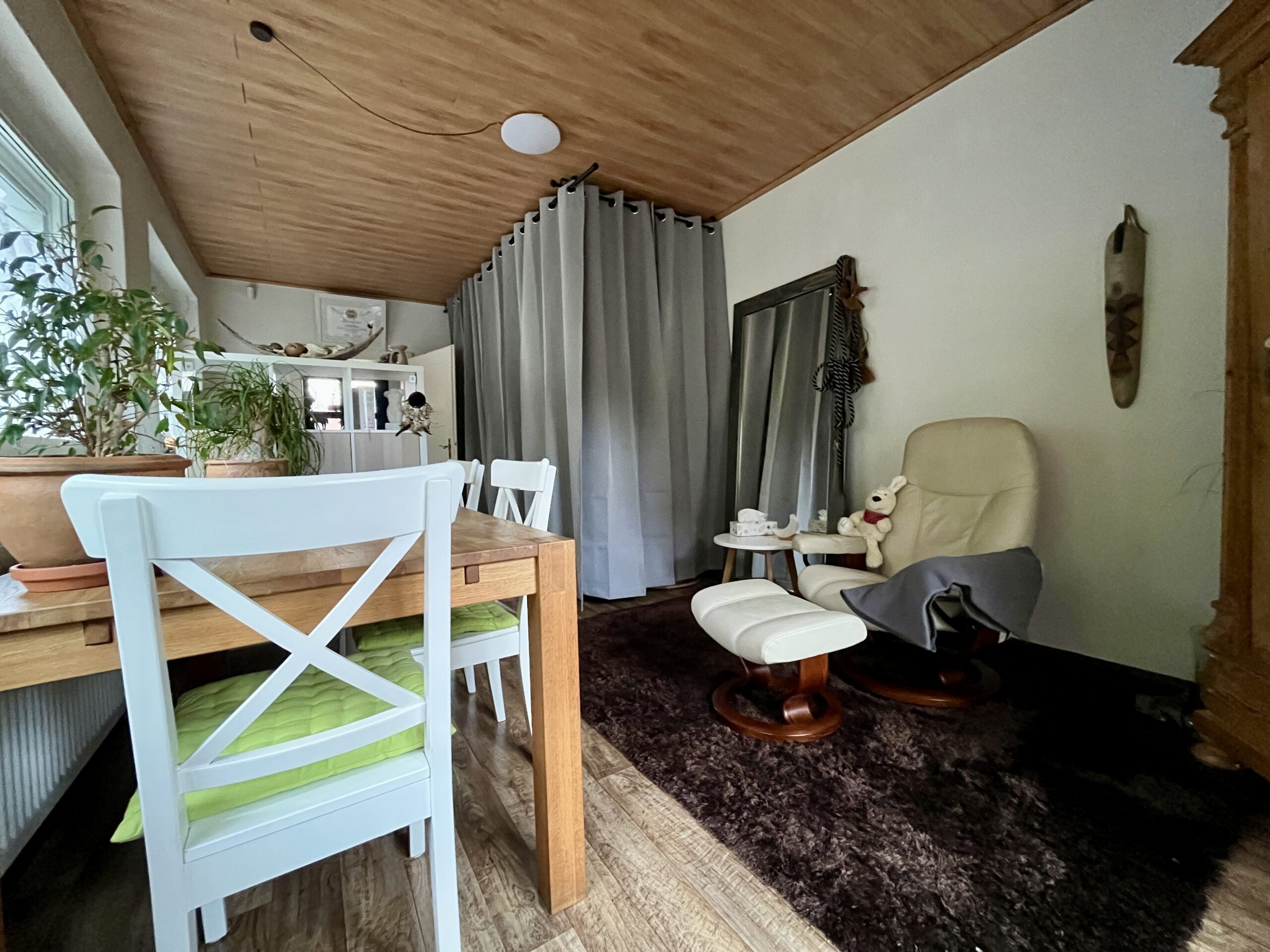
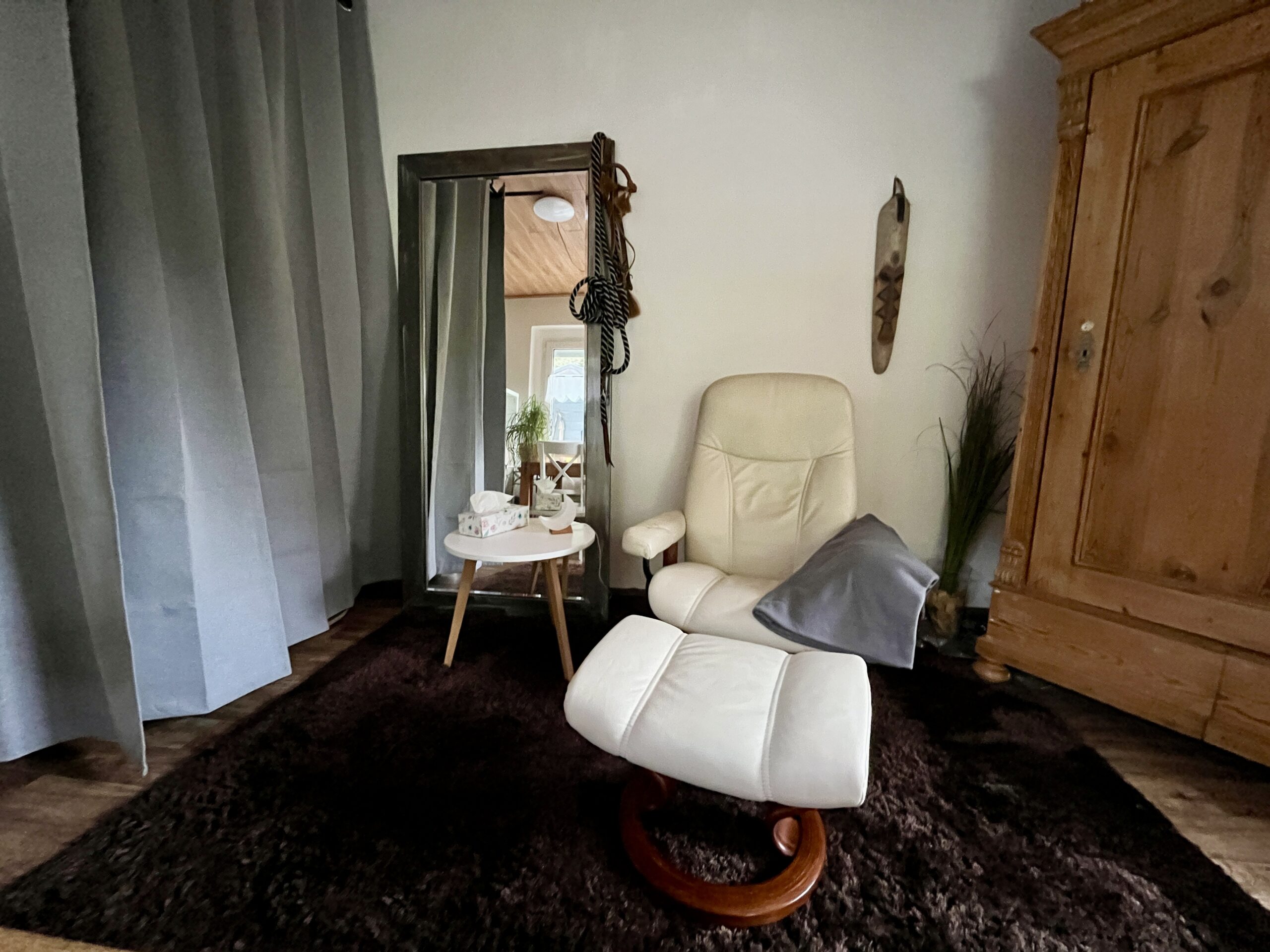
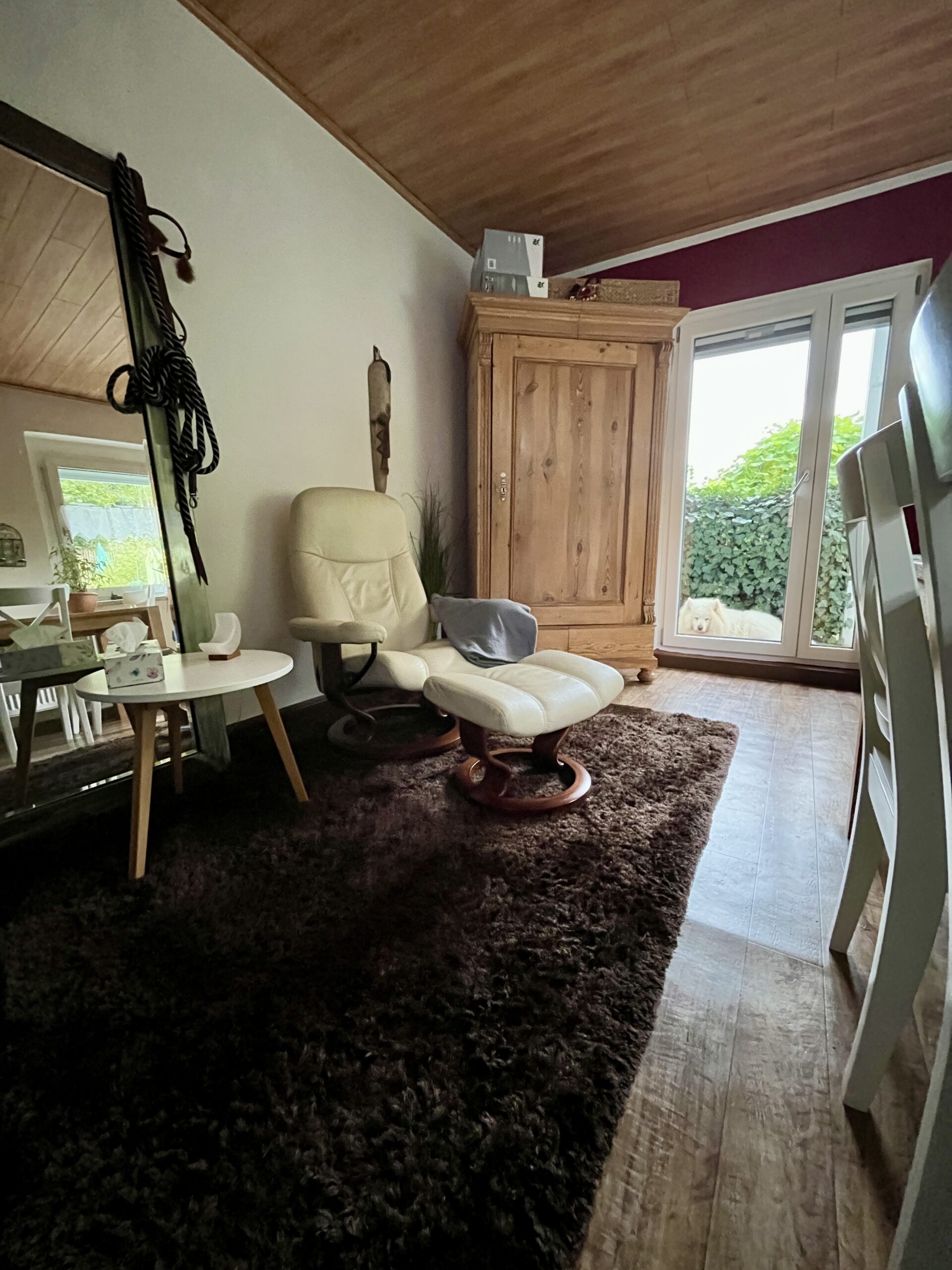
Video from the creator of the Simpson Protocol
If you can’t watch the video right now, here is what Ines says in the video: „Hi, I’m Ines Simpson. Creator of the Simpson Protocol. And I just wanted to explain something to you about the practitioner that’s on this website. Is a very proficient example of Simpson Protocol expert. Because they’re what we call a certified Simpson Protocol practitioner. Which means that they have taken the course. Not just taken the course. They have mentored with me to make sure they got absolute experts. So consider that hypnosis is a tool. And hypnosis is something we use to allow you to get attached to your parts of your mind that are not your conscious mind. So the whole part of you. Including what we call the superconscious. Which is the part of you that knows everything about yourself and how to change what you need to change or want to change. So certified practitioner of Simpson Protocol knows every aspect of this tool. So you are in great hands. As we say they’re experts in this field.”
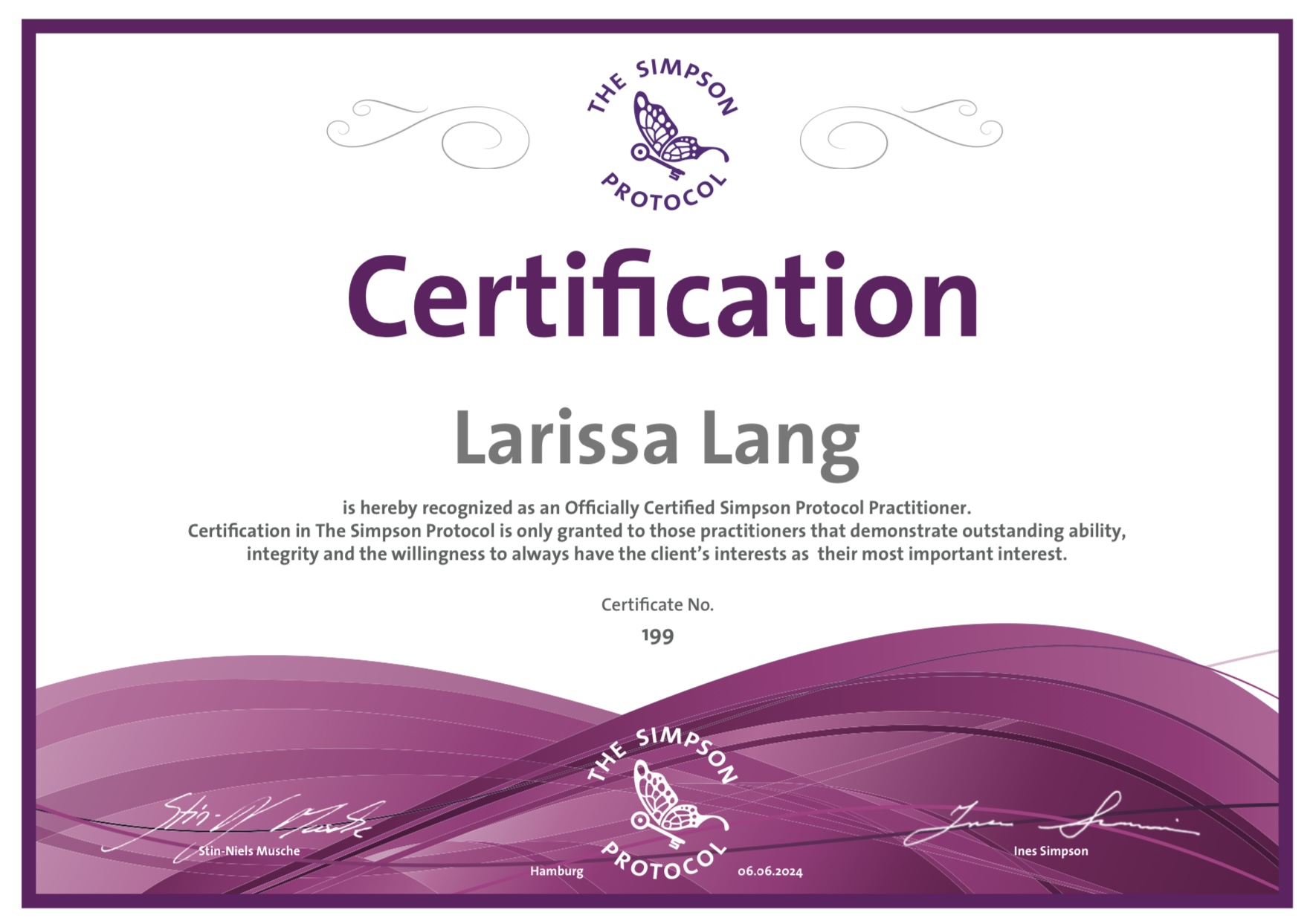
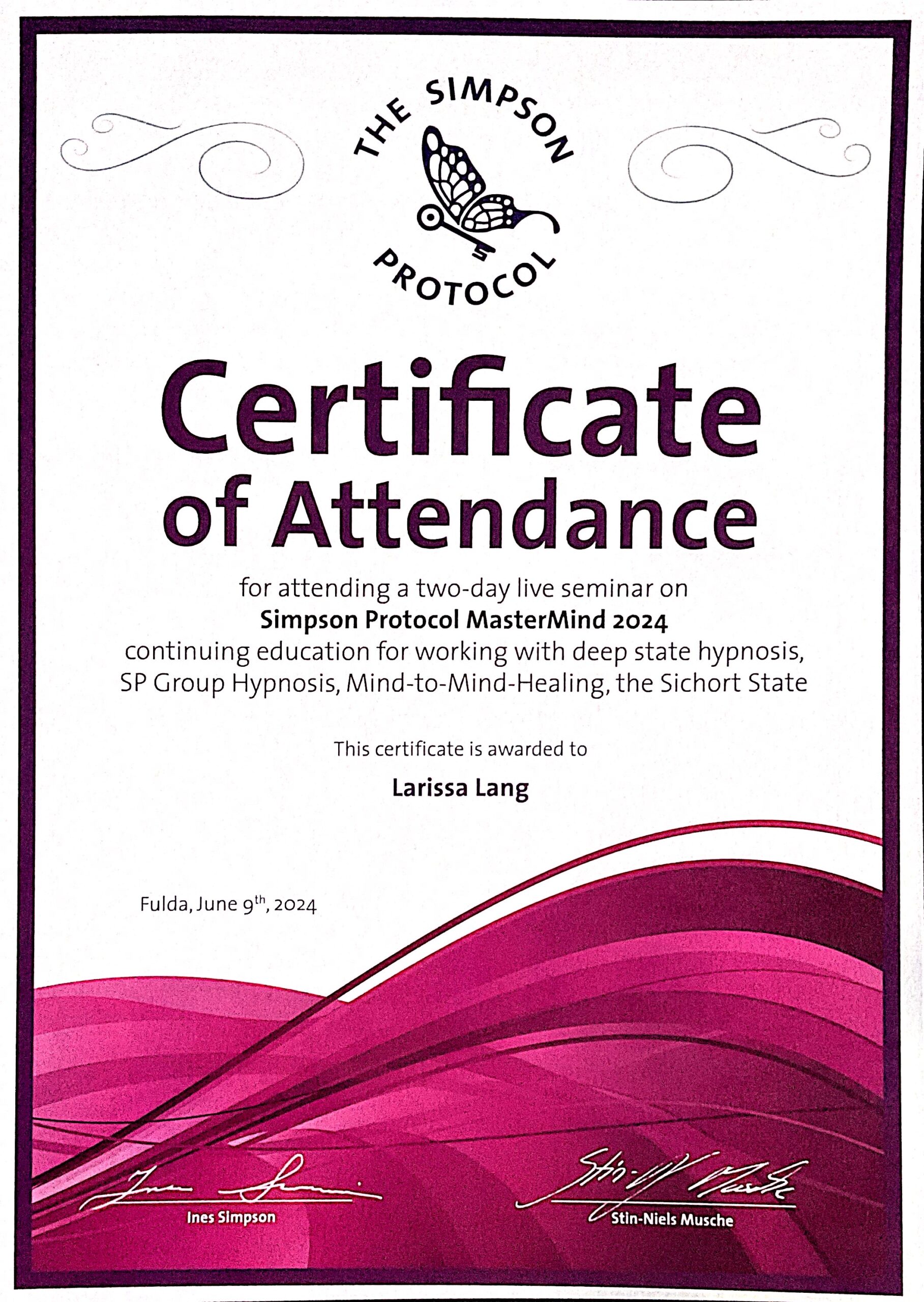
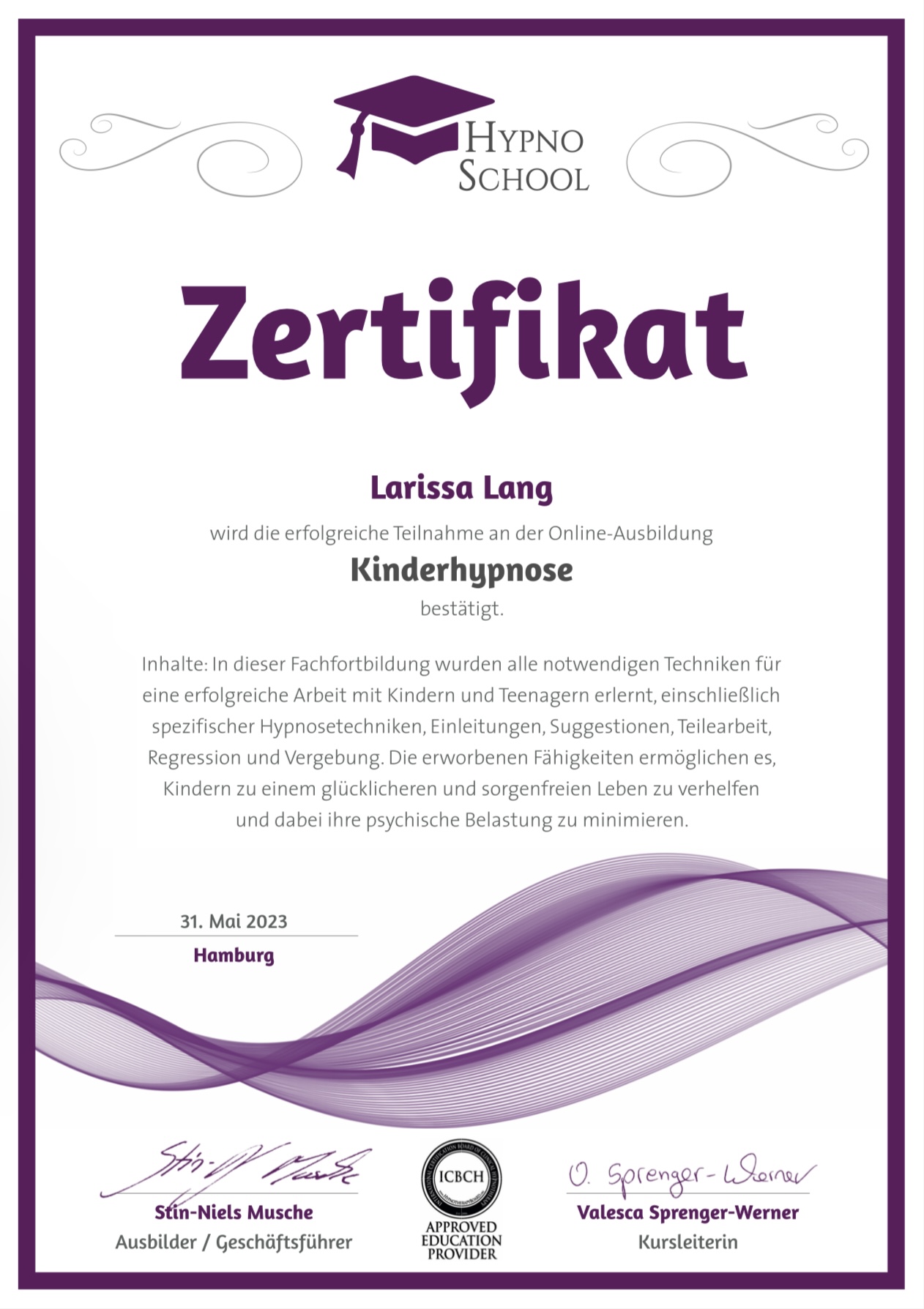
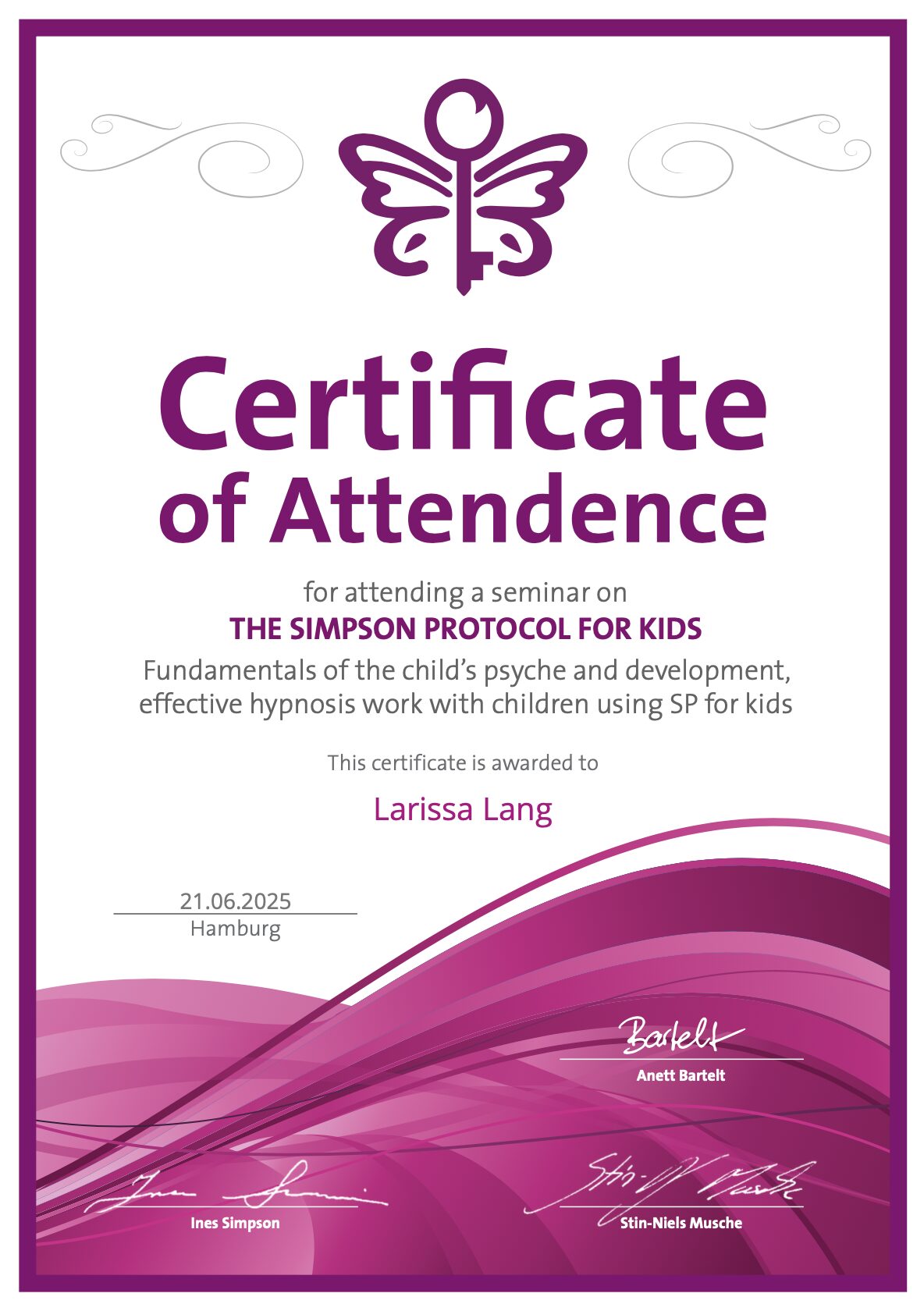
My certificates

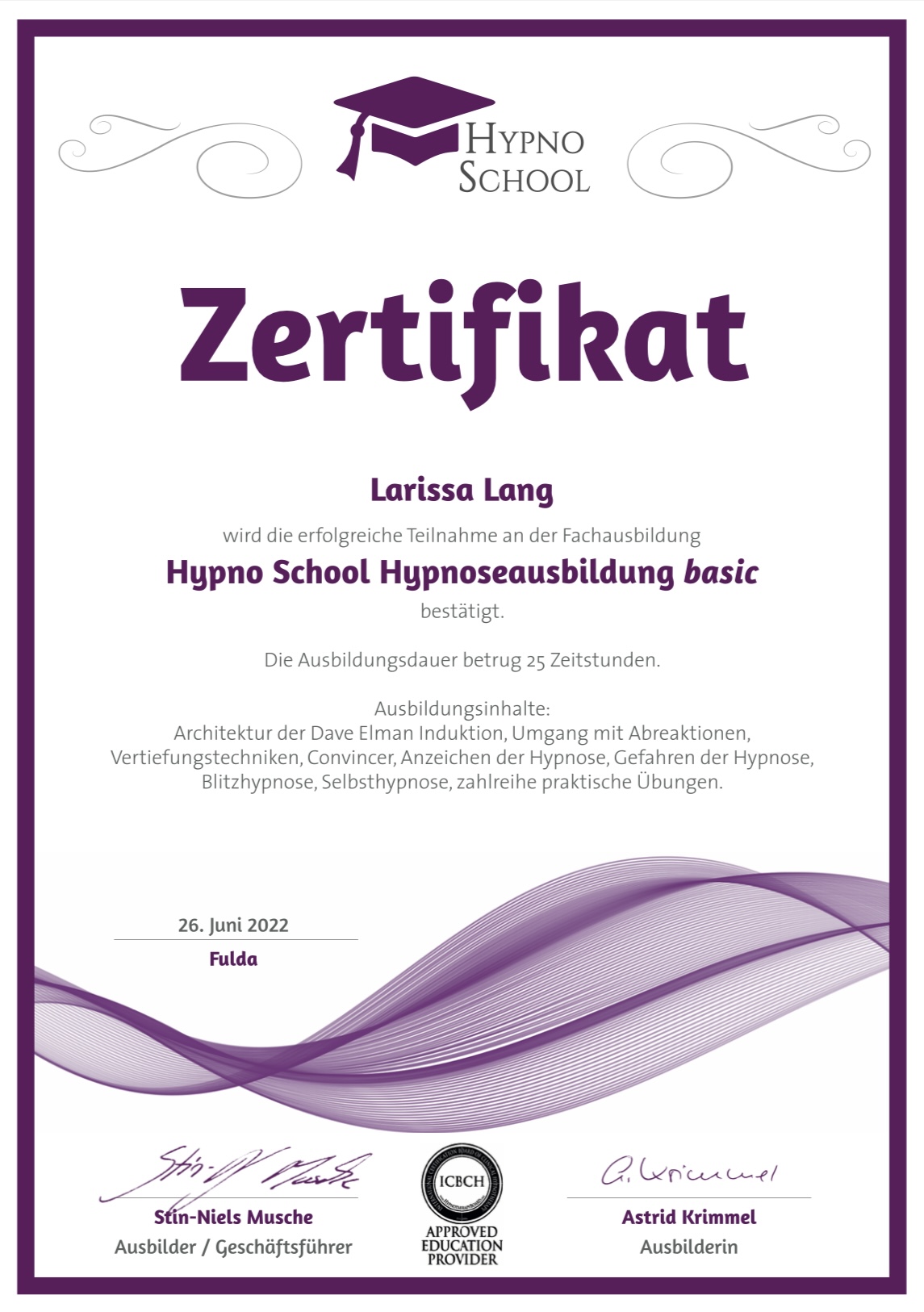



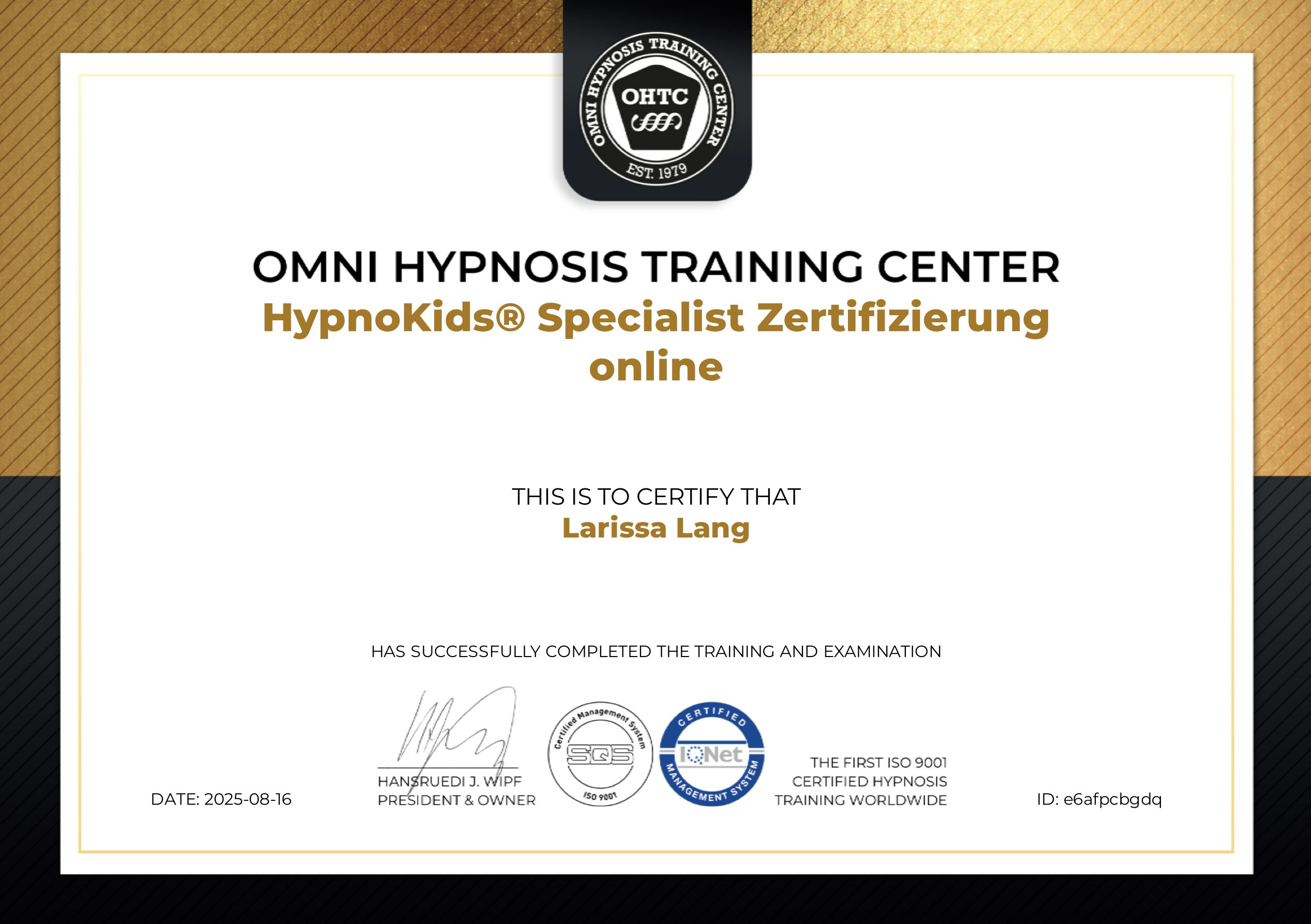
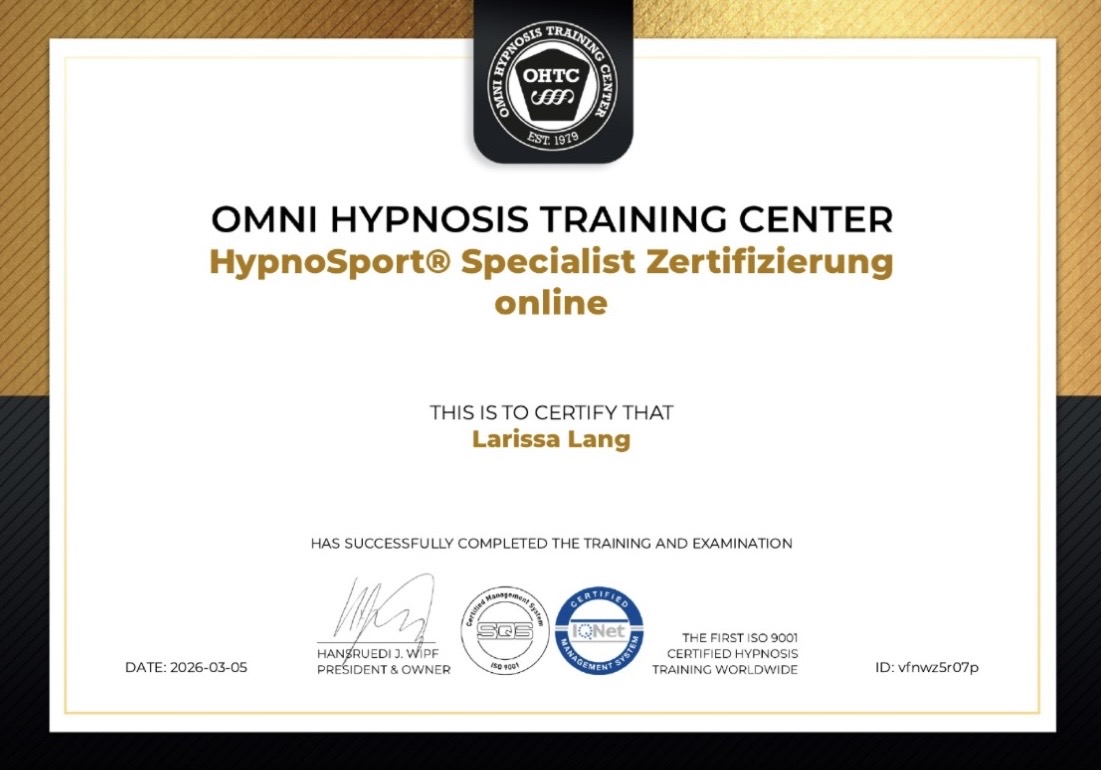
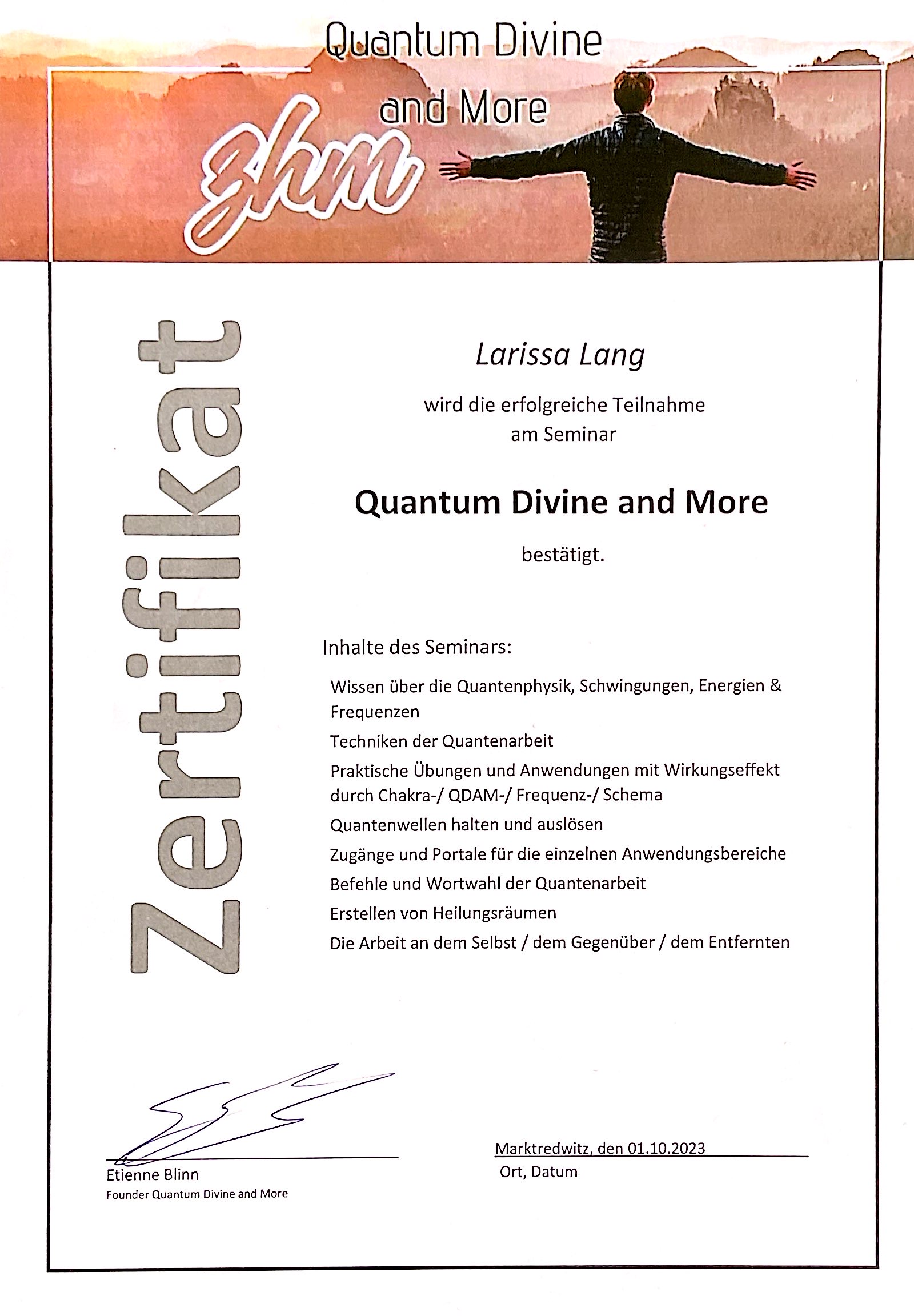
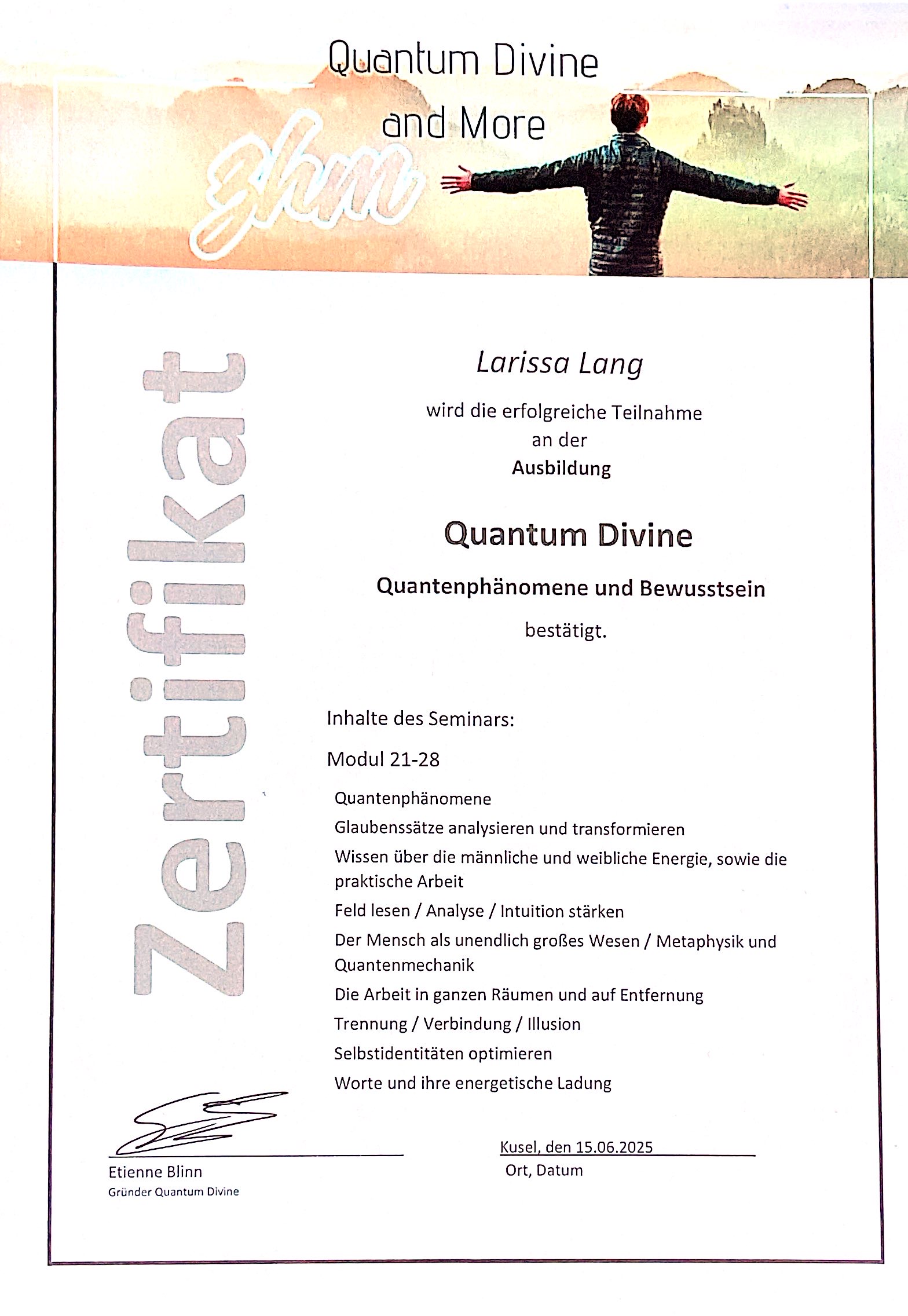
Brief overview of hypnosis
Online session
- Just as effective as an in-person, on-site session (if not even more effective).
Advantages of an online session:
- Safe environment
- Familiar surroundings
- No access route
- Certainty that the goal is still reached when you are at home
- Possible from every where
- Children online session possible from about elementary school onwards
Needed:
- PC / laptop (optional cell phone or tablet) with camera (clean!), microphone and speakers
- Optional: headset
- Zoom installed
- External power supply for the device
- Enough light
- Optional: blanket or pillow
- Peace
What is hypnosis?
Definition:
- Relaxation
- Increased attention
- More control than without hypnosis
Terms:
- Suggestion => offer (suggestion)
- Word „sleep“ => Command for the brain, to act like asleep
Other:
- Even science hastn’t managed to find a definition
- Hypnosis is nevertheless an approved method
Montessori and hypnosis
“Help me to help myself.”; “Help me to do it myself.”
This is the motto of Montessori education. This could just as well be the motto for working with hypnosis. Why?
- You always help yourself
- The solution is already within you (in the client)
- As a hypnotist, I am the “tour guide”, so to speak
- Hypnosis is only the supporting tool for the change
- I’ll give you the help you need to be able to solve your problems yourself
Prejudices, myths, beliefs
To better understand the individual myths, read the respective texts in detail.
Hypnotic gaze (like Mowgli’s snake Ka from the Jungle Book):
Movies and TV… It doesn’t exist in real life. (But you can do an induction in a similar way -> mirror neurons are used)
Hypnosis necessarily requires a pendulum or a pocket watch:
Hypnosis also works without a pendulum or pocket watch (it is mostly used for show purposes to live up to the cliché, i.e. for fun)
Telling secrets:
If you would tell me without hypnosis, yes, otherwise not. You can also lie or deliberately conceal something in hypnosis.
Being without will:
No, you are always in control and with hypnosis even more so (by accessing your subconscious etc.)
Manipulation:
Nope, manipulation can be found in magic, physiotherapy, etc. Nothing is manipulated in hypnosis…
Being away:
You are not asleep or fainting, you just have your eyes closed and may feel (hypnosis feels different for everyone) a little different than usual (I can tell if you are really in hypnosis or just playing it… 😉)
No memory of what happened:
You can remember everything if you want (yes, there is the forgetting suggestion in show hypnosis, but it is always limited in time and the person allows it)
Getting stuck:
Self-selected state into which you have brought yourself (with the help and guidance of the hypnotist), therefore you could also end it yourself (interrupt focused attention) + In the entire history of hypnosis, no one has ever gotten stuck (if you want to know where this prejudice comes from, you can do that in the long part -> just scroll down)
Hypnosis is magic or supernatural:
No, it is not. It is neither magic nor something supernatural. It has been scientifically examined and proven several times that it can help.
Occultism:
Hypnosis also has nothing to do with the occultism. This assumption comes from the portrayal of hypnosis in films and television. However, this often does not correspond to reality.
Under hypnosis:
You are not UNDER hypnosis, but IN hypnosis. Under = NO control (you have even more control with hypnosis than without) and in = in a relaxation (you don’t say I’m under a relaxation)
Hypnosis is dangerous:
How dangerous is communication? Hypnosis is just as “dangerous” as communication… However, if you have no idea what you are doing, then hypnosis can be “dangerous”.
Evoking false memories:
Yes, it is possible, but this is only the case if you are poorly trained and don’t know what to look for when asking questions. (right: Ask open questions, wrong: closed questions. Example: Open question: Where are you? Closed question: Is it raining or is the sun shining? -> Cloudy, snow etc. is therefore not an answer). Incidentally, I learned in my trainings which questions to ask and how etc.
Only weak / easily influenced people can be hypnotised:
No, that is not the case. In principle, anyone who wants to can be hypnotised.
Hypnosis is only for psychological problems:
No, it can also help with physical problems, as most of these are related to the psyche (Psychosomatics). Acute treatment with hypnosis is also possible under certain circumstances (-> emergency hypnosis; e.g. to reduce swelling, pain, bleeding etc. => please only with a doctor).
PS: If you do not want to do something, please tell me (also during hypnosis), this is the only way I can react.
How does hypnosis work?
Very good! 😉
Just kidding!
So, we use the neuroplasticity of our brain and create a change by using a cognitive restructuring through hypnosis, e.g. through guided imagery 😉
You can find out exactly what that means, when you click on the button below for the long version.
Show hypnosis vs. change hypnosis
Hypnosis is basically hypnosis. Difference: What happens and what is done
Show hypnosis:
- Pure entertainment
- The people on stage are willing to do things that they would not otherwise do
Change hypnosis:
- Working on problems
- Always being treated with respect
- Without spectators (only client and hypnotist)
- Only do things that you want to do (and are good for you and NOT for entertainment)
- Do not do embarrassing things or ” tell secrets ” (unless you would also tell the secrets without hypnosis, in which case hypnosis acts as a catalyst)
Hypnosis session process
- Contact / booking an appointment
- (Admission interview) Admission form
- Preliminary discussion
- Induction
- Deepening
- Work
- Exduction
- Follow-up discussion / explanation
- (Follow-up session)
Regression
To understand the writing here I would suggest that you read the text in the long version (you can find this on the page; click on the button below the text).
- Search for the ISE (Initial Sensitising Event) so the trigger
- ISE usually occurs in early childhood
- -> “But I had a nice childhood, there was nothing…!” =>ISE can be something quite banal
- ISE occurs when the young child’s subconscious evaluates a situation “incorrectly”
- SSEs (secondary sensitising events) occur when a similar event is stored incorrectly “on top” of the first incorrectly stored event
- Comparable to dandelions, which are only mowed over until they are pulled out by the root
- Three checks are carried out to ensure that it really is the ISE
- Since our brain cannot really distinguish whether something is real or if it is happening during hypnosis, the ISE can be re-evaluated during a session and is thus neutralised
- -> But I can’t remember my childhood… => You don’t have to, your brain or your subconscious has recorded everything and with remembrance work we can get there
- During the session: Spontaneous answers
- Logic = mind -> The consciousness has no plan, otherwise you wouldn’t have the problem
- What if the cause is not in my childhood after all, but perhaps in a previous life or i slide into a previous live? -> No problem, I am also trained in spiritual hypnosis, so I know how to deal with it
Brief overview of Simpson Protocol Hypnosis
What is Simpson Protocol
Please read the long text (you can find this on the page; click on the button below the text), thank you!
- A holistic hypnosis method
- Working with the conscious, subconscious, body, mind and spirit through the superconscious mind
- Working with the superconscious mind instead of the subconscious mind
- Superconscious mind knows everything (but does not always respond to everything if you as the client block it)
- Comparable to Akashic records, divine consciousness, morphogenetic field or collective unconscious / subconscious according to Carl Gustav Jung
- Works on a physical, mental and spiritual level (and even beyond)
The Simpson Protocol is “like walking through a labyrinth, guided only by the flickering light of your own inner wisdom”
Advantages and uniquenesses Simpson Protocol
Advantages:
- Fast
- Flexible
- Efficient
- Holistic
- Less work for clients
- Less exhausting than “conventional” techniques
- Always the right goal is adressed (which is the most “acute” / present etc.)
- By working with the superconscious, access to all relevant information
- Topic does not have to be said => no judgment of the client
- Tearless procedure
Uniqueness:
- Holistic procedure
- Working with the body, mind and soul, as well as the conscious, subconscious and superconscious mind
- Only the goal needs to be clear, the problem does not need to be defined
- Klient does not have to (if he / she does not want to) talk about the matter
- Without judgment of the hypnotist towards the client
- Tear less / free
How does the Simpson Protocol work?
Very good! 😉
No, of course I’m only joking…
Please read the long text (you can find this on the page; click on the button below the text), thank you!
- Basic understanding of hypnosis necessary: How does hypnosis work?
- Comparable to a snow globe that you shake and the snowflakes fly around (you can read in detail what this means here)
- Work with the help of the superconscious instead of the subconscious
- Superconscious knows everything (but does not always respond to everything if you as the client block this)
- Comparable to Akashic Chronicle, divine consciousness, morphogenetic field or collective unconscious / subconscious according to Carl Gustav Jung
- Works on a physical, mental and spiritual level (and even above and beyond that)
The Simpson Protocol is “like wandering through a labyrinth, guided only by the flickering light of your own inner wisdom”.
Simpson Protocol Process
- The more you think about everything, the worse the session becomes
- It’s about feeling and not thinking
- The basic procedure is the same as for a “normal” hypnosis session
- Nevertheless, there are a few differences (adaptations e.g. to the Simpson Protocol)
Preliminary talk:
- Normal, as usual
- With “adapted” addition (but this is also the case with the different techniques in “normal” hypnosis)
Induction:
- Normal, as usual
- Exception: Follow-up session -> code words (from the first session, if the superconscious has allowed the code words to be programmed in)
Deepening:
- Normal, as usual
- Exception: follow-up session (code words)
Work:
- Simpson Protocol Process
- Parking the consciousness in a nice place
- “Handing over” the arm / hand to the superconscious (you are still in control, you just get a nice little extra support)
- Installation of the finger signals (one finger is for yes and one is for no -> the superconscious determines which one is which)
- Second session: this part is already done, so we skip the parking of the consciousness, the installation process of the finger signals etc.
- Actual work (working on the goal)
Exduction:
- Normal, as usual
- Mostly emergence from hypnosis by “instruction” to emerge yourself
Epigenetic
1. Genetics vs. epigenetics
- Genetics ≠ Epigenetics
Epigenetics:
- Cells remember the environmental influences we are exposed to in the course of our lives, consequences of our lifestyle, experiences of our ancestors, experiences from the time around our birth (from conception to the present day), etc.
- Regulates (in addition to genetics) which genes are active – influenced by environment, nutrition, stress, experiences, etc.
- Can change constantly (through our lifestyle, what we consume, etc.)
Genetics:
- Deals with our genetic material
- Determines whether we have blue or green eyes, for example
- Hereditary
2. Cell memory & transgenerational imprinting
- Cells store environmental influences, lifestyle and even experiences of our ancestors
- Perinatal imprinting: Events in the womb and in the first years of life shape health, personality and stress resistance for life
- Epigenetic changes can be passed down through generations (e.g. consequences of maternal stress or nutrition)
3. Control of genes through lifestyle
- Nutrition: micronutrients (e.g. folic acid, vitamin B12, zinc, etc.) influence DNA methylation and gene activity
- Stress: chronic stress alters gene expression (e.g. through cortisol – stress hormone), weakens the immune system and can damage brain structures
- Positive influences: Loving bonds, relaxation and a healthy lifestyle can prevent and partially reverse harmful epigenetic patterns
4. Epigenetics & hypnosis
- Experiences in childhood leave epigenetic traces (e.g. in the hippocampus)
- Hypnosis & meditation: Can positively influence gene expression (e.g. activation of “longevity genes” or self-healing processes)
5. Practical consequences
- Resilience can be strengthened through early bonding experiences and stress management
- Prevention: A healthy diet, avoiding toxins and mental health have an impact on future generations
- Potential: Epigenetic changes are partly reversible – “good genes” can be activated through a conscious lifestyle
Surrogate work
- Work through a surrogate on someone else (with their permission, if possible)
- Work with babies, small children and older people possible
- Work with animals possible
- Distance is no obstacle
- Working with the superconscious
- Principle similar to systemic family constellations, energetic work or quantum work
- Superconscious is comparable to the morphic field (Dr. Rupert Sheldrake) / collective unconscious or subconscious (Carl Gustav Jung) / divine consciousness etc. -> In principle, working with gut feeling
- The superconscious has all the information (which is necessary and can also give permission to work)
- E.g. mother’s superconscious connects with the superconscious of her baby
- Or the superconscious of the owner of the animal connects with the superconscious of the animal
Surrogate work for an animal
- For unexplained physical issues (previously clarified by a veterinarian and / or veterinary practitioner)
- For behavioural problems (previously clarified)
- For other problems
- Implementation by Simpson protocol (hypnosis)
- Works great because you as the owner have a very strong bond with your pet
- It is best if an animal communication (living animal) has taken place beforehand
- ONLY possible with living animals!
Simpson Protocol for Kids
- SPK (Simpson Protocol for children) is based on Simpson Protocol (for adults)
- More information about the Simpson Protocol
- SPK adapts to children (not the other way around)
- Suitable for children aged approx. 5-10 year olds (exceptions possible)
- Child-friendly time frame and words
- Easy for children to understand by immersing them in a fantasy world and working with the child’s superhero
- Instead of working with the superconscious, we work with the superhero
- The child does not have to be able to describe exactly what they no longer want
- The child responds with yes or no, e.g. by shaking their head / nodding or using other yes / no signals, which are determined in advance by the child
Brief overview of sport hypnosis
Brief overview of child hypnosis
Child hypnosis generally
- Possible from approx. 5 years (for younger children via surrogate work)
- Online from approx. preschool / elementary school
- Advantage: Problems / issues are not taken into the future and do not lead to further problems
- Very effective at a young age
- Every child reacts differently to hypnosis (just like adults)
- Important! -> It is not the age of the child that is decisive, but the (linguistic and mental) development of the child
Child hypnosis session process
- Contact / booking a get to know me meeting / booking an appointment
- (Admission interview) Admission form
- Preliminary talk (together with parents)
- Induction (without parents)
- Consolidation (without parents)
- Work (without parents)
- Exduction (without parents)
- Follow-up consultation (with parents)
- (Follow-up session) (without parents)
Worth knowing child hypnosis
- The Critical Factor (CF), which can distinguish reality from fiction, does not develop until around the age of 5 (-> constant hypnosis, i.e. words, sentences etc. that are said to the child act like suggestions… both positive and negative).
- From around the age of 12, the CF is fully mature
- Until the age of 13, the child is energetically connected to the mother (this is where mirror issues come from)
- Mirror issues -> (mostly unnoticed) issues of the parents, which the child then shows (which dissolve when the parents have addressed their issues)
Brief overview of quantum work
What is quantum work?
- Based on quantum physics
- QDAM (Quantum Divine and More; i.e. the technique I use) is basically a state of consciousness
- Everyone is energy with consciousness and information (like everything we know or don’t know)
- Atoms = 99.999999999% nothing
- Rest electrons, neutrons and protons = 99.999999999% nothing
- Rest of quarks (plural of quanta) = 99.999999999% nothing
- -> Matter consists of 0.000000001% nothing and is therefore almost never there
- => Quantum work works with the 0.000000001%
- Everything consists of vibration
- Life would not be possible without vibration
- Atom = vibrating, energized, information-bearing something
- -> Low vibration adapts to high vibration, or goes (e.g. out of the room etc.)
- => You are the average of the 5 people you surround yourself with the most. – Jim Rohn
How does quantum work work?
Very good! 😉
Just kidding!
- Difficult to describe, so please watch the video ( More Videos where I demonstrate the quantum work )
- Technique shown in the video: slide controls (what I do behind Etienne’s back)
- The reaction to the collapse of the quantum wave is to sway (forwards or backwards) with e.g. falling over or lunging backwards
To really understand how the quantum work works, please read the text I wrote by long (you can find this on the page; click on the button below the text).
Quantum work process
- Contact / Appointment booking
- (Initial consultation) Intake form
- Preliminary discussion
- Work, e.g.:
– Chakra work
– Belief system work
– Frequency work
– Energy field work
– Time travel work
– Forgiveness work
– And much more - Follow-up discussion
- Follow-up appointment(s)
Quantum work surrogate
- Work through a representative on someone else (with their permission, where possible)
- Work with babies, toddlers, and elderly people possible
- Work with animals possible
- Distance is not an obstacle
- Principle similar to systemic family constellations, energy work, or representatives using the Simpson Protocol
- The quantum field is comparable to the morphic field (Dr. Rupert Sheldrake) / collective unconscious or subconscious (Carl Gustav Jung) / divine consciousness, etc. -> In principle, working with gut feeling
- The quantum field has all the information (that is necessary and can also grant permission to work)
- Example: Mother connects with her baby’s quantum field
- Or the owner of the animal connects with the animal’s quantum field
Quantum work for animals
- For unexplained physical issues (which have been clarified beforehand by a veterinarian and / or animal naturopath)
- For behavioral issues (clarified beforehand)
- For other problems
- Performed with the help of surrogate work via your animal’s quantum field
- Works great because you, as the owner, have a very strong bond with your animal
- It is best if animal communication (living animal) has taken place beforehand
- Only possible with animals that are still alive!
Brief overview of animal communication
What is animal communication?
- Short AC
- Telepathic communication with animals
- Through thoughts / feelings / emotions / images
- Tele = distance (Greek)
- Pathos = feeling, experience, initiation (Greek)
Requirements animal communication
- Consent of the owner
- Name of the animal (no nickname)
- Current picture of the animal (where it looks best into the camera and is fully visible => You can find an example image below)
- Ideally also a photo of you as the owner (preferably current and where you are looking into the camera)
- Specific and concise questions (no question in the question)
How does animal communication work?
Very good! 😉
Just kidding!
Telepathically through:
- Images
- Thought
- Spoken words
- Information
- Etc.
- Not by making animal sounds at each other…
Animal communication process
- Contact / Appointment booking
- (Initial consultation) Intake form
- Preliminary discussion (if you would like to describe your situation in more detail)
- Contact with your animal
- Follow-up discussion + you receive the consultation transcript
- Follow-up contacts
Possibilities and limitations of animal communication
Possibilities:
- Farewell, Clarity & Consolation
- Conveying messages
- Insights into the emotional life of the animal and its wishes / needs
- Promoting mutual trust
- Help with blockages
- Clarifying and harmonizing conflicts
- Finding solutions
Recognizing mirror issues - Strengthening the human-animal relationship
- Detecting and understanding the causes of behavioral problems / changes
- Preparation for upcoming changes
Important: Everything in addition to veterinary treatment!
Limitations:
- Replace veterinary or medical diagnostics and treatment
- Be purely an “educational measure”
- Restrict an animal’s free will
- Make promises of healing
- Making contact with other animals without the animal owner’s permission (except for wild animals)
- Ignore the animal’s refusal to make contact (or other interventions such as energetic harmonisation)
Worth knowing animal communication
Animals can also lie (for their own protection):
- E.g. animal hurts paw
- Nothing visible on the outside
- Animal is afraid of the vet
- Therefore conceals pain
- When asked if it is in pain, it lies to avoid the vet
Mirror themes:
- The animal mirrors the owner’s behaviour (but the owner is not always aware of this)
- Animal keeps repeating a behaviour that was not there before
- Animal shows behavioural abnormalities
Average success rates
Source: Statistics from IHVV (publicly available on the Internet). American Health Magazine; Barrios, Alfred A. “Hypnotherapy: A Reappraisal,” Psychotherapy: Theory, Research and Practice, 1970
Each of these forms of therapy has its right to exist. It is not a question of disparaging any of them or anything like that. The aim is simply to show the average success rates and possibilities of the different types (hypnotherapy was carried out with scripts for better comparison. This means that everyone was read the same script and it was not individually adapted. For example, the Simpson Protocol enables the desired goal to be achieved individually).
I am also a coach and consultant. I therefore do not provide therapy, but rather coaching and consulting.
Q&A
Here you will find the most frequently asked questions and answers.
If your question is not listed here, you may find the answer on the Q&A page.
If you still cannot find the answer there, you are welcome to book an prelininary talk at any time. During this meeting, you can ask me any questions you may have. For those who are more introverted, there is of course also the option of sending me an email.
Can you make me…
Nope!… In fact, I can’t just make you… I can’t “heal” you either. If anyone can do that, it’s you. I can only guide you to do it yourself. You can find out what I mean by that here:
Important: I do not have a healing license and may not make any promises of healing.
Is hypnosis the right approach for me?
Yes, if:
- You are ready to change yourself and your life
- You *don’t* want to carry on as before
- You finally want to lead a free, self-determined and carefree life
- You take initiative for change
- You want support from me
- You see hypnosis as a tool to help you on your journey
- You are looking for support for your whole family (incl. animals) You want to follow my suggestions for action animals)
- You want to follow my suggestions for action
- You can concentrate for more than just a few minutes
- You are able to focus on what I say
- You believe (or allow yourself to believe) that hypnosis can help you
- You want to work with me on your goals
- You are not affected by a pathological intellectual disability, blindness or deafness
No, if:
- You do not fulfill the points just mentioned
Does hypnosis work?
Counter question: Does the butter knife work if it is in the drawer and then taken out to spread butter? Yes, it works… Just like hypnosis. It works when it is used. But if you don’t want the butter knife to work and deliberately try to spread butter with the handle, then it won’t work the way it’s supposed to. It’s the same with hypnosis. If you think I’m doing all the work for you, then it won’t work. But if you want to achieve your goal, it will most likely work.
If you want to know what my clients have to say about it, take a look here:
I have to believe that hypnosis works, in order for it to work, right?
No, you don’t have to believe that hypnosis works. You just have to allow it to work. As long as you are able and willing to follow my instructions, hypnosis will work. (Gravity is also there or works, even if you don’t believe in it). Hypnosis is a technical process, so you don’t have to believe in it, but it would help the process a lot.
What is the difference between the unconscious, subconscious, conscious and superconscious?
Unconscious:
- Controls bodily functions (e.g. heartbeat, digestion, blinking, etc.)
Subconscious:
- Emotions
- Feelings
- Long-term memory
- Refers to our “innermost”
- Personality
- Values
- Moral concepts
- Seat of the self-protection factor
Consciousness:
- Thinking
- Filtering of thoughts
- Conscious perception
- Mediator and filter between self and subconscious
- Works at the level of the mind
- Logical thinking
- Analytical thinking
- Rational thinking
- Willpower
- Short-term memory
- Seat of the critical factor (CF)
Superconscious:
- “Higher authority” which can “influence” everything
- Overview of everything that happens and has happened in life
- Comparable to Akashic Records, Morphogenetic Field, Divine Consciousness etc.
I am not hypnotisable!
Okay. Then I have a few questions for you, which you should answer spontaneously with yes or no (note or write down how many yeses and no’s you have), because you’ll find the answer below.
Questions:
- Can you sleep at night? Yes or no?
- Did you briefly not know where you were when you fell asleep and/or woke up? Yes or no?
- Do you sometimes daydream? Yes or no?
- Are you sometimes lost in thought? Yes or no?
- Do you sometimes watch movies and feel like you are in the middle of the action? Yes or no?
- Do you sometimes read novels, for example, and feel like you are in the middle of the action? Yes or no?
- Do you sometimes drive a car and after a few minutes no longer know whether you have really followed all the traffic rules and/or missed an exit? Yes or no?
- Can you listen to the other person during a conversation and maintain a dialog with them? Yes or no?
- At a party in a beer tent or at a party, can you concentrate only on the person who is talking to you and block out everything else around you? Yes or no?
How many questions did you answer yes to? If you answered yes to at least one of them (or more), you are most likely hypnotizable. In fact, 80-90% of all people are hypnotizable.
But there are also the 10-20% who are not hypnotizable. This is usually because they have a pathological reduction in intelligence.
The more intelligent a person is, the better they should (normally) be able to be hypnotized. People who do not go into hypnosis are usually either afraid of it or have misconceptions about hypnosis.
Hypnosis is a natural state that “occurs” several times a day (e.g. when reading an exciting book, driving a car, in the workflow, etc.)
Everyone reacts differently to hypnosis. Some need a little longer, others respond very quickly.
I am not a visual person so hypnosis doesn’t work on me, right?
You don’t have to see anything during hypnosis. Some people see images and some don’t. This is completely normal and fine. Hypnosis works even if you can’t see any images.
If you are one of those people who can’t see anything during hypnosis, you can usually still describe what is going on, e.g. by hearing, tasting or intuitively knowing things. You may also get flashes. Everything is just right the way it is.
Hypnosis is only used by spiritual people, right?
No, because hypnosis is not spiritual, but a scientifically recognized method (since 2006).
There are even celebrities who use or have used hypnosis. Here are a few of them:
- Adele
- Ben Affleck
- Courteney Cox
- Drew Barrymore
- Matt Damon
- Charlize Theron
- etc.
What does hypnosis feel like?
- Everything coming from outside is no longer so important
- Concentration on the hypnotist and the here and now (what is happening right now)
- Possibly changed feeling -> feeling of lightness (like floating), feeling of heaviness (pleasant pressure on the body, e.g. under water) or feeling of “I have my eyes closed”
- May feel different from session to session and even within a session
How do I know I am hypnotised?
- Eyelid fluttering (from top to bottom)
- Eye movements (from left to right)
- More frequent swallowing, due to increased salivation
- Gurgling / rumbling in the stomach
- Altered breathing (deeper breathing, slight moaning -> hypnotic sigh, rapid breathing, regular definite exhalation)
- Wet hands
- Increased tearing (without crying)
- (Red) spots on the skin
- Hypnotic phenomena such as catalepsy etc.
- Etc.
PS: By the way, I can determine whether you are really in hypnosis or just playing the whole thing 😉.
Can I hypnotise myself?
Yes, indeed. You can also hypnotize yourself. In fact, all hypnosis (even if it is performed by an experienced and trained hypnotist) is self-hypnosis.
But you can also hypnotize yourself (without someone else). You already do this several times a day without even knowing it. If, for example, after driving a few kilometers you have already asked yourself whether you have really obeyed the traffic rules, you have already been in a trance. You are also in a trance when watching a movie or reading a book.
Apart from the fact that you are already unconsciously hypnotizing yourself several times a day, you can also do it consciously. With the help of code words, for example, which I can give you during hypnosis. I will be happy to explain to you exactly how the code words work after our hypnosis session. Simply bring up the subject before (or after) the session. It’s best to talk about it beforehand so that I can give you the code words that are right for you.
What should I look out for when searching for the right hypnotist for me?
First and foremost, you should make sure that the chemistry is right. So if something goes against your values, it will probably also affect the hypnosis, which is why it is / would probably be better to keep looking for someone who fits better.
What can be a good indicator, but doesn’t have to be, is the training and price of the person. So pay attention to whether the person works in a cause-oriented / goal-oriented way or just reads out scripts. If someone only reads out scripts, they will charge you less than someone who works in a cause-oriented / goal-oriented way. It’s a case of what costs nothing is good for nothing and if you buy cheap, you buy twice.
PS: I was trained to be cause-oriented / goal-oriented 😉 If you don’t want to talk about your issue in detail, you can of course do that too. This is possible with the Simpson Protocol.
If you are not sure whether the person is right for you, then you usually have the option of arranging a preliminary talk / informational meeting etc. After that, you will probably be better able to decide whether it feels right for you or not.
I've been to hypnosis before (and it didn't work). Why should I trust you now or give the whole thing another chance?
If you have already tried hypnosis and it did not bring the desired results, I am sorry to hear that.
I understand your concerns. Without knowing the exact circumstances, I cannot judge what the reason was, as there are many factors that can influence the success of a session. Even with background information, it is often difficult to pinpoint the exact reason. It is always very individual, and sometimes it is impossible to recall the details because it was too long ago, etc.
I will simply list a few of the most common reasons here.
- Many hypnotists work purely suggestively. This is also a good method, I won’t deny that, but sometimes a different approach is simply needed.
Through all my training ( certificates & certifications ), I have learned about many different tools (which are goal-oriented), experienced them myself, and of course used them countless times. - It may also be that your original issue was not resolved because there was another issue that had to be addressed first/was more important at that moment.
- Perhaps it wasn’t the right time yet.
- Maybe it just needs a little time and close support.
- Occasionally, however, it may be that there was simply no good relationship of trust or that the person was not the right one for you.
I don’t want to badmouth anyone or anything here. I’m just trying to give you a few pointers so that you can make a decision.
I would be happy to answer any questions you may still have in a free, no-obligation preliminary talk and to continue supporting you afterwards, if it feels right for both of us.
How long does a hypnosis session take?
This is always different. This depends on several factors, e.g.
- Which goal is to be achieved
- Whether there are other goals that influence the actual goal
- The complexity of the goal
- How big the goal is
- etc.
Sessions usually last between 30 and 210 minutes.
Children’s sessions usually last 20 – 90 minutes.
How many sessions do I need and how long does it take for my problem to be gone?
This depends on many different factors, e.g:
- Which goal is being tackled
- How long this goal has been in place
- Whether there are other goals that reinforce the actual goal (you don’t have to consciously know or be able to identify this)
- Whether you are really willing to change (or whether you think you don’t have to do anything for it => this is not the case, by the way, you “have” to be actively involved!)
- etc. pp.
I promise you that I will only do as many sessions with you as necessary.
Exactly how long it takes for your problem to be completely resolved depends on the factors I have just mentioned. In most cases, changes can be clearly seen after the third session. However, this varies from person to person.
If the Simpson Protocol is used, it may be that the necessary goals are tackled first and you may not notice the change at first.
It is best to ask or ask those around you to give you feedback if they notice changes that you have not yet noticed (as this can sometimes be a gradual process).
Can I do something wrong?
You can’t really do anything wrong during hypnosis. As long as you are ready for change and follow my suggestions for achieving your goals, we can achieve great things together.
The only thing you can do “wrong” is that you don’t prepare yourself properly (i.e. you don’t go through the information from the client area) and thus resist the change due to possibly false beliefs about hypnosis or other counterproductive influencing factors.
Please also read the point What should I pay attention to before and after my session? You will find further important information for you there.
Are there any risks and / or contraindications associated with hypnosis?
Yes, there are “dangers” with hypnosis and I deliberately put the word in quotation marks. Why? Because these risks only occur when hypnosis is performed by someone who does not know what he or she is doing. Professional hypnosis training teaches you how to deal with abreactions and prevent re-traumatization.
PS: I learned this in my training courses.
„Dangers”:
- Abreactions
- Retraumatization
- => This happens if someone has not undergone any in-depth training and has no idea what they are doing or should be doing -> Therefore, always check whether the person has any idea of the subject matter
PS: During my training, I learned what to do and how to prevent it 😉
Contraindications:
- Thrombosis
- Myocardial infarction
- Stroke
- Psychoses
- => The above are absolute contraindications
- In my case, there are also non-absolute contraindications, which are all illnesses as defined by ICD-10 / 11 (in America better known as the DSM-5), since I do not have a healing license.
What should I look out for before and after my session?
It is best not to work on this day (if possible) or only do light work. Take time for yourself before and after the session. For example, go for a walk or do something else that is good for you. It is best to wear comfortable dark clothing (and if you like to wear make-up, it is best not to wear make-up). Don’t drink alcohol or take drugs. Caffeine can also be a hindrance. Don’t do anything that upsets you (e.g. your tax return or a horror movie etc.)
You will also be given everything you need to know in the client area. Please go through this completely before the session so that you are optimally prepared.
Yes, you can drive and attend appointments etc. after hypnosis. However, it is advisable not to do anything after hypnosis, as hypnosis can be exhausting. Rest afterwards and possibly even sleep. Do not tell anyone about the session for the time being, otherwise the success may be impaired. -> For example, if you tell your better half, “Honey, I had a hypnosis session today for xyz and I’m doing very well and I’m already noticing a change!”, your better half will reply with “You don’t seriously believe that your problem, which you’ve had for a long time (for years), will disappear into thin air with a bit of hocus-pocus (hypnosis)…”. This can ruin the success of the session with just one sentence (which doesn’t even have to be meant in a bad way). Observe what changes you (and your environment etc.) can perceive and book a follow-up session (if necessary).
Am I allowed to move during hypnosis (e.g. scratching)?
Yes, you may move during hypnosis. You may scratch yourself or sit differently as long as I can see you (your head and hands) (and can still hear you).
If you need to go to the toilet during hypnosis, you can simply tell me and you can go to the toilet during hypnosis without any problems.
Am I a different person after the hypnosis?
Yes and no. I cannot and will not fundamentally “reprogram” you. But you will become a better version of yourself if you want to.
Do I still have to go to psychotherapy?
Yes and no. Please never discontinue psychotherapy without consulting your practitioner. Hypnosis can be used to support psychotherapy. Through hypnosis, it is possible that your situation will change in such a way that you no longer need psychotherapy. Of course, I cannot and must not promise this. Please discuss everything with your therapist beforehand.
If you are undergoing treatment (whether medical, psychological or otherwise, e.g. with an alternative practitioner), please ask them to confirm in writing that it is okay for me to work with you. Please also send this confirmation to me. That way we are both on the safe side.
I do not have a healing license and do not make any promises of healing.
Is hypnosis possible for pregnant women?
Yes, hypnosis is also possible in principle for pregnant women, but if you as a pregnant woman want to solve a problem in yourself that existed before the pregnancy (or that arose during the pregnancy but is not directly related to the pregnancy or birth, for example), I would advise you to wait until after the birth. There are several reasons for this. But it would be too much to list them here briefly.
Is hypnosis possible if I have a disability?
There is no general answer to this question. It depends on several factors.
For example:
- What disability is it?
- How does it affect him or her?
- Is the disability cognitive or physical? Or both?
- How long has it existed and how severe is it?
- Etc.
Hypnosis is more likely to be possible with a physical disability than with a cognitive impairment. If the person “only” sits in a wheelchair because he or she cannot walk, for example, but has no other limitations, there is usually nothing to prevent hypnosis (except perhaps the accessibility of the practice).
In the case of a cognitive disability, however, the situation is usually different. Here it also depends on the limitation etc. As long as the person is able to follow the hypnotist’s instructions and suggestions for action, there is usually nothing to prevent hypnosis.
However, it is always a case-by-case decision (even for people without disabilities) whether and if so, to what extent hypnosis can take place and whether it makes sense.
Furthermore, not every hypnotist has the confidence to work with someone who has a disability. This is not necessarily due to the competence of the hypnotist, but perhaps due to a lack of background knowledge about the disability in question or a lack of a healing license.
Is it possible to hypnotise animals?
Yes and no. If you shout very loudly at an animal, for example, it sometimes goes into a state of shock. This is only “comparable” to a hypnotic trance.
But just because you can’t hypnotize animals “directly” doesn’t mean that you can’t help them with the help of hypnosis. This is done through surrogate hypnosis for animals, through the Simpson protocol and with special questions.
With the Simpson Protocol, my fingers must move on their own „as if it is magic“, right?
No, your fingers do not have to move “as if by magic”. Some people feel a tingling sensation in the finger that provides the answer to the question. Some simply know which finger is the right one (and then consciously lift it) and others have nothing of the sort. This is perfectly fine and normal.
The important thing is that you get involved in the process and the session and that you have faith (in yourself, the process, your superconscious and in me). If your fingers move automatically, that’s great, but not a must. (With children, it can also be that they shake their heads for the no-answer or that the answer is given verbally).
Swapping fingers is also possible. However, the above is the exception rather than the rule.
Do I always have to wait for the whole question before I can give the answer?
No, you don’t have to wait until I have finished the question with yes or no. If you feel the answer beforehand, you can also give the answer beforehand.
Just make sure that I have also noticed that you have already given the answer by leaving the answer finder up until I have said thank you (or repeat the answer again).
Simpson Protocol Certified Practitioner (SP CP) vs. Simpson Protocol user
Simpson Protocol Certified Practitioner (SP CP; i.e. Simpson Protocol Certified User) is an additional qualification that can be achieved by completing additional further training with the SP and proving that you have a secure command of the SP, can use it correctly and act for the highest good of all, etc.
Simpson Protocol users have “only” completed the Simpson Protocol training.
PS: I am an SP CP 😉


Simpson protocol for animals?
Yes, the Simpson Protocol is ideal for working with animals. Through surrogate work and the protocol I have further developed and specially adapted for animals, furry friends can also be helped.
Does the Simpson Protocol also work for children?
Yes, the Simpson Protocol can also be used for children. In fact, I have completed the special additional training for this. More information: Simpson Protocol for Kids
At what age is a hypnosis session for kids possible?
From approx. 5 years. However, this is always an individual decision. I cannot make a blanket statement that a 6-year-old child is “better” suited to hypnosis than a 5-year-old child.
It is best to book a preliminary talk with me (preferably together with your child), then I can look with you (and your child) individually to see whether and if so, how I can best help.
Is my child suitable for hypnosis?
I cannot give a general answer to this (without having more detailed information). It is always a case-by-case decision.
However, children are usually suitable for hypnosis.
In most cases, child hypnosis works even better than hypnosis with an adult, as children are not yet as sold and question everything as adults like to do. Furthermore, children’s hypnosis does not usually feel like hypnosis to children, but rather like a journey of thought or a dream journey. Of course, hypnosis is always tailored to the individual child.
However, if your child is still very young (under 5 years old), I recommend that you as parents start with yourselves and begin to address your issues. In most cases, this will also solve the problem for your child. This happens because children mirror us. This is also the case with animals.
It is also possible for you to make yourself available as a surrogate and virtually take over the hypnosis for your child. However, direct work is usually the better option.
Further details on child hypnosis and the Simpson Protocol for Kids:
More information on surrogate work:
Can I be present during the hypnosis for my child?
In principle, you can be there. However, I can tell you from experience that it usually makes the most sense for your child to be alone with me. This is because you might be part of the problem and your child might not dare to talk openly about their concerns (e.g. for fear of consequences) if you are there.
However, you are very welcome to be there at the beginning and at the end.
Can I do the hypnosis for my child?
Yes and no. In most cases, it makes sense to work directly with the child. This is done in a child-friendly way with fun and games, so that the child usually doesn’t even realize that they are working on their challenges. However, there is also the possibility that the child’s problem will change if you as parents start with your own issues and fix them. The whole thing is called mirroring and is also done by animals.
For example, if your child is still very young (under approx. 5 years old -> but this depends on the child’s development), it is actually smartest if the hypnosis is done via you as mom / dad (etc.). This is called surrogate work. You can find more details here:
How do I explain to my child who you are and what you do?
For example, you can tell your child (depending on their age) that I am a “sorceress”. (You haven’t even lied, because I really am, even if I’m not very active anymore).
But maybe “wish-fulfiller” or “fairy godmother” is a better explanation for your child.
If they are older and can understand what hypnosis is and how it can help them, please tell your child the truth. (You should also do this independently.)
Regardless of how you explain it to your child, tell me beforehand (preferably when you meet and in the presence of your child) what you have already told them about me so that I can respond to this and not say something completely different.
How long does quantum work take?
This depends on several factors.
Usually between 30 – 120 minutes.
How many quantum work sessions do I need?
You can’t say that across the board. It also depends on several factors (as with hypnosis).
I promise you that I will not do more sessions with you than are necessary.
What do you do in quantum work?
- Chakra work
- Belief system work
- Frequency work
- Energy field work
- Time travel work
- Forgiveness work
- and much more
You can find the entire quantum work process here: Quantum work process
Can I do something wrong?
You can’t really do anything wrong during quantum work. As long as you are ready for change and follow my suggestions for achieving your goals, we can achieve great things together.
Quantum work possible for pregnant women?
Yes, quantum work is also possible in principle for pregnant women, but if you as a pregnant woman want to solve a problem in yourself that existed before the pregnancy (or that arose during the pregnancy but is not directly related to the pregnancy or birth, for example), I would advise you to wait until after the birth. There are several reasons for this. But it would be too much to list them here briefly.
Is quantum work possible if I have a disability?
There is no general answer to this question. It depends on several factors.
For example:
- What disability is it?
- How does it affect him or her?
- Is the disability cognitive or physical? Or both?
- How long has it existed and how severe is it?
- Etc.
Quantum work is more likely to be possible with a physical disability than with a cognitive impairment. If the person “only” sits in a wheelchair because he or she cannot walk, for example, but has no other limitations, there is usually nothing to prevent quantum work (except perhaps the accessibility of the practice).
In the case of a cognitive disability, however, the situation is usually different. Here it also depends on the limitation etc. As long as the person is able to follow the quantum workers instructions and suggestions for action, there is usually nothing to prevent quantum work.
However, it is always a case-by-case decision (even for people without disabilities) whether and if so, to what extent the quantum work can take place and whether it makes sense.
Furthermore, not every quantum worker has the confidence to work with someone who has a disability. This is not necessarily due to the competence of the quantum worker, but perhaps due to a lack of background knowledge about the disability in question or a lack of a healing license.
Quantum work for animals?
Yes, quantum physics can also be used to help animals. I have developed a special procedure for animals, which I have put together based on my extensive experience.
Further information: Quantum work for animals
Does animal communication also work with... ?
Yes, animal communication will most likely also work with your animal.
As long as the animal has a name and an owner or keeper and the owner or keeper agrees to me talking to the animal (and the animal is also willing to talk to me), animal communication is possible.
Animal communication with … possible: hamster, rabbit, guinea pig, bird? -> Yes!
Of course, it is also possible with “classic animals” such as dogs, cats, horses, but also with unusual animals such as tortoises, bees, raccoons and so on.
Animal communication can also take place with animals that can already speak (e.g. parrots).
If you have an animal rescue center or something similar (also animal shelter, foster home etc.), and the animals do not belong to you, please contact me anyway ( LarissaLang@magiemitworten.com ). This is the only way I can work with you to see whether and if so, how animal communication can also be achieved for this animal 😉
Here you can find some animals:
If your animal is not included in this list or if it is a wild animal (an animal without an owner), please feel free to contact me. I will then check individually whether animal communication with the animal is possible.
PS: Even “special” animals, such as assistance animals, rescue animals, or competition animals, can benefit greatly from animal communication.
Can I look over your shoulder to see how you do animal communication?
No. Every animal communication (just like hypnosis or quantum work, for example) is very individual. Apart from that, you would only see me sitting there writing with the photo of the animal, the questions and a writing utensil.
No, I’m not sitting in a room covered in incense smoke and I’m not wearing a white robe. Nor am I performing a dance or making any mystical sounds.
I also don’t sit opposite the animal and bark at it and it barks back (if it’s a dog, for example).
Do your sit opposite the animal and bark at it, for example? (In the case of a dog)
No, I don’t sit opposite the animal and bark at it and it barks back (if it’s a dog, for example).
Apart from that, I imagine it is somehow very complicated to communicate with a giraffe or an earthworm, for example, in this way. Firstly, because I’m not as tall as a giraffe (and I don’t think climbing a ladder is such a good idea either) and secondly, I don’t even know what sounds / noises an earthworm makes, for example.