
Martial arts sport hypnosis
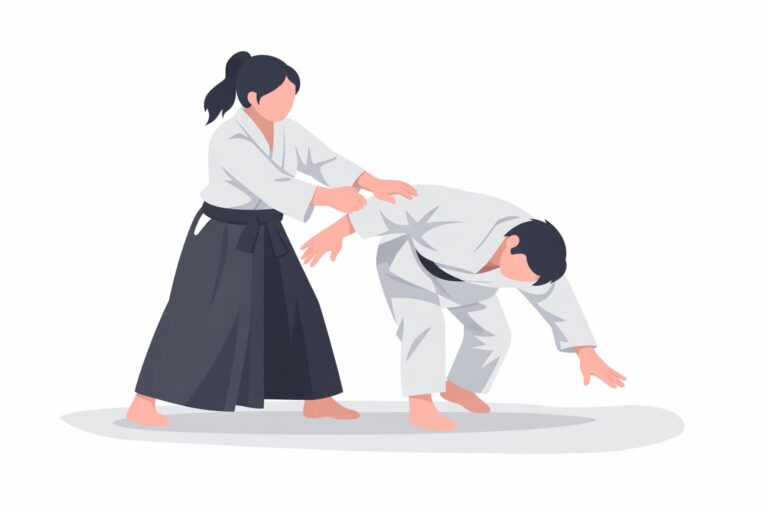
When your inner critic strikes harder than any opponent: The path back to your true martial art
Do you remember the moment you first stepped onto the mat? That specific feeling when your feet touch the firm yet yielding surface of the tatami. The smell that eats into your clothes. A mixture of sweat, cleaning spray, and that indefinable, venerable “dojo smell” that only insiders know. Maybe you were still a child, maybe you were already an adult. But you knew immediately: something is different here. There is more to this.
In judo, the “gentle way,” you learned that yielding means winning. That your opponent’s strength can become your own if you are skilled enough to evade and lead. In aikido, the “way of harmony,” you understood that it is not about victory or defeat, but about fusion. You learned to see an attack not as a threat, but as energy that you can redirect, in combat as in life. This is difficult to understand for your colleagues at the office who wonder about the bruises or sore muscles. Even more so for your partner, who sometimes mistakes your strict discipline for stubbornness. But you? You always knew better. The dojo was your space. Your refuge.
The calm before the storm: When your mind sabotages itself
But then came the day when something shifted. It rarely happens from one second to the next. It creeps up like a shadow that grows longer as the sun sets. You stand at the edge of the mat, your feet just short of the line, and suddenly that familiar tingling sensation is gone. Instead: a tugging in your stomach. A slight dizziness. A thought that sticks like a catchy tune: “What if I fail today?”
You go in anyway. You bow. You sit in seiza. You close your eyes to collect yourself, just as you have done hundreds of times before. But instead of calm, there is only noise. Images flash through your mind: the last competition you lost, even though you were better. The last belt exam, where you forgot the simplest technique in the middle of the kata. The looks from the others. The silence after your mistake.
You try to push the thoughts away. You tell yourself, “I’m experienced. I’ve done this countless times before. I can do this in my sleep.” But that’s exactly the problem. You could do it in your sleep. You could wake your partner up at three in the morning and he would get a perfect osoto-gari or a smooth irimi-nage. Your body knows it. Your muscle memory is a library of thousands of repetitions. But your mind? It just closed the library and threw away the key.
The randori begins. Your breathing becomes shallow. You see the attacker, or competition opponent, coming towards you and your brain switches into survival mode. You tense up. You try to do everything right, and that’s exactly why you do everything wrong. The fluid movements you’ve trained for years seem jerky and choppy. You’re no longer fighting the other person. You’re fighting the chaos in your head.
And the worst part? Your opponent senses it. Your partner senses it. Fear has a smell, and everyone in the dojo can smell it.
The blackout: when emptiness swallows you up
Perhaps you know that moment when things go terribly wrong. The moment of silence. You stand there, the attack comes, you reach for your sleeve, want to initiate, want to move, and there is nothing. Simply nothing. White noise. A vacuum. The technique you’ve done a thousand times is gone. As if erased. You stand there, a foreign body on the mat, and time seems to stand still while your insides are on fire.
Then comes the shame. It hits you harder than any throw. You leave the mat with your head down, making excuses (“The warm-up was too short,” “I had a hard day”), but deep down you know the truth: you failed. And not just technically. You failed yourself.
The next training sessions become torture. You go, but you’re not really there. You hold back, afraid that it will happen again. You avoid certain partners, certain exercises. Your ego, that fragile tyrant, constantly whispers new horror stories to you: “What if you try the throw now and land awkwardly? What if everyone sees that you ‘can’t do it anymore’? What if you’re just not good enough anymore?”
You, who once sought harmony between body and mind, now feel only division. The mind wants to, but the body blocks it. Or the body could, but the mind sabotages it. The downward spiral spins faster and faster. You wonder whether you should take a break. Whether you should change sports. Whether you are simply not cut out for it.
Futile attempts: The search for the switch
In your desperation, you look for solutions, just as you always have: with discipline and dedication. You do extra training to give your body back its feeling of strength. You analyze your technique down to the smallest detail, film yourself, break down every movement into individual parts. Maybe you even look for an experienced trainer for private lessons, hoping that one crucial tip will flip the switch again.
But the switch isn’t in your muscles. It’s not in your movement pattern. It’s in a region that you can’t reach with all the sweat and discipline in the world: your subconscious. That’s where fear has built its throne. That’s where that one defeat from the past has combined with today’s doubts to form a bulwark of self-doubt.
Returning to the source: Deep mental training for martial artists
This is exactly where my work comes in. And I’m not talking about some standardized mental coaching method taught to you by a psychologist with little experience on the mat. I’m talking about something else. I’m talking about something I’ve experienced myself.
I was a proud judoka for many years. I know the pressure just before a competition. I know the trembling in your legs when you face someone who seems stronger. I also know the humiliation when things don’t go your way. And I am now an active aikidoka. I have learned that the greatest battles are not those you fight on the mat, but those you fight within yourself before you step onto it.
My approach is not external coaching. It is internal guidance. I don’t offer hypnosis, where you lose control, because that would be the opposite of what a martial artist wants. I offer you deep mental training, a kind of Za-Zen for the modern warrior’s soul.
Together, we go to where the blockages are. We use hypnotic states, those deeply relaxed, focused moments that you may be familiar with from meditation after training, to talk to the part of you that is stuck down there. To the frightened child who doesn’t want to lose. To the perfectionist who doesn’t forgive mistakes. To the inner critic who shouts louder than any coach.
We install new, powerful images in your inner cinema. Imagine going through a technique in your mind. But not superficially, rather so deeply that every muscle, every fiber, every breath already knows the movement before you do it. That is the secret of the masters. Not just a thousand repetitions, but a thousand high-quality, mentally charged repetitions.
The principles of martial arts as an art of living
In judo, you learn that the best way to defeat a strong opponent is not to resist their strength, but to use it. That’s exactly what we do with your fear. We don’t fight it. We don’t say, “Go away!” Because that would only make it stronger. We do what you do on the mat: we use its energy. We redirect it. We ask: What are you trying to tell me? What are you trying to protect?
In aikido, they say: The attack is already the resolution. The opponent’s movement already contains the seed of their defeat. It’s the same with your blackout. The moment of greatest emptiness also holds the greatest opportunity. The opportunity to let go. The opportunity to trust. Not your mind, but your body. Not your ego, but what is really there. The skills you have trained for years, buried deep within you, beneath all the noise.
The way back to the mat and to yourself
Imagine you are returning to the dojo. But this time it is different. You are not entering the mat as a fighter who has something to prove, but as a student who is allowed to learn something, including about yourself. The bow is no longer an empty gesture, but a genuine arrival. You feel the ground beneath your feet. You hear your breath. You see your partner and you see not an opponent, but a mirror.
You begin the randori. The attack comes. And within you there is silence. No whirlwind of thoughts. No panic. Just presence. Your hands find the grip, your hips turn, the throw happens, not because you made it, but because it just happened. You feel the fall, the rise, the “ippon.” But the feeling afterwards is not triumph. It is gratitude. Gratitude that you are back. That you have not lost yourself.
That is what I offer you. Long-term and in-depth support. Support that sees you not only as an athlete, but as a person who has walked the path and wants to continue walking it. Support that understands that the black belt is not the end, but the beginning of the real learning.
The invitation
You didn’t choose this path because it’s easy. You chose it because it’s true. Because it teaches you who you are. Now you may be at a point where you think you’ve lost your way. But in judo, you know that there are no wrong moves, only those that teach you to fall better and get back up again.
Let’s get back up together. I offer you my hand. Not as a savior, but as a companion. As someone who knows the smell of the tatami, who knows the silence before the technique, who knows the pain of failure and the ecstasy of success.
Book your personal companion. Tell me about your journey. Tell me about the moment when everything came to a standstill. And then let’s find the flow again together. Because the journey is not over yet. It is just beginning.
I look forward to accompanying you on the mat, and in your life, in all your strength and gentleness.
Osensei, the founder of Aikido, said, “The way of the warrior is to find love in everything.” Perhaps it is time to rediscover this love for yourself.