Animal communication Hamster
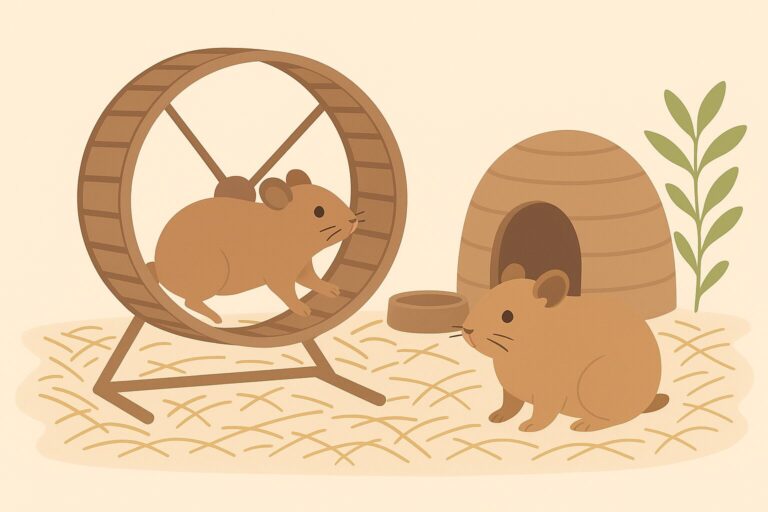
Discover the secret world of your fluffy companion
Your hamster is more than just a cute pet that runs in its wheel at night. It is a highly sensitive, clever solitary creature with a rich inner life and its own unique needs. But when it suddenly ignores its sand bath, gnaws restlessly at the bars, or sits apathetically in the corner, you ask yourself: “What’s going on inside it? Why isn’t it just… hamster-happy?”
You’ve set everything up according to the textbook: a large enclosure, good bedding, species-appropriate food, a safe exercise wheel. The external conditions seem perfect. Nevertheless, its behavior often remains a mystery. You wish you could understand this quiet, nocturnal soul.
This is where animal communication can open a door. It is your access to the unspoken experiences of your little companion. Imagine if you could finally know whether he doesn’t like the new house or finds it smells unpleasant. Whether the exercise wheel squeaks and bothers him, even though it’s quiet to you. Whether he’s just bored or deeply at peace. That’s the difference between good care and truly respectful coexistence.
Why hamsters need particularly subtle communication:
Hamsters are masters of subtle signals. Their world consists of smells, vibrations, and the finest sensory impressions that we can hardly perceive:
- Deep sensitivity to disturbances: As prey animals, they are always alert. A humming noise that is barely audible to us, a vibration from the television, or an unfamiliar energy in the room can cause them great stress.
- Clear individual character: Every hamster has distinct likes and dislikes – for food, bedding, hiding places, and the type of attention they receive.
- Body memory: Unpleasant experiences (loud talking above the cage, rough transport) can leave a deep impression and lead to permanent shyness.
- Complex territorial behavior: Their cage is their kingdom. Any change in it – even an enriching one – must be understood and accepted from their perspective.
In these situations, animal communication can make a decisive difference:
1. In cases of unexplained behavioral abnormalities
- Sudden cage chewing or excessive digging in one spot.
- Refusal to take sand baths or neglect of grooming.
- Restless, frantic running in the wheel or apathetic immobility.
What we can clarify:
Is it stress, frustration, an unfulfilled basic need, or an expression of pain or discomfort?
2. Questions about well-being and enrichment
- You ask yourself: “Is he bored? Is his enclosure mentally challenging enough?”
- He hardly responds to attempts to interact or seems generally shy.
What we can find out:
What would enrich his world? Is he missing a certain type of hiding place, a foraging task, or simply more peace and quiet?
3. During acclimatization or after changes
- Moving into a new, large enclosure.
- Redesigning the habitat.
What we can do:
Explain the change to him and get his consent. This creates trust and security.
4. In case of health concerns (always in consultation with the veterinarian!)
- Support in investigating the causes of changed eating behavior or activity levels.
- The veterinarian finds nothing, but your gut feeling tells you that something is wrong.
What we can ask:
Where does it feel uncomfortable? How does it describe the feeling? This can be a valuable addition to the veterinary diagnosis.
What animal communication can do here:
Many hamsters carry unprocessed experiences with them. Through animal communication, I can probably find out what happened and help your hamster overcome its negative memories in a targeted manner. For example, with the help of surrogate work. This can be done through surrogate hypnosis or surrogate work using quantum work .
“My hamster is nocturnal and shy. Will this work?”
Hamsters often send very clear messages if you give them the right, respectful space and listen to them.
Hamsters often communicate telepathically through:
- Very specific sensory impressions (“The smell of this wood is pungent,” “The floor is vibrating here”).
- Physical sensations (“My right cheek is tense,” “I feel heavy”).
- Simple emotional states (“Calm,” “Alarm,” “Contentment,” “Slight irritation”).
The discreet and empathetic process:
- You share your observations: In a preliminary discussion, you describe the situation to me.
- I enter his world: Using a photo of your hamster, I establish a silent connection. He is not disturbed in his usual daily routine.
- I receive and translate: I perceive the often very precise and factual impressions.
- You gain insight: I pass on the messages to you. For example, in the form of a written report, you learn what your hamster has told me and how you can tailor his kingdom even better to him.
Reviews from satisfied owners
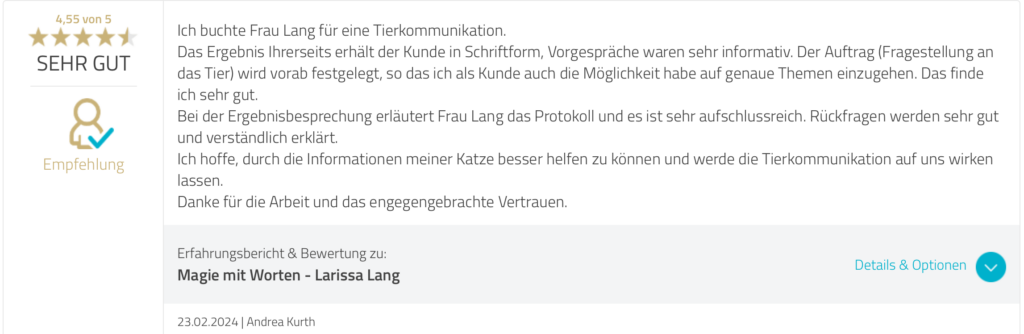
I booked Ms. Lang for an animal communication session.
The client receives the result in writing, preliminary talks were very informative. The assignment (questions for the animal) is determined in advance, so that I as the client also have the opportunity to address specific issues. I find that very good.
At the results meeting, Ms. Lang explains the protocol and it is very informative. Any queries are explained very well and clearly.
I hope to be able to help my cat better with the information and will let the animal communication work on us.
Thank you for your work and the trust you have placed in us.
Andrea Kurth
Satisfied dog owner
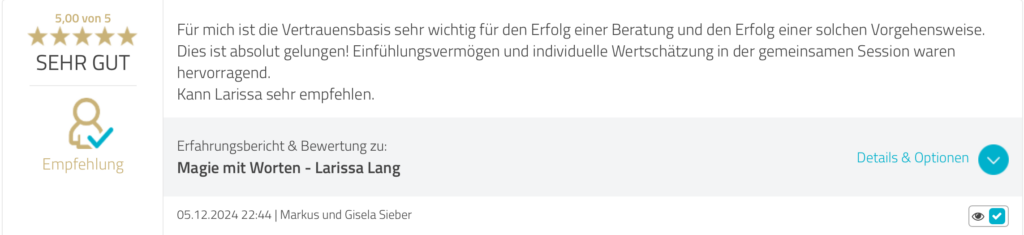
For me, the basis of trust is very important for the success of a consultation and the success of such an approach. This was absolutely successful! Empathy and individual appreciation in the joint session were outstanding.
I can highly recommend Larissa.
Markus und Gisela Sieber
Satisfied clients
Your next step
You are the guardian of their little universe. Animal communication can be the key to not only managing this universe, but truly understanding it. It transforms care into understanding and observation into connection.
Listen to the silence between nighttime activities. Many owners are deeply moved when they learn how clearly and distinctly their supposedly “simple” pet communicates once you speak the same language.
Book your animal communication session for your hamster now. Stop guessing about your fluffy companion’s needs and become the trusted creator of their world.
I look forward to deciphering the subtle messages of your furry friend for you.
Note:
Animal communication and / or surrogate work are not a substitute for veterinary treatment.
However, after consultation with the practitioner, animal communication and / or surrogate work can be used as a supportive measure.
Furthermore, there is no guarantee that the animal will always provide information or, if applicable, suggest solutions.