
Animal communication goat (goats)
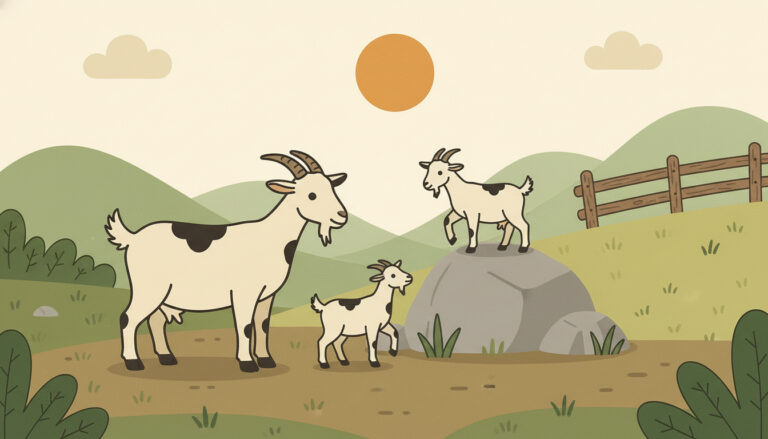
Unlock the playful wisdom of your climbing artists
Your goat is not just a sheep with more character. It is an original, curious, and deeply social individual. A personality on four hooves. But behind their funny antics and seemingly ever-hungry gaze lies a complex emotional world. When their behavior suddenly changes, you ask yourself, “What are they really trying to tell me?”
You know its basic needs: climbing opportunities, species-appropriate food, company. You have optimized its stable and outdoor area. But why does a goat suddenly avoid its favorite spot? Why does feeding always cause stress? You sense that your solution is not addressing the real issue because you lack the key to understanding.
This is where animal communication comes in. It is your translator for the often misunderstood language of goats. Imagine if you could finally know whether your goat is gnawing on wood out of boredom or deprivation. Whether she simply doesn’t like her new herd mate or whether there is a specific, unresolved conflict. That’s the difference between trial and error and targeted action.
Why goats are particularly receptive to intuitive communication:
Goats are not only clever. They are masterful nonverbal communicators with qualities that enable deep exchange:
- Pronounced emotional intelligence: Studies show that goats can read the moods of other goats and humans. They mourn, rejoice, and feel empathy.
- Clear individual will: A goat always has an opinion. Understanding his will – rather than breaking it – is the key to harmony.
- Physical memory: They physically store unpleasant experiences (when being stabled, having their hooves trimmed, or undergoing treatment) and react with stress the next time.
- Highly developed social structure: Their group life is a finely balanced system of friendships, hierarchies, and alliances. Disturbances here affect everyone.
In these situations, animal communication often brings about a decisive change:
1. In the case of undesirable behavior with an unknown cause
- Constant jostling at the stable gate, pushing at the feed rack, or aggression.
- Defending corners or drinking troughs for no apparent reason.
What we can clarify:
Is it underchallenge, frustration, pain, or a reaction to a disturbance that is invisible to us (e.g., an unpleasant draft, a food intolerance)?
2. In the case of social challenges in the herd
- A goat is constantly bullied or isolates itself.
- Constant unrest and discord despite sufficient space.
- Problems integrating new animals.
What we can clarify:
Is there an underlying historical conflict? Does a goat feel uncomfortable in its role? Is there an invisible scarcity of resources (such as the best resting place)?
3. In case of sudden changes in behavior
- A goat that is otherwise curious and sociable appears apathetic, listless, or fearful.
- Reduced climbing and playing behavior.
What we can clarify:
Has it been frightened? Is it suffering from silent pain? Does it feel threatened by something in its environment?
4. Preparing for change & coping with the past
- Moving, stable renovation, or the arrival of new animals.
- For goats from poor husbandry or with an unknown past.
What we can do:
Explain the change to the goats, alleviate fears, and, in the case of traumatized animals, understand what they need to truly settle in.
Many goats carry unprocessed experiences with them. Through animal communication, you can find out exactly what happened and help your goat overcome the negative memories. For example, with the help of surrogate work. This can be done through surrogate hypnosis or surrogate work using quantum work.
“My goat is so stubborn. Will this work?”
Precisely because goats are so independent, they deeply appreciate finally being understood. Communication takes place on their level: through pictorial scenes (“I remember the cramped transporter”), clear physical sensations (“My left front hoof tingles when I step on it”) or simple emotional impressions (“boredom,” “jealousy,” “joy on the sunbed”).
The simple and stress-free process:
- You tell me your concern: In a short preliminary discussion, you describe what is on your mind.
- I establish the connection: I make telepathic contact using a photo of your goat. Your goat remains completely in its familiar surroundings.
- I receive and structure: I perceive the messages and translate them into our language.
- You receive your answer(s): In a written report, for example, you will learn what your goat has communicated to me.
Reviews from satisfied owners
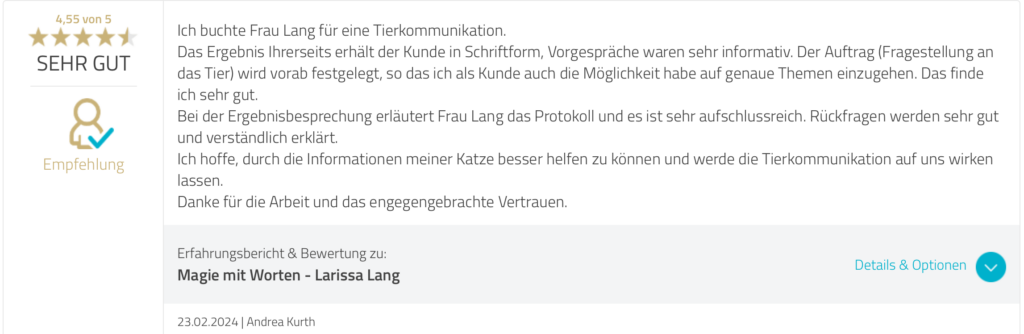
I booked Ms. Lang for an animal communication session.
The client receives the result in writing, preliminary talks were very informative. The assignment (questions for the animal) is determined in advance, so that I as the client also have the opportunity to address specific issues. I find that very good.
At the results meeting, Ms. Lang explains the protocol and it is very informative. Any queries are explained very well and clearly.
I hope to be able to help my cat better with the information and will let the animal communication work on us.
Thank you for your work and the trust you have placed in us.
Andrea Kurth
Satisfied dog owner
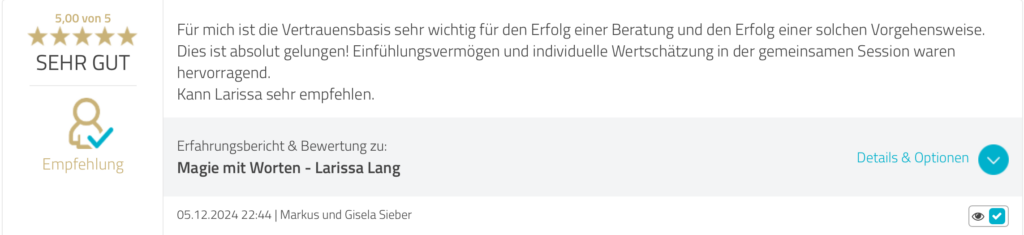
For me, the basis of trust is very important for the success of a consultation and the success of such an approach. This was absolutely successful! Empathy and individual appreciation in the joint session were outstanding.
I can highly recommend Larissa.
Markus und Gisela Sieber
Satisfied clients
Your next step toward a genuine partnership
You are more than just their provider. You can become their trusted partner. Animal communication can help you end the guesswork and give you the clarity to lead your herd not only well, but in a way that is appropriate for their species.
Listen beyond the loud “baa.” Most goat owners who have gone down this path are amazed at how clear and pragmatic their animals’ messages are and how much peace this understanding brings to the barn.
Book your animal communication for goats now. Discover the world through the eyes of your climbing companions and become the architect of a truly happy goat life.
I look forward to conveying the messages of your unique personalities to you.
Note:
Animal communication and / or surrogate work are not a substitute for veterinary treatment.
However, after consultation with the practitioner, animal communication and / or surrogate work can be used as a supportive measure.