
Animal communication duck (ducks)
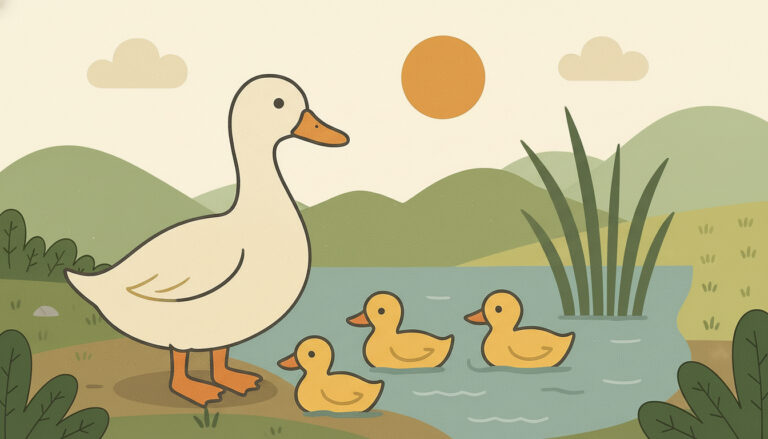
Discover what your waterfowl really want to tell you
Your ducks are more than just cute waterfowl or farmyard residents. They are intelligent, social animals with complex emotions and their own unique perspective on the world. But sometimes you may wonder:
- Why is a certain pair suddenly quarreling, or why is a single animal being excluded?
- Why do they show inexplicable shyness or aggression, even though you are doing your best?
- Why do they lay their eggs in hidden places or show changes in their plumage?
- Does a duck seem down, even though the water is clean and the food is good?
Perhaps you have already tried everything possible:
- Changing the pond environment
- Changing the feed several times
- Consulting a veterinarian
- Creating even more places of retreat
But the behavior of your duck family remains a mystery. You sense that there is more to it than meets the eye. You wish they could just tell you what they need to be completely happy.
This is exactly where animal communication can help. It may be the key to better understanding the world of your ducks. Imagine if you could finally understand what is going on in their clever minds, what invisible stress factors are weighing on them, or what small changes would dramatically increase their well-being.
Why animal communication is particularly fascinating with ducks
Ducks are much more than their affectionate “quacking” suggests. They have:
- Deep social bonds: They form lifelong partnerships, maintain friendships, and often suffer from loneliness.
- A keen sense of energy: They are very sensitive to discord in their flock or negative moods among their humans.
- Physical memory: Negative experiences (such as an attack by a predator) are stored in their cellular memory and can trigger long-term fears.
- Pragmatic intelligence: They solve problems, remember feeding places, and communicate using complex calling systems.
When animal communication can be a turning point for your relationship:
1. In case of social tensions within the group
- Ongoing fights over hierarchy
- An individual animal is being bullied or isolates itself
- Problems integrating new ducks
- What we can find out: Is it a lack of space, an invisible conflict, or something else?
2. In case of unexplained behavioral changes
- Sudden aggression or extreme shyness
- Neglect of plumage care
- Unusual laying behavior (hidden eggs, laying breaks)
- What we can find out: Does a duck feel threatened by something in its environment? Are there energetic interference fields? Does it suffer from subtle, chronic stress?
3. Preparing for and coping with change
- Moving to a new coop / pond area
- New animals moving in
- Preparing for your vacation (outside care)
- What we can do: Mentally prepare your ducks for the change. This reduces enormous stress and may prevent problems.
4. For health issues (always in consultation with the veterinarian!)
- Support in investigating the causes of unclear symptoms
- Questions about quality of life in old age or with chronic complaints
- What we can do: Ask how the duck is feeling, where it is experiencing pain or discomfort, and how it feels about its treatment.
In addition to animal communication, you can also help your sheep through surrogate work. This can be done through surrogate hypnosis or surrogate work using quantum work.
“But how is that supposed to work? My ducks can’t talk!”
That’s the fascinating part! Communication takes place on the level of images, feelings, and bodily sensations.
- Preliminary discussion: You describe your observations and burning questions to me.
- Establishing contact: I connect telepathically with your duck or the herd consciousness. Your animals do not need to be present for this. It is sufficient for me to have one or more photos.
- Receiving messages: Ducks often communicate through vivid scenes (e.g., memories of an event), physical impressions (“My left leg feels heavy”) or emotional states (joy, anger, sadness, fear, etc.).
- Feedback to you: I pass on all messages to you. For example, in the form of a written transcript of the conversation.
Reviews from satisfied owners:
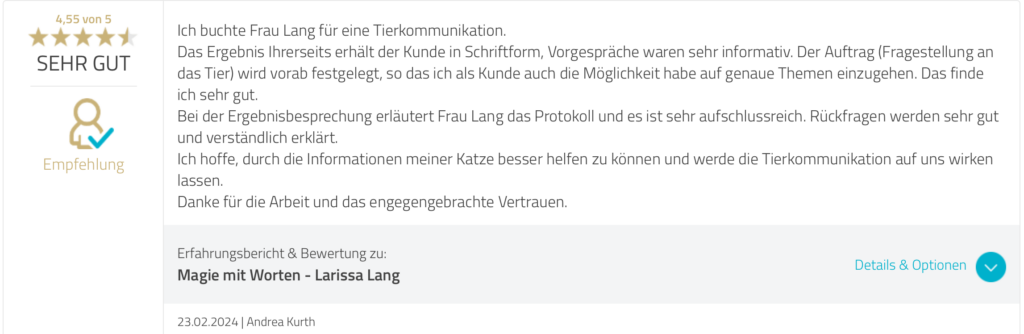
I booked Ms. Lang for an animal communication session.
The client receives the result in writing, preliminary talks were very informative. The assignment (questions for the animal) is determined in advance, so that I as the client also have the opportunity to address specific issues. I find that very good.
At the results meeting, Ms. Lang explains the protocol and it is very informative. Any queries are explained very well and clearly.
I hope to be able to help my cat better with the information and will let the animal communication work on us.
Thank you for your work and the trust you have placed in us.
Andrea Kurth
Satisfied dog owner
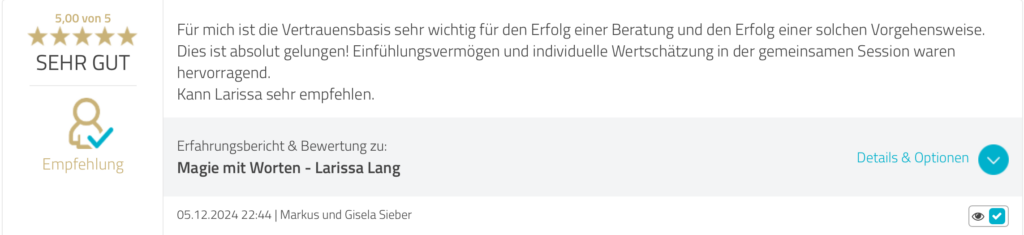
For me, the basis of trust is very important for the success of a consultation and the success of such an approach. This was absolutely successful! Empathy and individual appreciation in the joint session were outstanding.
I can highly recommend Larissa.
Markus und Gisela Sieber
Satisfied clients
Your next step toward a deeper understanding
You have already done so much for the well-being of your ducks. Animal communication may be the missing piece of the puzzle to create a truly fulfilling life for your ducks.
Many owners were skeptical at first, but are now grateful because they were finally able to take action instead of guessing.
Book your animal communication now and give yourself and your waterfowl the chance to reach a whole new level of harmony and trust.
I look forward to conveying your animals’ messages to you.
PS: Did you know that ducks have a strong memory for places and can even remember individual people over many years? Imagine what stories your ducks would like to share with you, but you don’t quite understand yet. But it doesn’t have to stay that way 😉
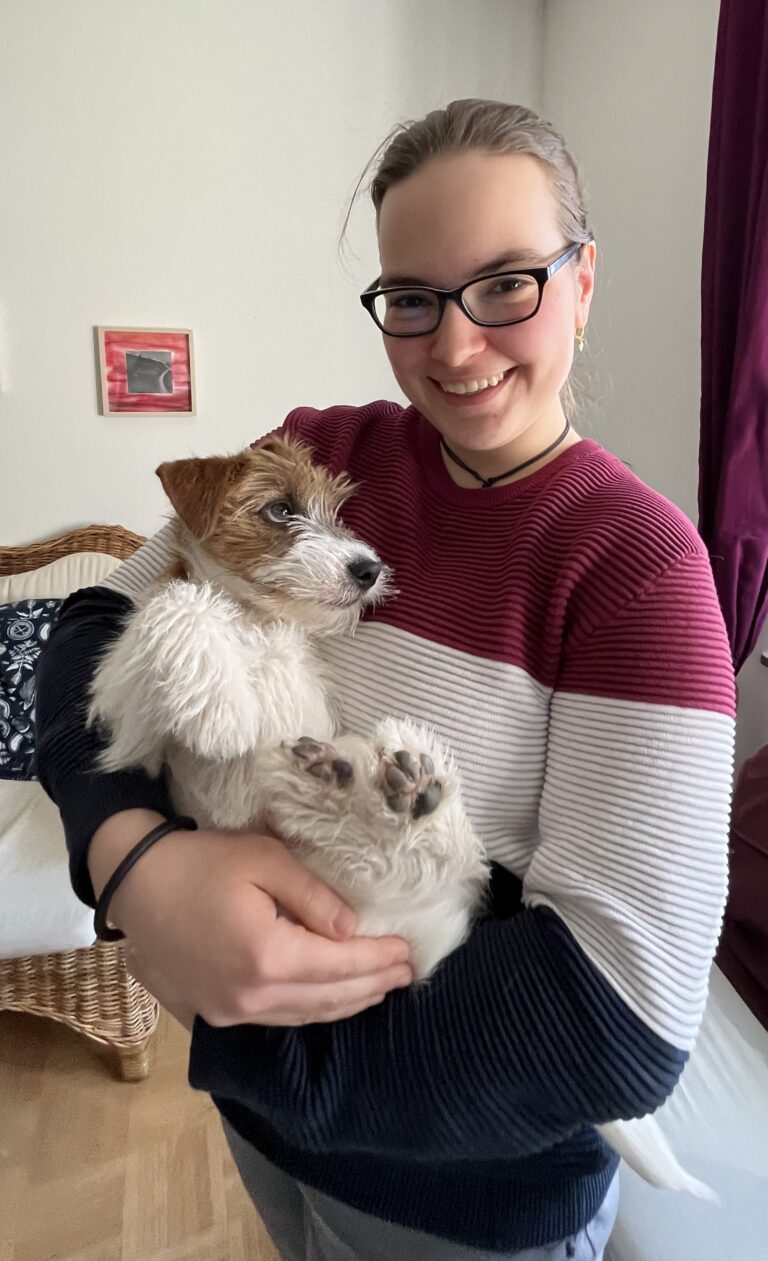
Note:
Animal communication and / or surrogate work are not a substitute for veterinary treatment.
However, after consultation with the practitioner, animal communication and / or surrogate work can be used as a supportive measure.