
Animal communication
Everything that happens happens for a good reason, even if you don’t always know or notice it right away. People always worry too much, even though it doesn’t help them at all to act that way. Life must be lived moving forward, but can only be understood looking back. … – Bounty the Cat
This is an original statement (slightly adapted) from Bounty the Cat, who chose very wise words in animal communication and thus moved her owner to tears.
From 85€
Anyely Rodríguez De Léon
I booked an animal communication session with Larissa Lang for my little dog Chichi, and I’m absolutely thrilled! What really won me over was that I not only learned an incredible amount of new things about Chichi, but Larissa also combined the animal communication with hypnosis—and performed it on me as a proxy. That’s truly something special! As a result, we were able to work together to resolve specific issues my dog was facing, including occasional house soiling and severe anxiety—problems that had been on my mind for quite some time. The fact that we were able to address and resolve these issues for Chichi during the session really impressed me.
That’s exactly what makes Larissa so special to me and the reason why I recommend her without hesitation. I will definitely keep coming back to her for any further issues involving Chichi.
Thank you, Larissa! 🐾
About animal communication
- Short AC
- Telepathic communication with animals
- Through thoughts / feelings / emotions / images
- Tele = distance (Greek)
- Pathos = feeling, experience (Greek)
Long: What is animal communication?
What is animal communication?
Animal communication (TC) is the ability to communicate with animals on a telepathic level. It does not matter whether they are pets or wild animals. Yes, even wild animals can communicate “out of the blue”. For example, when you go for a walk in the forest. Animals can sense who is open and ready for this type of communication.
How does animal communication work?
Normally, you need a picture, the name of the animal and specific questions for animal communication. Of course, this is not possible with wild animals. But animal communication usually works anyway. The connection is established through telepathy, i.e. the exchange of thoughts, feelings, emotions and/or images.
The word “telepathy” comes from the Greek:
- Tele means “far away”.
- Pathos stands for “feeling” or “experience”.
Animal communication is therefore about establishing a feeling-based connection.
Why animal communication?
- Understand your animal better: find out what it thinks, feels and needs.
- Communication without boundaries: Whether pet or foster animal.
- Deep insights: Get answers to your questions and strengthen your relationship with your animal.
Would you like to know what your pet is trying to tell you?
What would your animal tell you if it could speak? Animal communication opens the door to a world in which you can understand the needs, wishes and even fears of your animal friend.
- Consent of the owner (kahu -> hawaiian for owner)
- Name of the animal (no nicknames)
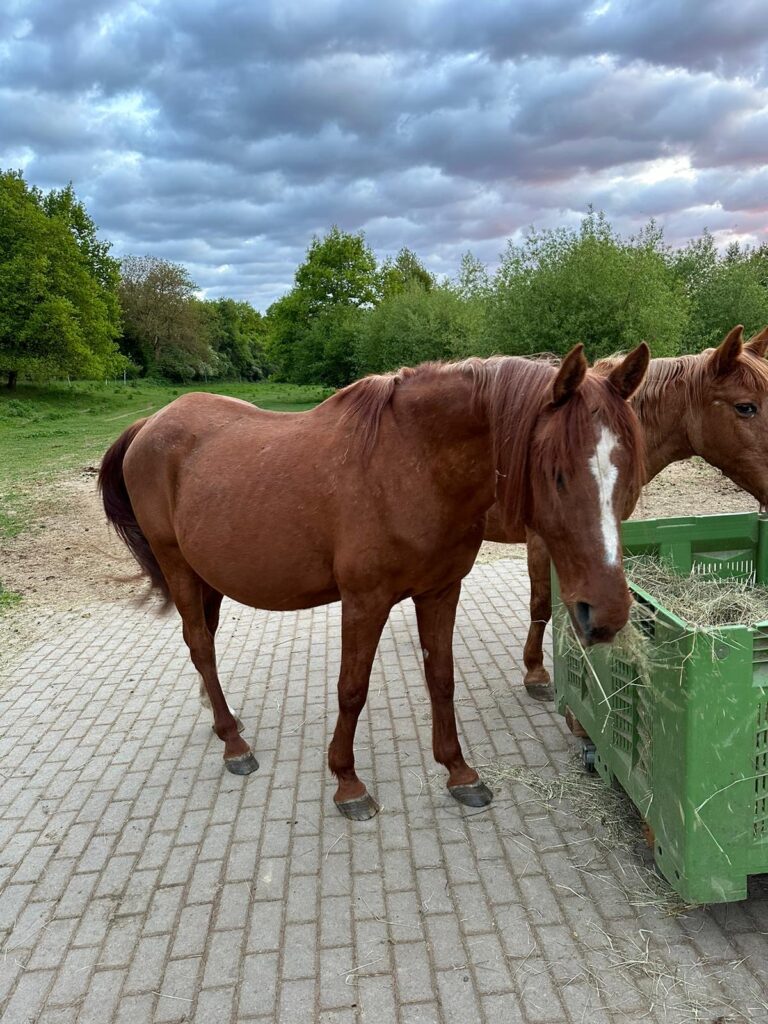
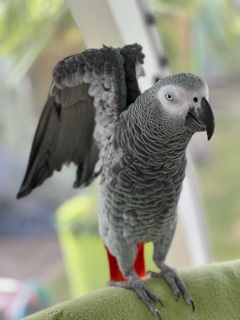
- Current photo of the animal (where it looks directly at the camera and is fully visible => example photos can be found below)
- Ideally, a photo of you as the owner (as recent as possible, where you are looking at the camera and no one else is in the photo; this makes communication easier for me)
- If several animals live / have lived in the household: pictures of these animals (this makes communication easier for me)
- Specific and concise questions (no questions within questions)
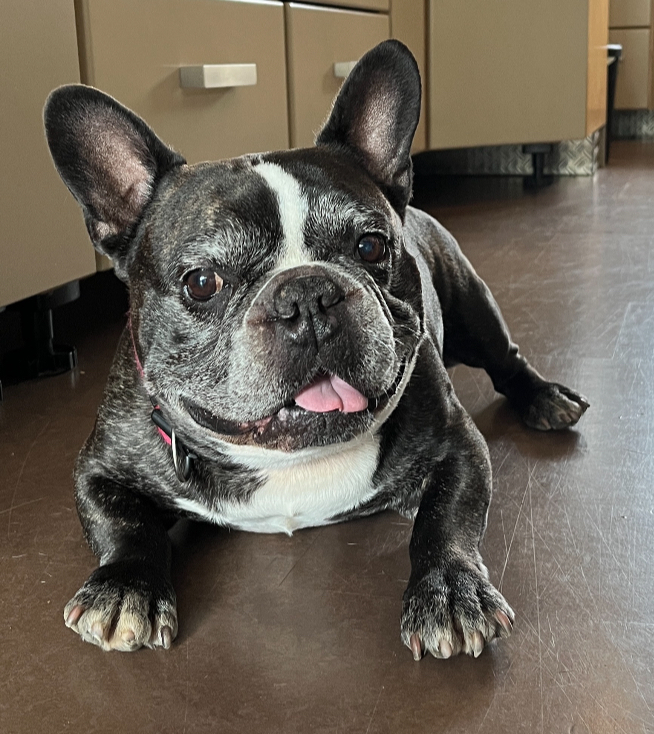
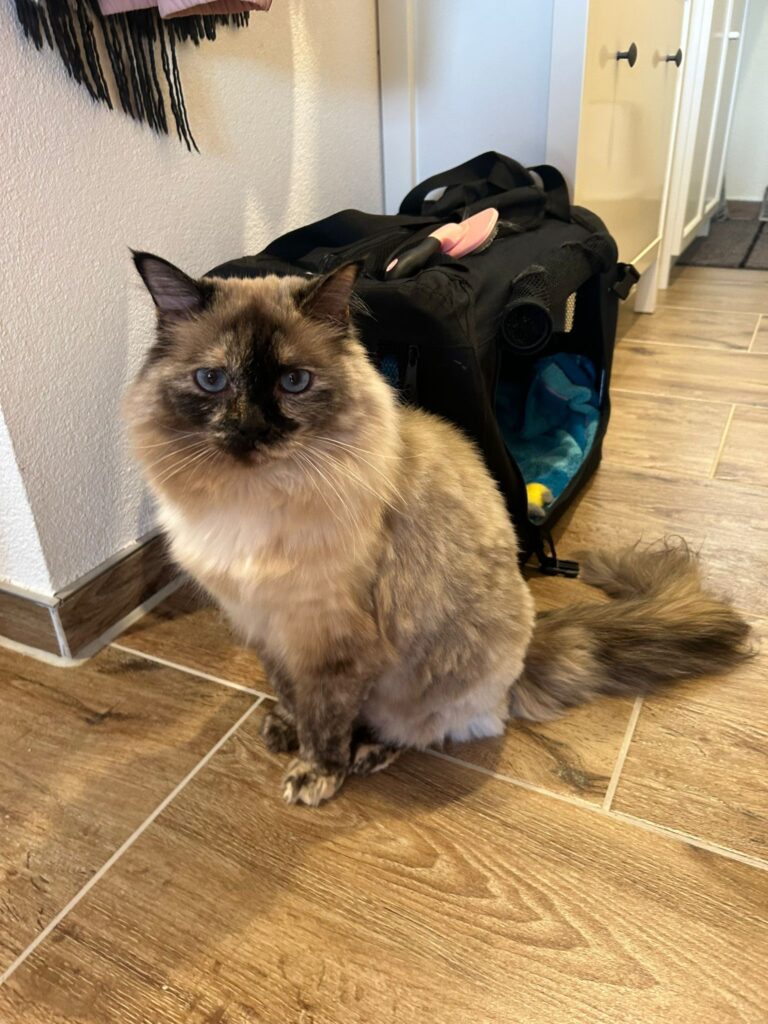
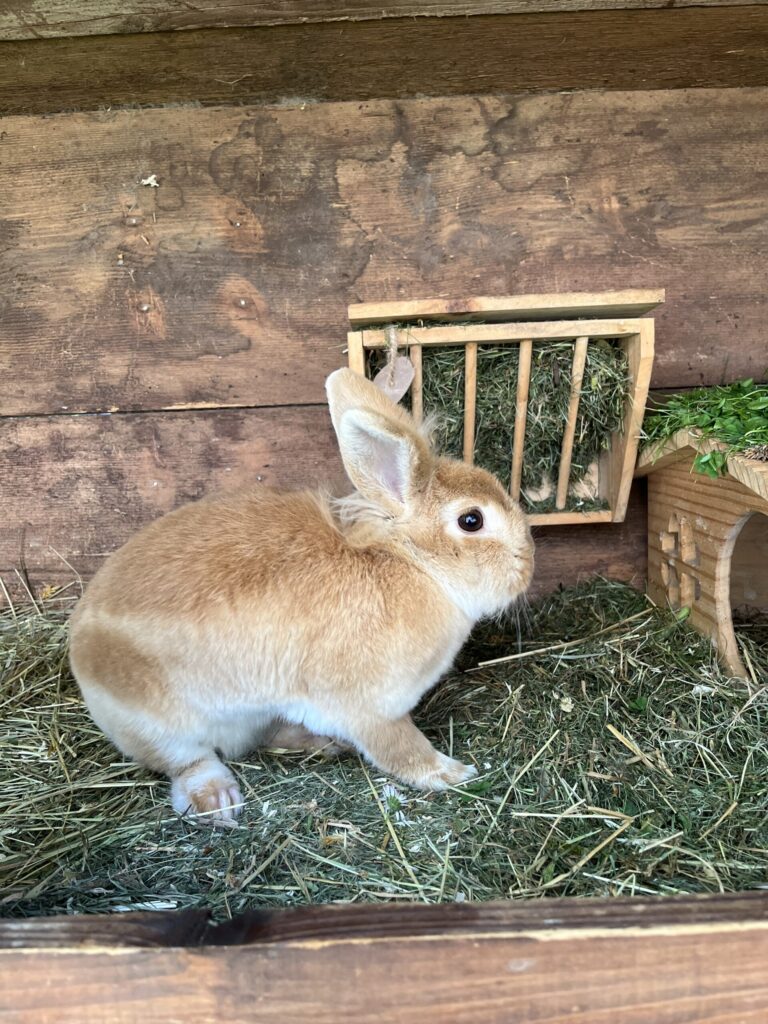
Long: Requirements for animal communication?
What do you need for animal communication?
You don’t need much for successful animal communication, but a few important things are essential:
- The consent of the owner
I cannot and will not carry out animal communication without the express permission of the animal owner. Respect and trust are the basis of all animal communication. - The name of the animal
Please give me the correct name of your animal. (No nickname!) The name helps me to establish the connection to your animal. - A recent photo
A picture in which your pet is clearly recognizable and looking into the camera is ideal. If the animal is not fully visible in the photo, animal communication is often still possible. - A photo of yourself
To make communication easier, please send me a recent photo of yourself in which you are looking directly at the camera and no one else is in the picture. - Photos of other animals living in your household
If there are other animals in your household, please send me photos of them as well (this makes communication easier for me). - Specific and concise questions
The clearer your questions are, the better I can receive your animal’s answers. Therefore, please refrain from asking double questions, i.e. questions that are actually two questions.
Why are these points so important?
Each of these aspects helps me to establish a clear and effective connection with your animal. Without them, animal communication would be difficult or even impossible.
Would you like to know what your pet is trying to tell you?
What would your animal tell you if it could speak? Animal communication opens the door to a world in which you can understand the needs, wishes and even fears of your animal friend.
Very good! 😉
Just kidding!
Telepathically through:
- Images
- Emotions
- Thoughts
- Feelings
- The spoken word
- Information
Etc.
- Not by making animal sounds at each other…
Long: How does animal communication work?
How does animal communication really work?
Animal communication is not a matter of animals making noises at each other. So you won’t catch me sitting across from a dog and trying to bark at it. 😊 Imagine what it would look like if I tried to communicate with a hamster – what does a hamster even sound like?
Animal communication works on a completely different level: telepathically. This means that communication takes place via images, thoughts, spoken words or the pure transmission of information. How exactly this information is perceived varies from animal to animal and from user to user.
For me personally, it works like this: I am a very visual person and often receive information in the form of images. At the same time, however, I also hear words or sentences that the animal “tells” me. This combination of images and spoken words helps me to understand your animal’s messages clearly.
Why telepathic animal communication?
- Simple and effective: No sounds or gestures are needed. Communication takes place on a deeper level.
- Individually adapted: Each animal communication is unique and adapts to the needs of the animal and the user.
- Understanding on a new level: Experience how you can better understand your animal’s thoughts and feelings.
Would you like to know what your pet is trying to tell you?
What would your animal tell you if it could speak? Animal communication opens the door to a world in which you can understand the needs, wishes and even fears of your animal friend.
- Contact / Appointment booking
- (Initial consultation) Intake form
- Preliminary discussion (if you would like to describe your situation in more detail)
- Contact with your animal
- Information transfer (in writing via written transcript, audio recording, or in person via Zoom)
- Follow-up contacts
Possibilities:
- Farewell, Clarity & Consolation
- Conveying messages
- Insights into the emotional life of the animal and its wishes / needs
- Promoting mutual trust
- Help with blockages
- Clarifying and harmonizing conflicts
- Finding solutions
Recognizing mirror issues - Strengthening the human-animal relationship
- Detecting and understanding the reasons of behavioral changes
- Preparation for upcoming changes
Important: Everything in addition to veterinary treatment!
Limitations:
- Replace veterinary or medical diagnostics and treatment
- Be purely an “educational measure”
- Restrict an animal’s free will
- Make promises of healing
- Making contact with other animals without the animal owner’s permission (except for wild animals)
- Ignore the animal’s refusal to make contact (or other interventions such as energetic harmonisation)
Long: Possibilities and limitations of animal communication
Possibilities:
What animal communication can do
Animal communication is a fascinating tool that can help you to better understand your pet’s needs, feelings and thoughts. In the short version you have already seen some examples. Here you can find out more about how animal communication can help you and your pet.
1. farewell, clarity & comfort
Animal communication can also help to provide clarity and comfort when it’s time to say goodbye. You can say everything that is close to your heart before your beloved animal goes to Rainbow Land.
(Note: This does not replace veterinary or veterinary care and is not an end-of-life care).
Think of it this way: When a person passes away, we often want to talk to them one last time. This is also possible with your animal and even beyond, because animal communication also works with deceased animals.
2. transmitting messages
The most classic form of animal communication is the transmission of messages. Whether your animal wants to tell you something or you want to send your animal a message, animal communication creates a bridge between you.
3. insights into the emotional life of the animal and its wishes / needs
Would you like to know how your animal is feeling or what it wants? Animal communication allows you to immerse yourself in your pet’s emotional world. Be it through direct questions or by intuitively sensing its needs.
4. promoting mutual trust
Sometimes animals have experiences from their past that shape their behavior. Through animal communication, you can find out what your animal has been through and together you can find ways to strengthen your trust. For example, an animal that used to live in a small cage promises its new owner not to run away and the owner promises more space in return.
5. help with blockages
Just like us, animals can have blockages that affect their well-being. Through animal communication, these blockages can be tracked down and resolved, for example through methods such as surrogate hypnosis for an animal or quantum work.
6. clarifying and harmonizing conflicts
Why is your pet suddenly refusing to eat? Or why has it stopped scratching the scratching post and is now scratching the couch? Animal communication can help to find the causes of such changes in behavior and to develop solutions. An example: A cat refused to eat because the new food bowl was a different color. After replacing it with a new bowl, which was the same as the old one, everything was fine again.
7. finding solutions
Sometimes it only takes a small change to solve a problem. In animal communication, your pet can make suggestions about how you can find a solution together. As in the case of a cat that found the sisal on the scratching post unpleasant. After it was changed, everything was fine again.
8. recognize mirror themes
Animals often unconsciously mirror the problems of their owners. If you are stressed, for example, this can be reflected in your pet. An example: You have broken your foot, which is why you now have to walk with crutches and on one foot. Your cat notices this and starts to limp. The vet can’t find anything wrong, but animal communication reveals that your cat is mirroring you. Incidentally, your pet is not mirroring you because it wants to annoy you. Quite the opposite! Your pet mirrors you because you are important to it. Through animal communication, I can recognize mirror issues and we can find a suitable solution together.
9. strengthen the human-animal relationship
Clarify open questions, clear up misunderstandings and find solutions together. You can ask your animal open questions, but your animal can also ask you questions via animal communication. All of this strengthens the relationship between you and your pet. Animal communication creates a deeper connection and more harmony in your life together.
Would you like to know what your pet is trying to tell you?
What would your animal tell you if it could speak? Animal communication opens the door to a world in which you can understand the needs and wishes of your animal friend.
Limitations:
Important principles of animal communication
Animal communication is a valuable tool to better understand the needs and feelings of an animal.
Principles that everyone must follow:
- Not a substitute for veterinary or animal health care
Animal communication can and must never replace a veterinary diagnosis or treatment. Nor is it an alternative to practical veterinary methods. In the event of health problems or behavioral problems, a specialist should always be consulted first. - Not an educational measure
Animal communication is not a tool to educate or discipline animals. It is used exclusively for communication and understanding between humans and animals. However, you can, for example, convey a message to the animal that a certain behavior is inappropriate and that it should please refrain from it. - Respect for the animal’s free will
Every animal has free will and this must be respected. Animal communication must never restrict or override the animal’s will. The animal is always asked for permission and if it refuses contact, this is respected. This also applies to other interventions such as surrogate work. However, you can try to make contact again or do surrogate work at a later date. If this is rejected again, this must be respected. - Permission from the animal owner
Contact with an animal must never be made without the express permission of the owner. The only exception is wild animals, as they do not have an owner who could be asked for permission.
Why these rules are so important
Animal communication is a sensitive and responsible activity that must always be in harmony with the needs of the animal and the wishes of the owner. It should create trust, bring clarity and strengthen the relationship between humans and animals, but never exert pressure or overstep boundaries.
Would you like to know what your pet is trying to tell you?
What would your animal tell you if it could speak? Animal communication can open the door to a world in which you can understand the needs and wishes of your animal friend.
Animals can also lie (for their own protection):
- E.g. animal hurts paw
- Nothing visible on the outside
- Animal is afraid of the vet
- Therefore conceals pain
- When asked if it is in pain, it lies to avoid the vet
Mirror themes:
- The animal mirrors the owner’s behaviour (but the owner is not always aware of this)
- Animal keeps repeating a behaviour that was not there before
- Animal shows behavioural abnormalities
Long: Worth knowing animal communication
Can animals lie? And what are mirror subjects?
Yes, animals can actually lie. They usually do so out of self-protection. For example: If an animal is in pain, for example in its paw, but nothing can be seen on the outside, it may deliberately conceal the fact that it is in pain out of fear of the vet. It is therefore “lying” to avoid having to go to the vet. It is therefore essential to always seek veterinary or veterinary practice advice in the event of behavioral changes or problems to ensure that your pet is well.
Mirror issues:
Another common reason why people make use of animal communication is so-called mirror issues. The animal unconsciously mirrors the behavior or emotions of its owner. People are often not even aware that their animal is mirroring them and so the changes in the animal’s behavior are not noticed at first.
The animal suddenly shows behavior that was not there before, or it appears strikingly different. For example: a cat that used to love to play suddenly loses interest in doing so. The reason could be that its owner is going through a difficult phase. Perhaps after a separation. Instead of being active, the human spends their days in bed, eating unhealthily, scrolling through social media for hours on end and trying to numb their sadness. This mood is transferred to the cat, who mirrors the behavior.
How do I recognize and resolve a mirror issue?
If you notice that your pet is suddenly reacting differently or behaving unusually, there could be a mirror issue behind it. The key often lies within yourself: Once you begin to reflect on your own situation and make positive changes in your life, your pet’s behavior probably will also return to normal.
Would you like to find out more about how animals mirror us and how you can use this connection to help you both? Animal communication can give you valuable insights.
Why animal communication?
- Deeper connection: Understand what your animal is trying to tell you.
- Recognize mirror themes: Recognize how your own behavior affects your pet.
- Growing together: Create positive changes for you and your pet.
Would you like to know what your pet is trying to tell you?
What would your animal tell you if it could speak? Animal communication can open the door to a world in which you can understand the needs and wishes of your animal friend.
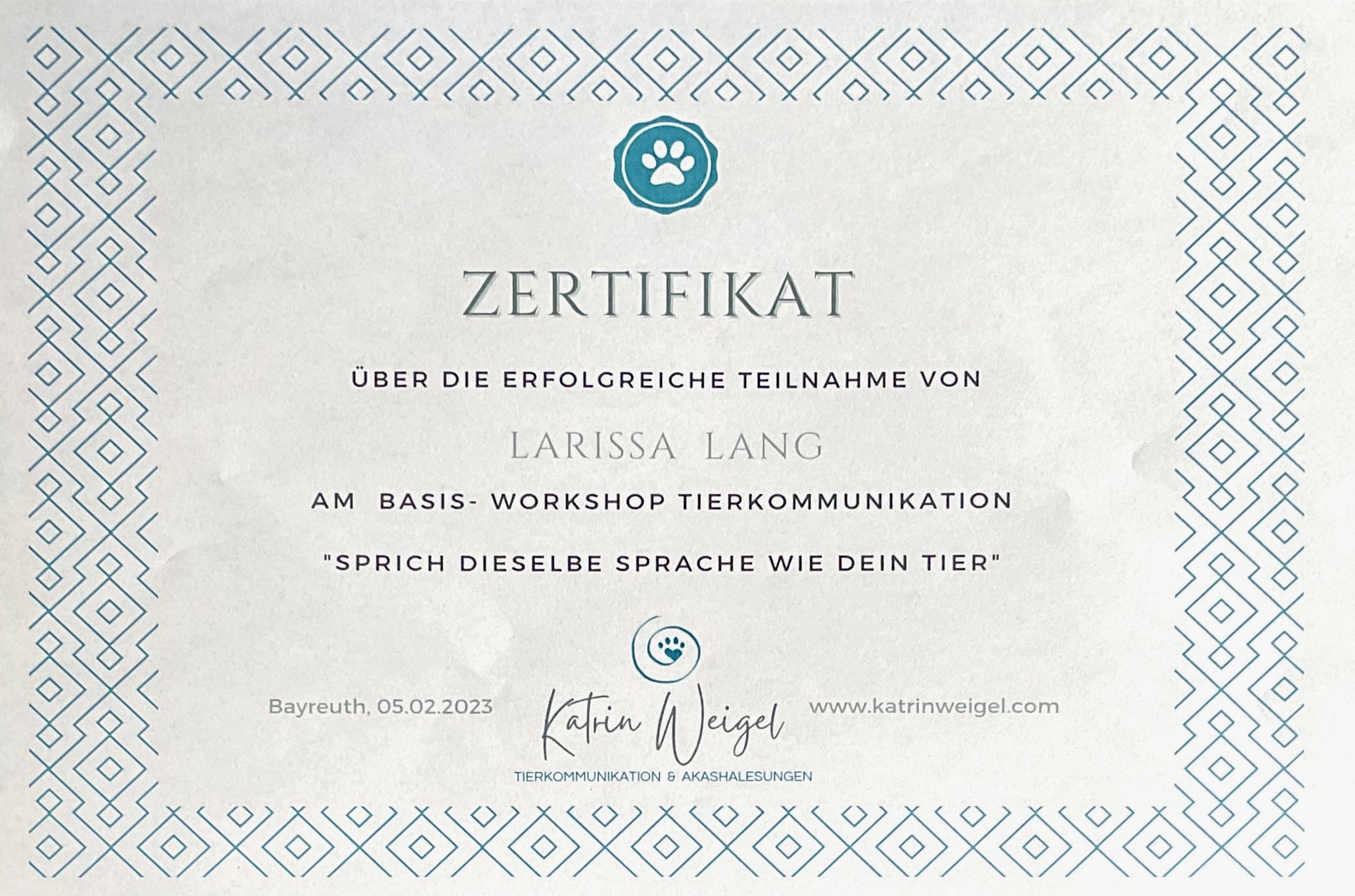
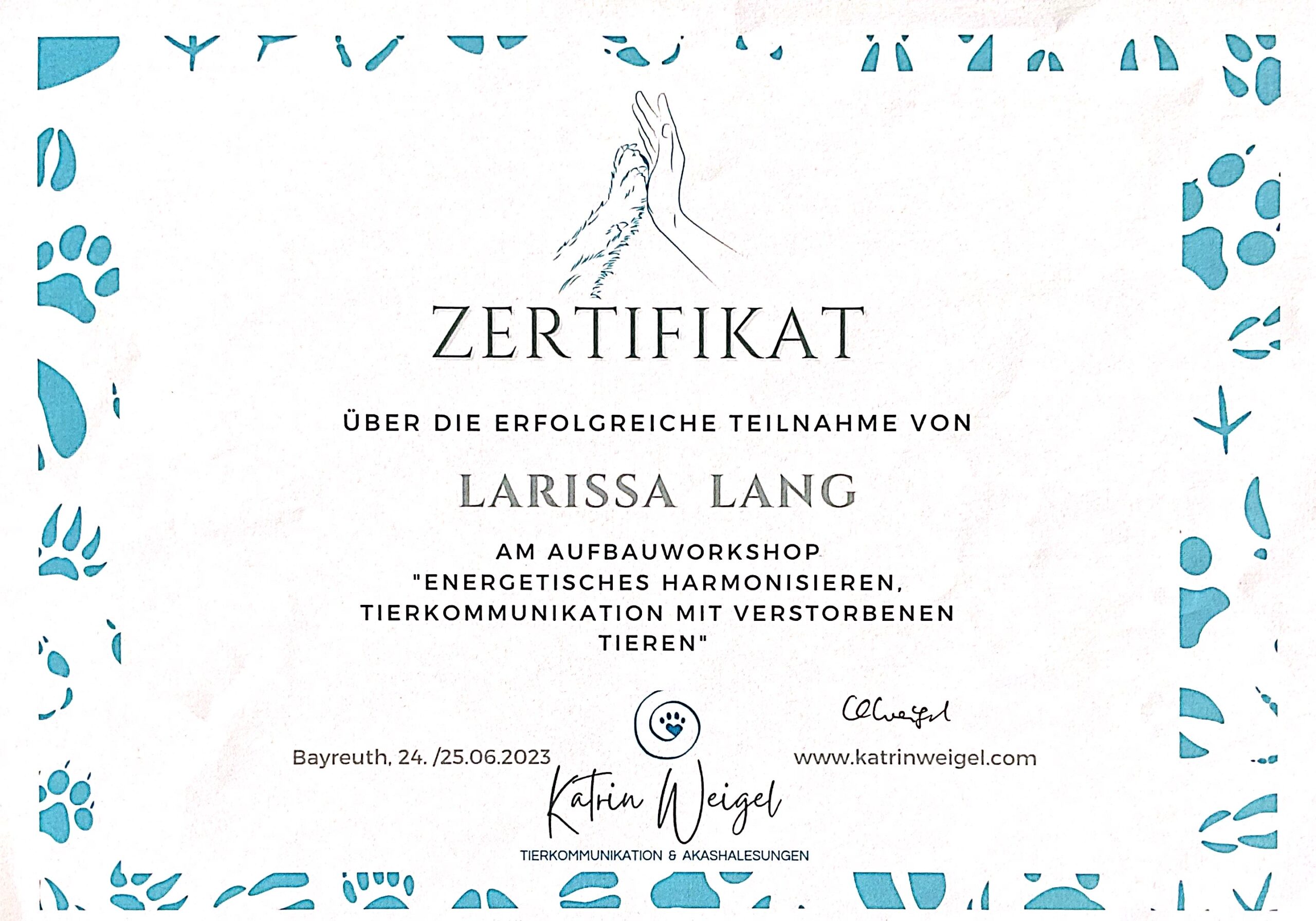
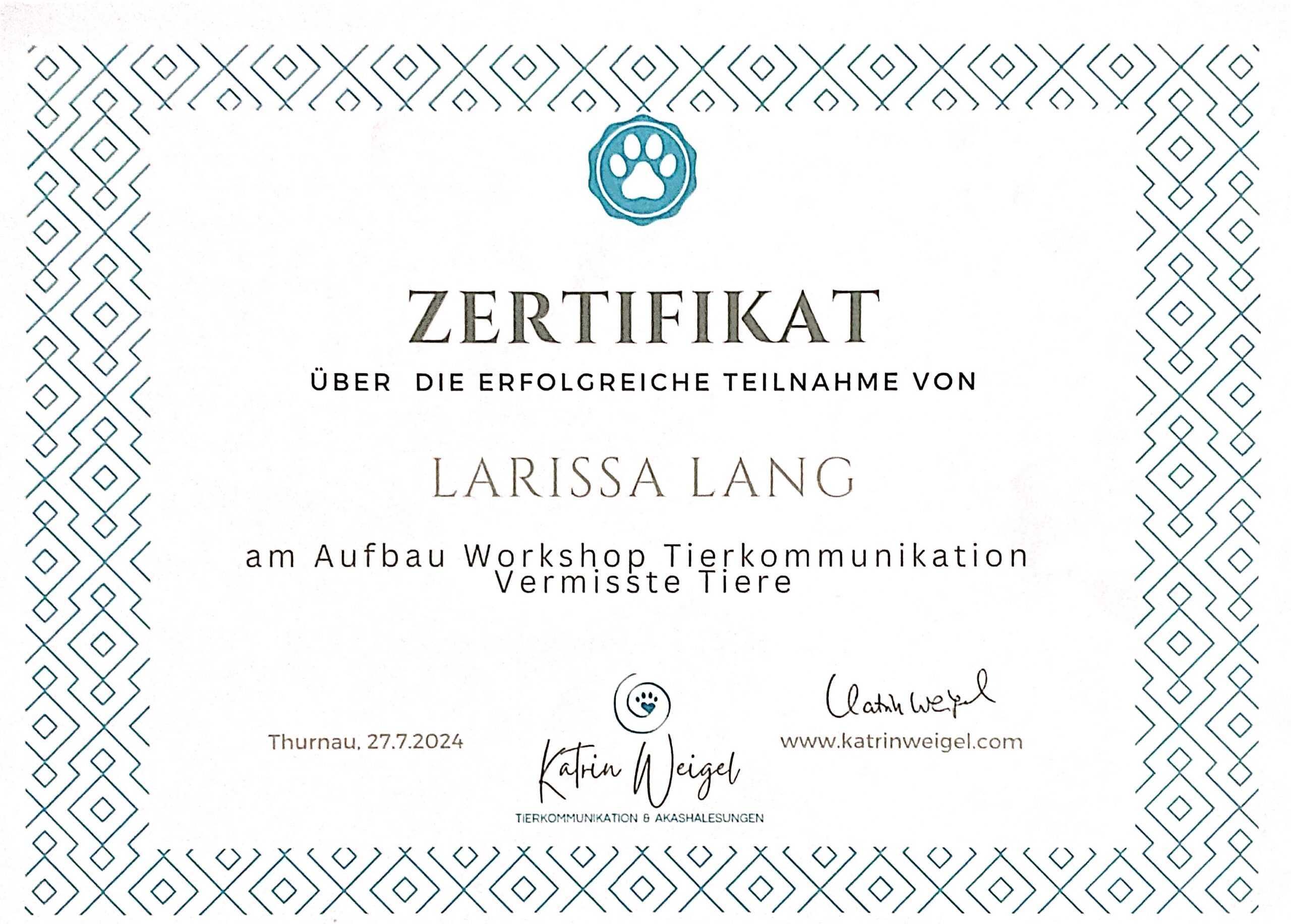
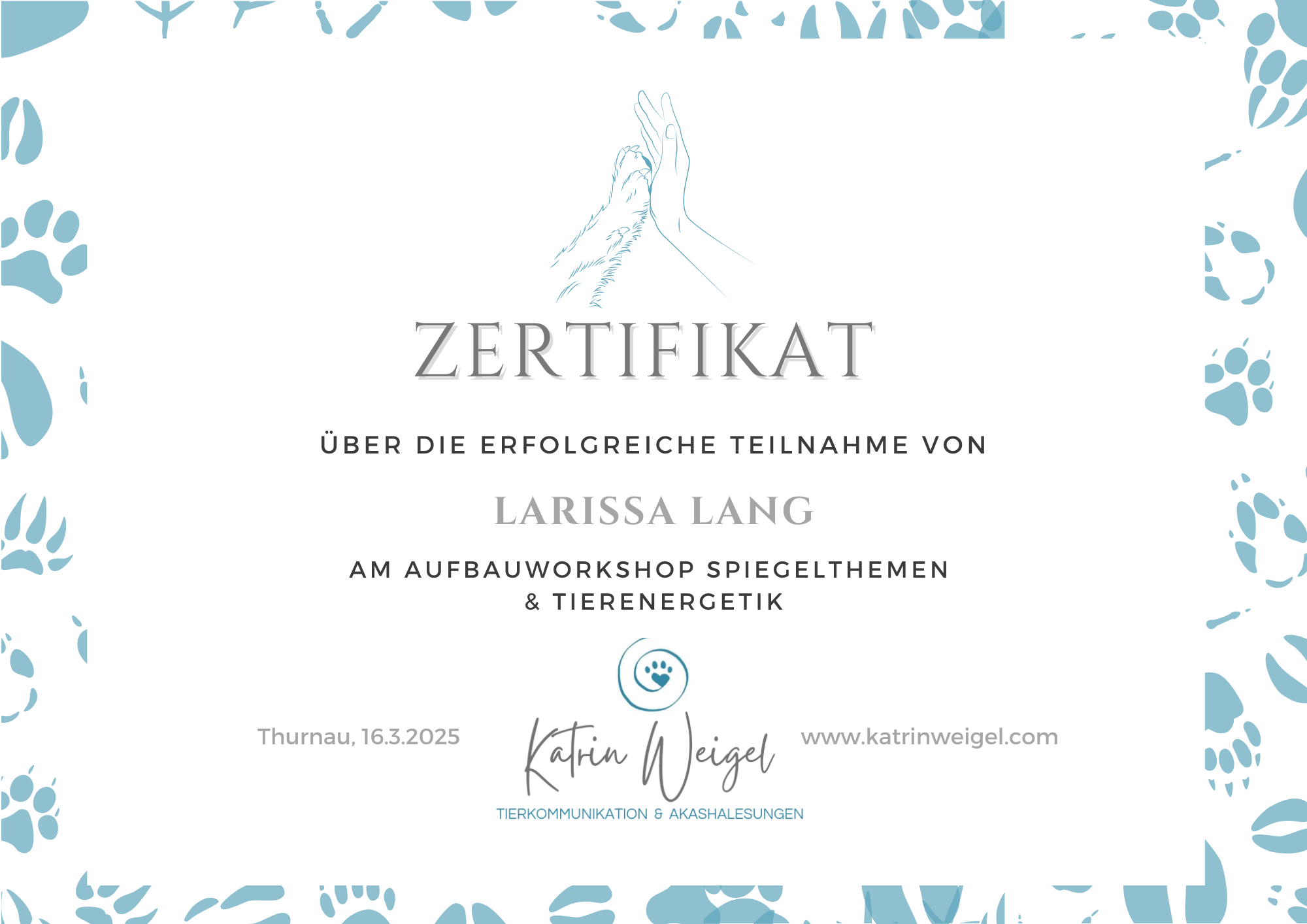
My certificates
Reviews
The reviews were originally written in german. I translated them for you.
Q&As
Animal communication doesn't really work... You're just making it all up, doing cold reading, or it's the Barnum effect...
Well, in my experience, animal communication really does work.
If I were just making all of this up, I would have become a filmmaker. Especially since I usually only have a picture and the animal’s name, along with your questions.
I can’t use cold reading, because, for one thing, I’m not trained in it, and for another, I (mostly) don’t do animal communications live, so I wouldn’t be able to infer anything from your body language, facial expressions, or gestures.
Regarding the Barnum effect: I’ve experienced it quite often now that the owner was skeptical at first but decided to “give it a try” anyway. In hindsight, everyone was actually always convinced, since some of the statements were things I couldn’t possibly know – statements that aren’t general in nature but, on the contrary, are or were very specific…
Do your sit opposite the animal and bark at it, for example? (In the case of a dog)
No, I don’t sit opposite the animal and bark at it and it barks back (if it’s a dog, for example).
Apart from that, I imagine it is somehow very complicated to communicate with a giraffe or an earthworm, for example, in this way. Firstly, because I’m not as tall as a giraffe (and I don’t think climbing a ladder is such a good idea either) and secondly, I don’t even know what sounds / noises an earthworm makes, for example.
Can I look over your shoulder to see how you do animal communication?
No. Every animal communication (just like hypnosis or quantum work, for example) is very individual. Apart from that, you would only see me sitting there writing with the photo of the animal, the questions and a writing utensil.
No, I’m not sitting in a room covered in incense smoke and I’m not wearing a white robe. Nor am I performing a dance or making any mystical sounds.
I also don’t sit opposite the animal and bark at it and it barks back (if it’s a dog, for example).
Does animal communication also work with... ?
Yes, animal communication will most likely work with your pet as well.
As long as the animal has a name and an owner or caretaker, and that person agrees to let me speak with the animal (and the animal is also willing to speak with me), animal communication is possible.
Whether the animal will answer all my questions is another matter. This isn’t necessarily out of malice, but may be because the animal wants to protect you or itself, for example. There are other reasons why an animal sometimes doesn’t answer, but that would be too complex to explain briefly here.
Is animal communication possible with…: hamsters, rabbits, guinea pigs, birds? -> Yes!
Of course, it works with “classic animals” like dogs, cats, and horses, but also with less common animals, such as turtles, bees, raccoons, and so on.
Animal communication can also take place with animals that can already speak on their own (e.g., parrots).
Whether animal communication is possible with a disabled animal is always determined on a case-by-case basis. It all depends on the nature of the animal’s disability. If it is “only” a physical disability, animal communication is more likely to be possible than in the case of a mental disability. If you have an animal with a disability or impairment, simply contact me and we’ll see together if animal communication with your animal is possible.
If you run an animal rescue center or something similar (including an animal shelter, foster home, etc.), and the animals therefore do not belong to you, please contact me anyway (LarissaLang@magiemitworten.com). This is the only way I can work with you to determine whether – and if so, how – animal communication can be facilitated for this animal as well 😉
If your animal isn’t listed here or if it’s a wild animal (an animal without an owner), feel free to contact me. I’ll then assess on a case-by-case basis whether animal communication is possible with that animal.
P.S.: “Special” animals, such as service animals, rescue animals, or competition animals, can also benefit greatly from animal communication.
Can animals really say anything about xyz? They don't even understand it...
Animals usually have a much better grasp and understanding of things than we’d like to admit.
There are some things or situations that animals (just like humans) don’t have an answer for, but they’ll let you know when that’s the case.
So, just write down the question or ask it, and then see what happens 😉
Quote from Tiger the Cat (abridged and slightly rephrased, but the gist remains the same): I wish we animals had more of a say. No matter what it’s about. Even if that means an animal communicator has to be present during the appointment. We have thoughts, feelings, and opinions, too.
Can you ask my (also already deceased) animal xyz?
Yes, I probably can. You simply write me all your questions (max. 5 per animal communication, otherwise it gets too much) and I ask them to your animal. After that, I’ll send you the answers (in writing, as an audio file, or in person via Zoom).
By the way, if you want to ask a question that I don’t want to or can’t ask (ethically, morally etc.) I will tell you and you can then formulate another question 😉
Can you find my missing animal?
Unfortunately, I can’t give a general answer / promise. However, the chances are usually very good that I can find out whether your pet is well and possibly also where he/she is at the moment. However, there is much more to animal communication with missing animals than just answering these questions…
Can you talk to the animal from xyz?
Well, sort of. If the owner (Kahu) doesn’t know about it, then no! That would be totally inappropriate. Just imagine if the animal were your child and someone in your circle of friends asked a stranger to talk to your child about (sometimes) intimate matters and ask questions. That would be very strange, wouldn’t it? It’s the same with animals…
If the Kahu is aware of this, please have them contact me directly.
Do I have to / can I be present during animal communication?
No. I conduct animal communication independently of you. This means that I communicate telepathically only with your animal. You don’t need to be present during the session. You can go about your normal daily routine and don’t need to pay attention to anything in particular.
Does my pet need to be alone during the session, or does it need to be doing something specific, like sleeping?
No. Your pet doesn’t have to be alone during the animal communication session. You can stay with your pet. Your pet can also be with other animals, sleeping, going for a walk, etc.
Can I tell when you're talking to my pet?
I can’t give you a blanket answer to that. However, I have received feedback that the animal became more withdrawn during that time, was calmer than usual, more affectionate, wanted to cuddle more, and sought physical contact and closeness—but I’ve also heard that the animal showed no signs at all.
When you book the appointment, you can be almost certain that I’ll usually conduct the animal communication the day before (provided I have the capacity to do so; otherwise, I’ll choose another day). (Example: Booked appointment: May 4. Animal communication likely on: May 3.) The exact time always varies. However, I can let you know afterward (if you’d like) when I’ve spoken with your animal.
Zoom or in-person for animal communication? And which appointment should I choose?
Zoom. I conduct the animal communication independently of you (which means you don’t have to be present). So when you book, just click on Zoom right at the beginning (when you’re asked to select a location). A Zoom link will then be sent to you automatically. However, you can ignore this if you haven’t booked the option where I personally convey your animal’s answers to you (via Zoom).
If you would like the information to be conveyed via Zoom, please select the date on which we can hold the Zoom meeting. If you have chosen another method of information delivery, the appointment is only for me. You can therefore also select a date when you are unavailable. (The date is then only important for me or for others in the booking calendar so that no one else can book an appointment during that time frame.)
How do I get my pet's answers?
You can choose whether you’d like a written transcript of the conversation, an audio recording (with narration added later), or to receive the answers in person via Zoom. You can also combine options – for example, a written transcript and a session via Zoom.
Can I also have my session on site?
Yes, this option is available. When booking, you can choose whether you would like to have your session on site ( in Warmensteinach ) or online via Zoom.
Please note that an appointment on site (in Warmensteinach) is only possible after an initial meeting (via Zoom) or after an initial session (via Zoom).
This is for my safety and is NOT negotiable!
In addition, an on-site session cannot be guaranteed, as this is partly weather-dependent.
What is the purpose of the preliminary talk?
- Clarify your open questions (it’s best to write them down so that everything is thought of)
- See together if, and if so, how I can best help you
- Get to know each other (is the chemistry between us right, also in relation to your child, if I am going to work with him / her)
- Recommendations on how to proceed if I am not the right person for you / your child / your animal
I work during your office hours… Can I schedule an appointment outside of your office hours?
No!
I understand that you work. However, I ask you to understand that I work too. And specifically during the hours I’ve listed or that are available for booking. You can’t very well tell a restaurant, “They’re not open in the morning, and I work in the afternoon and evening, so I’d like to come eat there at 3 a.m.”
How is it still possible for you to make an appointment with me? I also work on Saturdays. Many people have the day off then and can make the appointment. I also often work on holidays (when many people are off) and during school breaks. If that doesn’t work for you either, then you’d have to, for example, swap shifts, take time off, or use overtime to make it work.
By the way, I advise against scheduling an appointment during your (lunch) break. For one thing, the (lunch) break is meant for you to relax and have something to eat. For another, it puts pressure on both of us to ensure you’re back at work on time. That way, you can’t fully focus on yourself because you’re always keeping one eye on the clock. Plus, change processes can be exhausting, which is why it’s not advisable to work afterward.
Why don't you offer individual sessions?
I offer individual sessions, but only upon request.
Experience has shown that many people are looking for a quick “miracle” and think they can achieve all their goals with just one session. To counter this and to keep things clear, individual sessions can only be booked upon request and (with possible exceptions) only after a package has been booked.
How can I get in touch with you?
Via E-Mail: LarissaLang@magiemitworten.com
Personally (via Zoom): preliminary talk
Will anyone notice if I book an appointment with you?
No, nobody will find out. Unless you tell someone else yourself.
Do you have a duty of confidentiality?
Everything you entrust to me remains between us, unless we agree otherwise and / or there is a risk to yourself or others.
If I work with your child, they can decide for themselves what they want to tell you about our appointment and what not. If there are issues that are of concern in relation to his / her health, for example, I would of course tell you.
However, I reserve the right to discuss this anonymously and with as few details as possible (e.g., during supervision, in conversations with colleagues, etc.). You may object to this at any time.
Does the health insurance / insurance company cover the costs?
No, health insurance companies usually do not cover the costs. Neither do private insurance companies and / or supplementary insurance, as I do not have a healing license and am not affiliated with the health insurance system.
If you would like to pay in installments, just get in touch with me. We will then clarify everything else.
How can I pay? Can I pay in installments? Will I receive an invoice?
Payment:
Through my payment provider Mollie:
- Via PayPal
- Bank transfer
- Card
- Cash (only on site)
Payment by installments:
Interest-free installment payment possible by arrangement
Invoice:
You will automatically receive an invoice via my payment provider. (If you have not received one but need one, please send me a quick email.)
How does it work with packages?
- Packages are generally non-transferable to third parties.
- There are no partial refunds.
- The sessions included in the package must be used within 9 months (or within 18 months for longer-term support); otherwise, they expire.
- The fee is due before the first session and must be paid privately.
How long before the session can I cancel?
Up to 7 days before appointment (with possible exceptions)
Is there anything I need to bear in mind when booking?
Yes.
Please make sure that you enter your details correctly.
After successfully booking, click on Done. This is the only way to receive the password for the client area.
For the surrogate work (Animal Transformation and Paws in the Quantum Field), please select dates that are directly consecutive.
In other words, animal communication on Tuesday / Friday and the first surrogate session on Wednesday / Saturday, so that the animal communication takes place one day before the surrogate work.
You can then book the second representative work as usual in 2 / 3 – 6 weeks.
For Animal Transformation, please book the second surrogate session after 3 – 6 weeks, and for Paws in the Quantum Field, please book after 2 – 4 weeks.
When booking animal communication, please make sure to select the type of information transfer you would like. Audio recording (post-recorded), written transcript, or in person via Zoom.
If you want to book a service involving animals, you must select a method of providing information. Otherwise, you will not be able to complete the booking process.
I'm stuck in the booking process… What should I do now?
There are two reasons why you’re having trouble proceeding in the booking system.
1: You haven’t filled out a required field. Please fill it out, and you should be able to continue.
2: You are booking a service that involves a treatment for an animal, e.g., animal healing, paw energy work, animal communication, etc. In this case, you must select a method of information transmission. Once you have done this, you should normally be able to proceed.
If you are still having trouble, please send me an email.
How do I get to the client area and what can I expect there?
Depending on the service you have booked, you can select the appropriate client area. For example, there is a different client area for child hypnosis than for spiritual hypnosis. The client areas are each tailored to the corresponding service.
In the client portal, you’ll find all the important information you need for your session. The documents are also stored there; please fill them out and email them back to me. Everything else is described in the client area. If you still have a question, please write it down so you can ask me before the session. If it’s a question that can’t wait (e.g., regarding the documents), please send me an email.
Where do I get the password from for the client area?
You will receive the password for the respective client area after you have clicked on “Done” when booking your appointment and in the automatic confirmation email from my booking system.
If you don’t have it, just send me a short email.
Animal consultation hour
3 Animal communications (living animals)- Animal commu. with 3 animals or 3x one animal
- Further animals (max. 2)
- 5 questions
- Additional extra questions (max. 5 per animal)
- 1 message from the animal to you
- Message(s) to the animal (max. 5 per animal)
- Written protocols of the animal communications
- Audio recordings of animal convers. (post-recorded)
- Personal information transfers (Zoom)
- Access to the exclusive client area
- Information material (in the client area)
- Preparation checklist
- Initial E-Mail Support
- Initial queries possible
Living animal
Clarify your open questions- 5 questions
- Additional extra question(s) (max. 5)
- 1 message from the animal to you
- Message(s) to the animal (max. 5)
- Written protocol(s) of the animal communication(s)
- Audio recording(s) of animal convers. (post-recorded)
- Personal information transfer(s) (Zoom)
- Access to the exclusive client area
- Information material (in the client area)
- Preparation checklist
- Initial E-Mail Support
- Initial queries possible
Deceased animal
Finally find peace- 5 questions
- Additional extra question(s) (max. 5)
- 1 message from the animal to you
- Message(s) to the animal (max. 5)
- Written protocol(s) of the animal communication(s)
- Audio recording(s) of animal convers. (post-recorded)
- Personal information transfer(s) (Zoom)
- Access to the exclusive client area
- Information material (in the client area)
- Preparation checklist
- Initial E-Mail Support
- Initial queries possible
Missing animal
Where, where, where?- Several consecutive contacts (if necessary)
- 5 questions (Where is it?, Is it okay? etc.)
- Additional extra question(s) (max. 5)
- 1 message from the animal to you
- Message(s) to the animal (max. 5)
- Audio recording(s) of animal convers. (post-recorded)
- Written protocol(s) of the animal communication(s)
- Personal information transfer(s) (Zoom)
- Access to the exclusive client area
- Information material (in the client area)
- Preparation checklist
- Initial E-Mail Support
- Initial queries possible
Book animal communication
Any questions?
Then book a preliminary talk or write me an e-mail with your request.
Then we’ll clarify your last questions before you can start your carefree and self-determined life.