Winter sport hypnosis
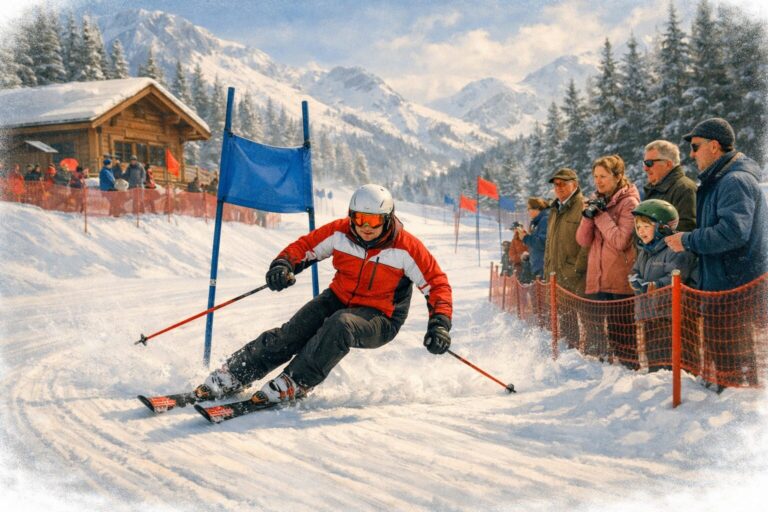
AI-generated image
When the mountain becomes your inner enemy: Your way back into the flow
Do you remember how it felt when you first really skied? Not that clumsy plowing down the beginner’s slope, that struggle with skis that felt like two unruly boards. No. I mean the moment when it clicked. When you felt for the first time that the skis were no longer foreign objects, but an extension of yourself. When you set your edges and the snow beneath you began to sing.
That feeling of freedom. The clear, cold air filling your lungs. The steady rattling of the edges in the ice, followed by that magical moment when you plunge into the deep snow and the world becomes completely silent for a moment. The mountain in front of you, the sky above you, and you. Completely in the flow. Nothing exists except the next turn, the next wave, the next moment of pure presence.
It’s hard to explain to anyone who doesn’t ski. Your colleagues at the office don’t understand why you spend every winter vacation in the Alps. Why you start checking the weather reports for the ski resorts in September. Why you’re willing to get on the lift at six in the morning in minus ten degrees just to make the first untouched tracks in the powder snow. But you? You don’t have to explain it. You know. The mountain is calling. And you’ve always skied.
The crack in the snow: When fear suddenly joins the ride
But then that one day came. Maybe it was a harmless moment. A small patch of ice that you saw too late. An unexpected bump in the steep passage. Another skier who got too close to you. Or maybe it wasn’t anything dramatic at all. Just a thought that crept into your consciousness like cold air under your jacket: “What if I fall today?”
You pushed the thought away, of course. You swung into the turn and let yourself fall down the slope. But the thought came back. More persistent this time. “The slope is icy today. It’s going to be tight down there. If I lose control now…”
And then it happened. Not the fall. Much worse. You started thinking. Suddenly there was no flow, only analysis. You questioned every movement, controlled every turn. Your legs became heavy, your knees locked, your upper body stiffened. You weren’t skiing anymore, you were being skied. By fear.
Maybe you know the feeling when your legs start to burn, not from exertion, but from tension. When you stand on the slope, looking at a steep incline that you used to take with a grin, and today there’s just this queasy feeling in your stomach. The voice inside you that says: “Don’t go. It’s too risky. You can’t do it anymore.”

The invisible accident: when your head slows down your body
The tricky thing about this fear is that it has nothing to do with your ability. Technically, you’re better than ever. You’ve taken courses, refined your skiing technique, can carve, can handle deep snow, can handle steep slopes. Your body is strong, your muscles know what to do. You have thousands of kilometers in your legs, countless turns, muscle memory that could carry you through any situation.
But your head? It has decided to stop participating.
Imagine you’re standing at the top of the glacier, the descent is steep, the snow looks tempting, but you hesitate. You look for a line, a way, an excuse. You decide to go for it, but every turn is a struggle. You don’t trust your edges, you shift your weight too early, too late, too tentatively. You fight against the mountain instead of flowing with it.
And in the afternoon, when the others are making one last descent, you sit down in the hut. Your legs aren’t tired, but your head is exhausted. This constant state of alertness, this inner tension, this battle against your own fear. It wears you out more than any kilometer of deep snow.
When the flow becomes torture: the downward spiral
At some point, you start to question yourself. Am I too old for this? Are my best skiing years behind me? Is it worth the risk? You’re still skiing, but the ease is gone. That feeling of freedom, of merging with the mountain. It just doesn’t come anymore. You’re just a tourist on your own skis, a guest who no longer feels at home.
Maybe you’ve even had a serious fall. One that showed you how vulnerable you are. Something has been different ever since. Ever since, the voice has been louder. Ever since, the confidence has gone. Not just in yourself, but in the mountain, in the circumstances, in life.
You’ve tried to fight it. More time on the slopes to regain your confidence. You booked a ski instructor to explain the technique to you again. Maybe you even consulted a sports doctor to check if your knees are really still up to it. But no matter what you do, that feeling of anxiety, of blockage, won’t go away.
The invisible trail: Why the mind is sometimes stronger than the mountain
The truth is, your problem isn’t in your legs. It’s not in your technique. It’s not even in the mountain. It’s in the part of you that decided, in that one moment, “Warning, danger! I’m taking over from now on.”
Your subconscious, that ancient, highly sensitive watchdog inside you, made a decision back then. It stored the shock, the fall, the fear, and since then it has been working flat out to “protect” you. It slows you down wherever it can. It whispers horror stories to you before you even step into the lift. It makes you tense up so that you don’t lose control.
The only problem is that this protective mechanism, which may have made sense back then, is now your biggest enemy. Not only does it rob you of the joy of skiing, it robs you of a piece of yourself. It turns free flying into a tough battle.
Returning to the flow: Deep mental training for skiers
I know this feeling. Not only because I have been a passionate skier since I was 5 years old, but also because I know what it means when your head is no longer in the game. When your body can do it, but your mind blocks you. I’ve learned that the greatest descents aren’t the ones you take on the slopes, but the ones you conquer within yourself before you plunge down the hill.
That’s why I don’t work with superficial mental techniques that tell you to “just think positively” or “take a deep breath.” You’ve tried that a thousand times, and it hasn’t worked. I work with what really works: deep mental training.
This is not hypnosis, where you lose control. The opposite is true. It is a return to yourself. A journey inward, to where the old blockages lie. Together, we enter that deeply relaxed state that you may be familiar with from your last turn in powder snow. That moment when time stands still and everything just flows. And in this state, we untie the knots.
We talk to the frightened part of you that wants to protect you and teach it that you are safe today. That you are strong. That you can ski. We replace the old horror images, the fall, the shock, the fear, with new, powerful inner movies. Films in which you swing down the slope with ease and effortlessness. In which every movement is perfect. In which the mountain is not your opponent, but your partner.
From thinking to feeling: rediscovering ease
Do you know what sets the world’s best skiers apart? It’s not their muscle power. It’s not their technique. It’s their ability to switch off their minds and trust their bodies. They are in the flow. They don’t think, they feel. They feel the snow under their skis, the shift in weight, the energy of the slope. And they let themselves fall, trusting that they will be caught.
That is exactly what we are restoring together. That basic trust in yourself, in your abilities, in the mountain. So that you feel again: I can do this. I’m in the right place. The mountain is my friend.
Imagine you’re standing at the top of the glacier again. The wind is blowing, the sun is glistening on the snow, and below you lies the wide, empty slope. But today, there’s no queasy feeling in your stomach. Instead, there’s anticipation. That old, familiar tingling sensation. You plant your poles, push off, and the first turn comes naturally. The edge bites, the snow sprays, you feel the centrifugal force pushing you into the slope, and you laugh inside because it feels like flying. You don’t think about the next turn, you are the next turn.
You ski down the slope, and the world below, with all its worries, no longer exists. There is only you, the snow, and the moment. Pure presence. Pure freedom.
The invitation: Conquer the mountain together and yourself
I’m not offering you a quick fix for your next ski vacation. I’m offering you long-term support. One that focuses not only on your skiing technique, but on you as a whole person. One that understands that skiing was never just about skiing. It was always about the feeling of freedom. About being at one with nature. About conquering your own limits.
If you are ready to open yourself up to this feeling again, then let’s talk. Tell me about your mountain. Tell me about the moment when the fear came. Tell me about the feeling you miss.
And then let’s find the path that will bring you back together. Back into the flow. Back to the mountain. Back to yourself.
I look forward to accompanying you on this journey and seeing you skiing down the slopes with a smile on your face again soon.
The mountain is calling. It’s time to answer again.
Note:
Hypnosis and / or surrogate work are not a substitute for medical and / or psychiatric diagnosis and / or intervention.
The success of hypnosis and / or surrogate work cannot be guaranteed.
Furthermore, my services are intended for healthy people and animals.
The text displayed above was generated using AI.
The photos shown above were also generated by AI.
Sports Mind
9 months support (sporting animals addable to the booking)- 12 sessions
- One session every 3 weeks
- Several topics can be addressed
- Work with „traditional“ hypnosis
- Work with simpson protocol
- Quantum work
- Surrogate sessions for the animal (up to 3)
- Animal communication (5 questions + 1 message included)
- Additional extra question(s) (maximum 5)
- 1 Message from you to your animal
- 1 Message from your animal to you
- Check-in with your animal between deputy sessions
- Final animal communication
- Written protocol(s) of the animal communication(s)
- Personal information transfer(s) (Zoom)
- Anchoring and NLP techinques
- Learn your own applications
- Learn self-hypnosis
- EFT / Tapping
- Audio files for further support
- 1:1 support
- Individual approach
- Holistic approach
- Preliminary talk with goal agreement
- Access to the exclusive client area
- Information material (in the client area)
- Preparatory hypnosis as MP3
- Preparation checklist
- Follow-up talk after the sessions
- E-Mail Support
- Queries possible
- Payment in installments possible (maximum 9 months)
Book Preliminary talk / Hypnosis
- Click on “Done” after booking.
Book your next appointments within 3 weeks.
Individual hypnosis sessions & quantum work sessions